Banner

Banner
Showing posts with label disaster. Show all posts

Monday, April 15, 2013

We Aren't The Only Ones, Part 5 and Final

by Stephanie Osborn
http://www.stephanie-osborn.com


As promised, the Chinese space failure. Excerpted from A New American Space Plan, by Travis S. Taylor and myself, from Baen Books.

It should be noted that the Chinese space program is considered a branch of their military, at least in part, and therefore is subject to much secrecy. In point of fact, it is only in recent years that there has even been a Chinese space program apart from that needed to develop ICBMs. In addition, upon the fall of the Soviet Union, much of that space agency's history came to light. We do not have this advantage in gleaning information about the Chinese space program, so this section is quite short relative to American and Russian space history.

~~~


China’s space program as such began in the late 1950s, under the auspices of their Ministry of Aerospace Industry, and Chairman Mao Tzedong. At that time it consisted mostly of work on intercontinental ballistic missiles, as we were at the height of the Cold War, and they were responding to what they considered potential threats from both the U.S. and Russia. They seemed to have no particular interest in manned space flight for several more decades.

Upon Mao’s death in 1976, Deng Xiaoping emerged as China’s leader, and canceled many missile programs and anti-missile defense programs considered important at the time. However, long range ICBM development did continue, as well as the Long March series of launch vehicles, enabling them to compete in the commercial launch industry. When the Cold War ended, Deng stepped up his commercialization of China, and moved away from the blatant use of communist revolution rhetoric in the naming of vehicles, and toward ancient Chinese religious and mystical names. This included, for example, renaming the Long March rockets “Divine Arrow.”

He split the Ministry into two parts in 1993: the China National Space Administration (CNSA), responsible for space policy and planning, and the China Aerospace Corporation (CASC), responsible for execution of the program.

Shortly thereafter, China had its first public space program disaster.

In February of 1996, the launch of the first Long March 3B heavy launch vehicle went drastically wrong. Carrying Intelsat 708, a commercial telecommunications satellite, the rocket failed almost immediately on liftoff as a result of an engineering defect, deviating drastically from its launch trajectory at the Xichang Satellite Launch Center. It crashed twenty-two seconds later and slightly more than one mile (slightly under two kilometers) from the launch facility—directly on top of a village. Xinhua, the official Chinese news agency, under government control, reported six killed and fifty-seven injured, with eighty houses destroyed. Unofficial reports, however, place the death toll at well over 500 people.

Three years after this disaster, Shenzhou 1 was successfully launched—unmanned—on the anniversary of the founding of the People’s Rebublic of China in 1999...China is a member of the UN Committee on the Peaceful Uses of Outer Space. However, its space program, despite the “corporate” designation of half of it, is entirely military-run, and in 2007 it shot down one of its own dead satellites.

~~~

So far, since the Long March disaster in 1996, the Chinese space program has been ambitious and successful. They have specified their intent to go to the Moon and to be the first humans to land on Mars. If they continue like this, they may well beat everyone in the doing; they seem to have the will and the political backing to advance, while the West is mired in political in-fighting and lack of apparent interest.

Despite our failures, I think it can safely be said that the US space program as put forth by NASA has hardly had quite so spectacular or horrific failures as have occurred elsewhere. We have not dropped any rockets on any small towns; we have never deliberately and with foreknowledge gone forward with completely inane designs. We have not wiped out a significant portion of our rocket team by requiring them to sit in the same field with the launch vehicle. Speaking as someone who has worked side by side with fellow American space flight controllers, I can honestly say that we have done the best we could do to keep our colleagues safe within reason - for space will never be completely safe. It is inherently an inimical environment, and one in which no human would live for a minute without layers of protection, whether that protection be physical, procedural, or otherwise. I have been a part of that protection, in a manner of speaking. It is a task that I strove to do to my utmost, and it is something of which I will always be proud.

-Stephanie Osborn
http://www.stephanie-osborn.com

Monday, April 8, 2013

We Aren't The Only Ones, Part 4

by Stephanie Osborn
http://www.stephanie-osborn.com

A bit more on the Soviet space program's failures, then on to China next week. Excerpted from A New American Space Plan, by Travis S. Taylor and myself, from Baen Books.

~~~


In 1971 the Soviets put up the world’s first space station, Salyut 1. Sort of like our Skylab, it was expendable and there was a whole series of these stations, military and nonmilitary. It was generally a successful program.

Except for the first flight to Salyut 1, Soyuz 11.

Soyuz 11 was the only manned mission to Salyut 1. All went nominally until it came time for reentry. At that time, the pyrotechnic bolts that were to release the service module from the reentry module fired simultaneously instead of sequentially. This in turn jolted open a breathing ventilation valve at an altitude of 104 miles (168 km) and bled the reentry vehicle’s atmosphere off into space. As it was located underneath the seats, the cosmonauts couldn’t locate and plug it fast enough to stop the loss of atmosphere. And due to the cramped conditions and the presence of 3 crew members, space suits were not worn for these early flights.

Flight recorder data later indicated the crew went into cardiac arrest within forty seconds. Within 212 seconds (less than four minutes) of the separation, the cabin pressure was zero. As a result, ground control lost communications with the crew long before the reentry comm blackout should have begun, realized that conditions were off-nominal, and began emergency preparations for the landing. The crew was found at the landing point, dead inside the cabin. Attempts were made to perform CPR by the service crew, but it was much too late.

In 1975 Soyuz 18a had the first ever manned launch abort. It’s forward momentum carriedit some thousands of miles downrange, nearly into China—which the Soviets were on particularly bad terms with at the time. It came down in the mountains again, sliding down the side of one, and nearly toppling off a cliff. This time, tangled parachutes saved the cosmonauts by snarling in the trees and preventing the sheer drop. The crew was pretty banged up.

In 1980 a Vostok rocket blew up on the launch pad. Forty-eight people died.

~~~

It should be noted that, since the dissolution of the Soviet Union, the Russian space program has, to my knowledge, not suffered a single major setback that has resulted in loss of life.

Next week as promised: The Chinese space program.

-Stephanie Osborn
http://www.stephanie-osborn.com

Monday, April 1, 2013

We Aren't The Only Ones, Part 3

by Stephanie Osborn
http://www.stephanie-osborn.com


Part 3 of this series takes us into the Russian manned program, specifically the Soyuz and the problems it experienced from the very beginning, as excerpted from A New American Space Plan, by Travis S. Taylor and myself.

~~~


Soyuz 1 was the first flight of the Soyuz spacecraft. It was also the Soviets’ first in-flight death. The craft was known to be faulty to begin with. The engineers reported over 203 design faults—not faulty equipment, not improperly installed, faulty design work, before the launch. Unfortunately, by this time Soviet leaders had caught moon fever. They wanted to beat the Americans to a manned landing, and they wanted to take advantage of the delay caused by the Apollo 1 fire. Oh, and they wanted to celebrate Vladimir Lenin's birthday with some fireworks. Big fireworks.


Vladimir Komarov was the primary, and Yuri Gagarin was his backup. The situation was so bad that Gagarin tried to get Komarov bumped from the primary position, because he knew that he was considered a national hero and therefore not expendable. He hoped to get the mission delayed until the problems could be fixed. He failed.

Soyuz 1 was launched, Komarov aboard. Its mission was to rendezvous and EVA with Soyuz 2. As soon as it got on orbit, one of the solar panels failed to unfurl, so the spacecraft was running on low power from the get-go.

The Soyuz 2 crew prepped themselves for a repair mission. Thunderstorms overnight at Baikonur fried the Soyuz electrical systems, so Soyuz 1 was on its own.

Then the “orientation detectors” (I assume this means gyroscopes or star trackers or some such, or maybe not) decided to malfunction, rendering maneuvering difficult. Then the automatic maneuvering system died entirely, and the manual system went on the fritz.

Once the maneuvering system went down, the flight director decided to abort the mission. At this point, everything looked like a happy ending.

Except this was a new ship. With new details. Like a thicker heat shield, and a correspondingly larger parachute. Remember those design flaws? Guess what? Nobody bothered to make the chute receptacle any bigger. In their brilliance, technicians used wooden mallets to beat the parachute into place.


So the drogue chute came out, but the main parachute didn’t. Simple enough: Komarov deployed the manual parachute. Which promptly tangled in the drogue chute. He hit the ground at an estimated 89 mph (140 km/hr).

The ship exploded.
 
The Soviets didn’t have too many manned firsts after that, and they never made it to the moon with a crewed lander. The same year we landed on the moon, they managed a docking and crew exchange of Soyuz 4 and 5. (The Soviets claimed that this was the world’s first space station.) Unfortunately when it came time to come home, Soyuz 5’s service module failed to separate, and the capsule with service module reentered nose first. The cosmonaut inside, Boris Volnyov, hung from his straps until the module’s struts burned through and it broke away, enabling the capsule to right itself before the hatch also burned through—the gaskets were already burning and filling the cabin with noxious fumes. But then the parachute lines tangled, and the landing retros failed, and while Volnyov walked away from that landing, he broke his teeth. He landed in—yes, you guessed it—the Ural Mountains instead of Khazakhstan, and with the temperature outside at -36°F (-38°C), he was forced to walk several kilometers to the cabin of a local.


~~~
 
-Stephanie Osborn

Monday, March 4, 2013

Remembrance: Columbia (Part 2)

by Stephanie Osborn


It is perhaps best if I simply let the timeline of the catastrophe speak for itself. Due to my familiarity with the subject, one of the crewmembers, and the bird itself, perhaps my readers will forgive me if I pull from the Wikipedia article on the matter [http://en.wikipedia.org/wiki/Columbia_disaster]. Having read the CAIB (Columbia Accident Investigation Board) Report in some detail, I find it to be accurate in the essentials.

~~~

The following is a timeline of Columbia's re-entry. The shuttle was scheduled to land at 9:16 a.m. EST.

2:30 a.m. EST, February 1, 2003 – The Entry Flight Control Team began duty in the Mission Control Center.

The Flight Control Team had not been working on any issues or problems related to the planned de-orbit and re-entry of Columbia. In particular, the team had indicated no concerns about the debris impact to the left wing during ascent, and treated the re-entry like any other. The team worked through the de-orbit preparation checklist and re-entry checklist procedures. Weather forecasters, with the help of pilots in the Shuttle Training Aircraft, evaluated landing-site weather conditions at the Kennedy Space Center.

8:00 – Mission Control Center Entry Flight Director LeRoy Cain polled the Mission Control room for a GO/NO-GO decision for the de-orbit burn.

All weather observations and forecasts were within guidelines set by the flight rules, and all systems were normal.

8:10 – The Capsule Communicator (CAPCOM) notified the crew that they were GO for de-orbit burn.

8:15:30 (EI-1719) – Husband and McCool executed the de-orbit burn using Columbia’s two Orbital Maneuvering System engines.

The Orbiter was upside down and tail-first over the Indian Ocean at an altitude of 175 miles (282 km) when the burn was executed. The de-orbit maneuver was performed on the 255th orbit, and the 2-minute, 38-second burn slowed the Orbiter from 17,500 miles per hour (7.8 km/s) to begin her re-entry into the atmosphere. During the de-orbit burn, the crew felt about 10% of the effects of gravity. There were no problems during the burn, after which Husband maneuvered Columbia into a right-side-up, forward-facing position, with the Orbiter's nose pitched up.

8:44:09 (EI+000) – Entry Interface (EI), arbitrarily defined as the point at which the Orbiter enters the discernible atmosphere at 400,000 feet (120 km; 76 mi), occurred over the Pacific Ocean.

As Columbia descended from outer space into the atmosphere, the heat produced by air molecules colliding with the Orbiter typically caused wing leading-edge temperatures to rise steadily, reaching an estimated 2,500 °F (1,370 °C) during the next six minutes. (As former Space Shuttle Program Manager Wayne Hale stated in a press briefing, about 90% of this heating is the result of compression of the atmospheric gas caused by the orbiter's supersonic flight, rather than the result of friction.)

Columbia at approximately 8:57. Debris is visible coming from the left wing (bottom).

8:48:39 (EI+270) – A sensor on the left wing leading edge spar showed strains higher than those seen on previous Columbia re-entries.

This was recorded only on the Modular Auxiliary Data System, which is similar in concept to a flight data recorder, and was not telemetered to ground controllers or displayed to the crew.

8:49:32 (EI+323) – Columbia executed a planned roll to the right. Speed: Mach 24.5.

Columbia began a banking turn to manage lift and therefore limit the Orbiter's rate of descent and heating.

8:50:53 (EI+404) – Columbia entered a 10-minute period of peak heating, during which the thermal stresses were at their maximum. Speed: Mach 24.1; altitude: 243,000 feet (74 km; 46 mi).

8:52:00 (EI+471) – Columbia was approximately 300 miles (480 km) west of the California coastline. The wing leading-edge temperatures usually reached 2,650 °F (1,450 °C) at this point.

8:53:26 (EI+557) – Columbia crossed the California coast west of Sacramento. Speed: Mach 23; altitude: 231,600 feet (70.6 km; 43.9 mi).

8:53:46 (EI+577) – Signs of debris being shed were sighted by people out to watch the re-entry. Speed: Mach 22.8; altitude: 230,200 feet (70.2 km; 43.6 mi).

The superheated air surrounding the Orbiter suddenly brightened, causing a streak in the Orbiter's luminescent trail that was quite noticeable in the pre-dawn skies over the West Coast. Observers witnessed another four similar events during the following 23 seconds. Dialogue on some of the amateur footage indicates the observers were aware of the abnormality of what they were filming.

8:54:24 (EI+615) – The Maintenance, Mechanical, and Crew Systems (MMACS) officer informed the Flight Director that four hydraulic sensors in the left wing were indicating "off-scale low." In Mission Control, re-entry had been proceeding normally up to this point.

"Off-scale low" is a reading that falls below the minimum capability of the sensor, and it usually indicates that the sensor has failed (stopped functioning, due to internal or external factors), rather than that the quantity it measures is actually below the sensor's minimum response value. The Entry Team continued to discuss the failed indicators.

8:54:25 (EI+616) – Columbia crossed from California into Nevada airspace. Speed: Mach 22.5; altitude: 227,400 feet (69.3 km; 43.1 mi).

Witnesses observed a bright flash at this point and 18 similar events in the next four minutes.

8:55:00 (EI+651) – Nearly 11 minutes after Columbia re-entered the atmosphere, wing leading-edge temperatures normally reached nearly 3,000 °F (1,650 °C).

8:55:32 (EI+683) – Columbia crossed from Nevada into Utah. Speed: Mach 21.8; altitude: 223,400 feet (68.1 km; 42.3 mi).

8:55:52 (EI+703) – Columbia crossed from Utah into Arizona.

8:56:30 (EI+741) – Columbia initiated a roll reversal, turning from right to left over Arizona.

8:56:45 (EI+756) – Columbia crossed from Arizona to New Mexico. Speed: Mach 20.9; altitude: 219,000 feet (67 km; 41 mi).

8:57:24 (EI+795) – Columbia passed just north of Albuquerque.

8:58:00 (EI+831) – At this point, wing leading-edge temperatures typically decreased to 2,880 °F (1,580 °C).

8:58:20 (EI+851) – Columbia crossed from New Mexico into Texas. Speed: Mach 19.5; altitude: 209,800 feet (63.9 km; 39.7 mi).

At about this time, the Orbiter shed a Thermal Protection System tile, the most westerly piece of debris that has been recovered. Searchers found the tile in a field in Littlefield, Texas, just northwest of Lubbock.

8:59:15 (EI+906) – MMACS informed the Flight Director that pressure readings had been lost on both left main landing-gear tires. The Flight Director then told the Capsule Communicator (CAPCOM) to let the crew know that Mission Control saw the messages and was evaluating the indications, and added that the Flight Control Team did not understand the crew's last transmission. [I believe that it was around this point that the pressurized landing-gear tires likely exploded from the heat. At the very least it would have torn a huge hole in the underbelly of the wing, if not outright sheared off a substantial portion thereof. Note that the next several entries occur in fractions of a second. --Osborn]

8:59:32 (EI+923) – A broken response from the mission commander was recorded: "Roger, uh, bu – [cut off in mid-word] ..." It was the last communication from the crew and the last telemetry signal received in Mission Control.

8:59:37 (EI+928) – Hydraulic pressure, which is required to move the flight control surfaces, was lost at approximately

8:59:37. At that time, the Master Alarm would have sounded for the loss of hydraulics, and the shuttle began to lose control, beginning to roll and yaw uncontrollably, and the crew would have become aware of the serious problem.

9:00:18 (EI+969) – Videos and eyewitness reports by observers on the ground in and near Dallas revealed that the Orbiter had disintegrated overhead, continuing to break up into more and smaller pieces, and leaving multiple contrails, as it continued eastward. In Mission Control, while the loss of signal was a cause for concern, there was no sign of any serious problem. Prior to orbiter breakup at 9:00:18, the Columbia cabin pressure was nominal and the crew was capable of conscious actions. The crew module remained mostly intact through the breakup, though it had lost enough structural integrity that it lost pressure, and was completely depressurized no later than 9:00:53.

9:00:57 (EI+1008) - The still intact crew module was seen breaking into small subcomponents. It disappeared from view at 9:01:10. The crew, if not already dead, were dead no later than this point. [I will take issue with this statement later. -Osborn]

9:05 – Residents of north central Texas, particularly near Tyler, reported a loud boom, a small concussion wave, smoke trails and debris in the clear skies above the counties east of Dallas.

9:12:39 (EI+1710) – After hearing of reports of the shuttle being seen to break apart, the NASA flight director declared a contingency (events leading to loss of the vehicle) and alerted search and rescue teams in the debris area. He made a call to the Ground Controller: "GC; flight, GC; flight. Lock the doors." Two minutes later Mission Control put contingency procedures into effect. Nobody was permitted to enter or leave the room, and flight controllers had to preserve all the mission data for later investigation.

~~~

The morning of the disaster was about 3 months after my husband had had emergency heart bypass surgery. It had been a grueling recovery for both of us, and I clearly recall that it was the weekend (I believe it was Saturday) and we had slept in. I got up, wandered into the den, grabbed the remote, and hit the power. The television came on to the last channel we'd watched – the Weather Channel – and even they were reporting that “...Space Shuttle Columbia is twelve minutes late exiting the re-entry comm blackout.” I knew what that meant; I worked too long on those birds – on THAT bird – not to. Twelve seconds...maybe. Twelve minutes, there was no doubt. I turned and yelled down the hall, “HONEY! Get in here! We've lost a Shuttle!”

In retrospect, probably not the wisest thing to do to a recovering heart patient.

But he survived. They didn't.

It was so very surreal for me, and still is. I worked with Columbia more than any other shuttle in the fleet. I had a friend on board her – I helped train Kalpana Chawla for her first mission, back in '97. I'd kept up with her, popping into the Astronaut Office to look for her whenever I was in Houston. We'd have a cup of coffee, sit down and catch up, laughing and chatting. But I was doing DOD work at that point, and had lost track of who was scheduled for which flights. It wasn't until my husband asked me if I'd known any of the crew that I thought to check. And I was horrified. KC had one of the widest smiles, the most cheerful demeanors, of anyone I have known, before or since. To think she went through that...it was, and is, hard for me to accept.

I'd written a book, entitled Burnout:The mystery of Space Shuttle STS-281. It was fiction, every bit of it. It was in the hands of my writing mentor, and later sometime co-author, Travis S. Taylor, to read and critique. He was going to help me polish it, then help me find a publisher. I'd researched using the information from the Challenger disaster, but decided to make it very obviously NOT that incident; I'd chosen a re-entry scenario instead. The disaster which now played out before my eyes was precisely what I'd written into the book. Travis had to talk me out of trashing it instead.

In the end, life went on for some of us. My book, and numerous more, have been published. In January 2012, I was invited to return to my undergraduate alma mater, Austin Peay State University, to help support the library and to give a talk and a book-signing. It was a messy, cold, stormy night with torrents of rain falling when I arrived at the location and began setting up. The Friends of the Library were setting up around me for a reception before the talk, when a gentleman showed up. In all honesty I cannot recall his name because what came next was very...I'm not sure the English language has the word for what I felt in those ensuing minutes.

Because he told me he had been one of the 3 field coroners for the Columbia disaster. He had come, partly to answer the questions I had about it that I'd never been able to answer, and partly to hear my perspective on it. He had copies of the autopsy reports which I was allowed to flip through – though I can't recall a word on any page. And he gave me the answer I didn't want to hear: my friend KC had been alive through the breakup – they all had. In fact, he told me, at least one crewman was found on the ground, body intact, death due to multiple blunt force traumas. He didn't say so outright, but I can interpret that – he died when he hit the ground.

A recent presentation I made on scientific and engineering work done since then included a summation of that chat. I was later gently challenged on the matter of the crew's deaths. This upset me because, unable to remember the man's name, I hadn't a way to verify his credentials. (If you're out there, mystery man, please contact me through this blog.) But today, as I refreshed my memory on the details of the catastrophe, I found a newspaper report that took its information from the final version of the CAIB report, and I quote:

The Working Group found no irregularities in its extensive review of all applicable medical records and crew health data. The Armed Forces Institute of Pathology and the Federal Bureau of Investigation conducted forensic analyses on the remains of the crew of Columbia after they were recovered. It was determined that the acceleration levels the crew module experienced prior to its catastrophic failure were not lethal. The death of the crew members was due to blunt trauma and hypoxia. The exact time of death - sometime after 9:00:19 a.m. Eastern Standard Time - cannot be determined because of the lack of direct physical or recorded evidence.” [http://www.spaceflightnow.com/columbia/report/030826crew/]

As a result of all this, some colleagues and I from SIGMA, the science fiction think tank [www.sigmaforum.org], are in process of developing a new system called SPEARED – Single Person Emergency Atmospheric Re-Entry Device. (This is the “scientific and engineering work” I mentioned earlier.) We have patents pending and hope that someday soon this new system will prevent deaths such as those aboard Columbia, and maybe even Challenger.

I'll keep you posted.


-Stephanie Osborn

Monday, February 25, 2013

Remembrance: Columbia (Part 1)

by Stephanie Osborn


You may remember that I started my career as a payload flight controller for first Shuttle, and then Station. And that I had a friend aboard Columbia during her final flight. For those who have read my all-too-painfully prescient book, Burnout: The mystery of Space Shuttle STS-281, you know I dedicated that book to my friend Kalpana Chawla, her crewmates, and all those who have died in pursuit of space. "Ad astra, per ardua." ("To the stars, through struggle/adversity.")

We've just passed through a period of time of which most people are unaware. You see, all of the major space disasters that America has experienced all occurred within a 2-3 week span on the calendar. And interestingly, they occurred in chronological order on the calendar.


Apollo 1 Fire - January 27

Space Shuttle Challenger disaster - January 28

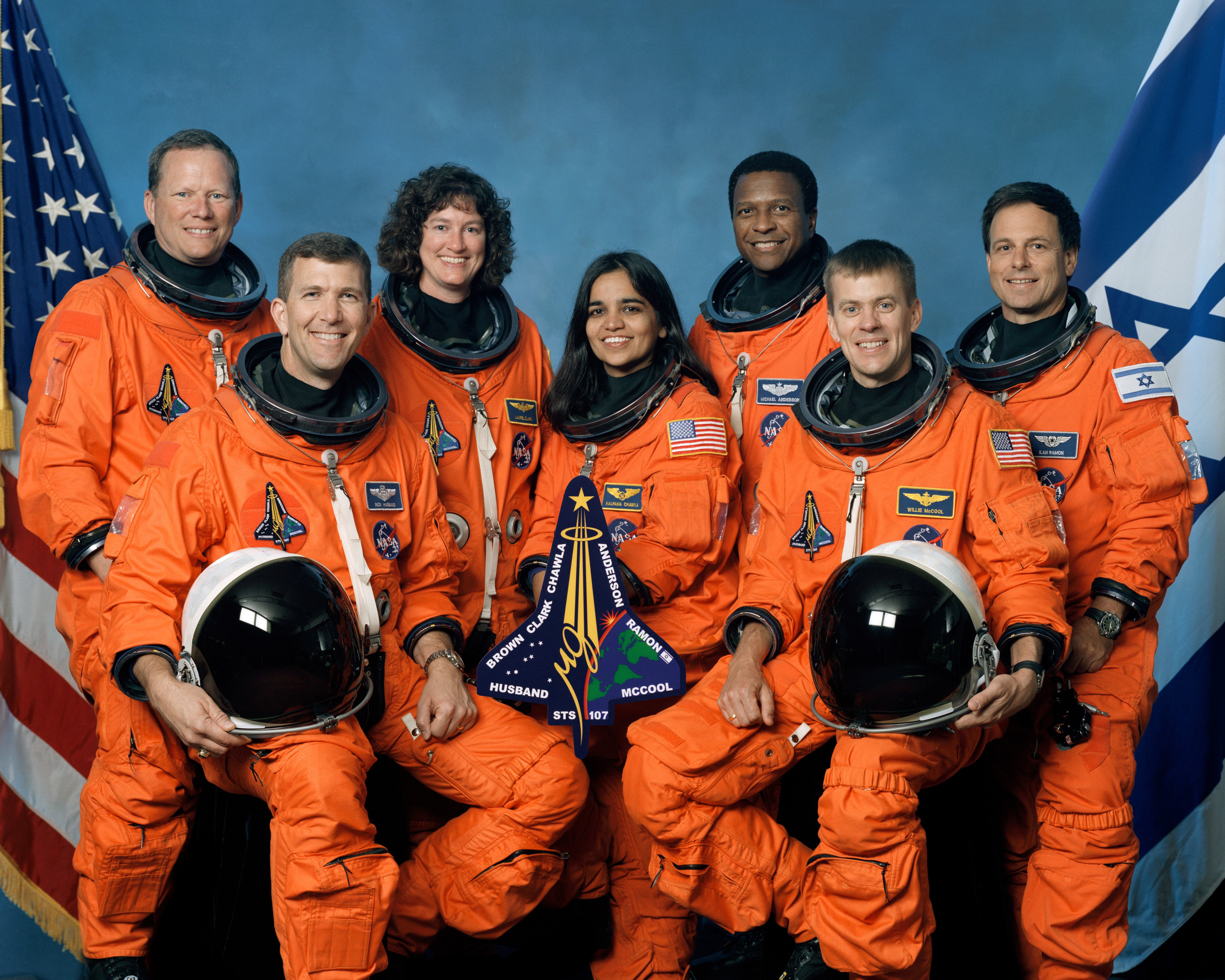
Space Shuttle Columbia disaster - February 1


~~~

Columbia - What happened?


On February 1, 2003, space shuttle Columbia experienced a catastrophic malfunction during re-entry. This was a result of damage sustained during lift-off 17 days earlier, on 16 January. Debris – specifically, a briefcase-sized piece of insulating foam from the external tank (ET) penetrated the leading edge of the port wing, and gouged a groove the length of the wing, possibly dislodging and at least damaging the flashing surrounding the port landing gear, and driving part of the carbon-carbon composite heat shielding on the leading edge into the wing’s interior.

The combination resulted in softening the wing struts, shearing off the wing when hydraulic pressure failed, resulting in a loss of control.

The resulting total loss of aerodynamic stability as well as wing loss caused a failure of structural integrity of the vessel, which broke apart around the crew at ~Mach17 or higher.

Kalpana Chawla, my friend, was a crew member.

But why did all this happen? Why did the foam turn loose? How could FOAM damage the wing?

First of all, remember when we talked about the Challenger disaster, how the SRBs (solid rocket boosters) had to be cast in segments like concrete? It's sorta like that for the external tank, too. Oh, it doesn't have to be done in segments, but it's next to impossible not to, because the thing is so durn big. So you spray your container for as far as it'll go, then you get another and pick up where you left off. That still results in a kind of segmentation, because there's a slight discontinuity in the uniformity of the foam at the point where you stopped and switched to a fresh container. At that discontinuity, you can get tiny cracks, you can get bubbling, you can get ice crystal formation, especially given the ET's function of holding cryogenic fuels. Unfortunately there's just no other way to do it with current technology. And while it had been noticed in several previous Shuttle missions that bits of foam would spall, nothing serious had ever come of it.

Until Columbia's last voyage, of course.

So how the blazes (pardon the rather dark pun) did a hunk of foam do this?


The foam is largely composed of a variety of dichlorofluoroethane. That stuff has a density of 1.25g/cc at 20°C. For a suitcase-sized piece, we'll assume dimensions of roughly 3in x 12in x 15in – this just happens to be the size of one of my laptop cases, and a reasonable approximation. That translates to 7.62cm x 30.48cm x 38.10cm. This yields a volume of 8849cc. This gives a mass for that little chunk of foam of just a smidge over 11kg (24lb and change)! At the time it detached, the Shuttle was moving at a little under Mach 2.5, about 840m/s or 1,870mph. Engineers estimated the impact occurred with a closing speed of ~530mph (~883km/hr or 245m/s) Therefore the kinetic energy of the impact was ½mv2, which is 0.5 x 11kg x (245m/s)2, which comes to roughly 330,000J. Put a simpler way, over a falling distance of about one meter, that is the equivalent of about 37 tons of force.

Not exactly a light tap.

So, at T + 82s, a chunk of foam fell off the left bipod foam ramp, hit the leading edge of the wing – one of the most crucial areas, as the only thing to take more friction heat during re-entry is the nose – and punched a hole in it, and according to the information I had, may also have gouged a scratch down the bottom of the wing.


During the mission, something was observed floating away from Columbia's underside on orbit. It is still not known for certain if this was a piece of the reinforced carbon-carbon heat shielding, or if it was a piece of flashing from the landing gear bay door, or something else. Also during the mission, the ground reviewed footage of the launch, specifically that from the camera which had become routine only 2 launches prior, to look for evidence of possible damage due to foam spalling. Concern was raised, but NASA management refused despite multiple requests for DOD viewing assistane from the engineers and scientists who worked on the heat management system. In this respect, the Columbia Accident Investigation Board (CAIB) reached the same conclusions that the Rogers Commission reached after Challenger – a difference in the views of management and the working engineers and scientists. To quote Richard Feynman from the Rogers Commission, "It appears that there are enormous differences of opinion as to the probability of a failure with loss of vehicle and of human life. The estimates range from roughly 1 in 100 to 1 in 100,000. The higher figures come from the working engineers, and the very low figures from management. What are the causes and consequences of this lack of agreement? … we could properly ask, 'What is the cause of management's fantastic faith in the machinery?'"

But that is precisely what happened. Per the blog of Wayne Hale, one of the Flight Directors on that mission, JSC's Director of Mission Operations, John Harpold, told him, “You know, there is nothing we can do about damage to the TPS. If it has been damaged it’s probably better not to know. I think the crew would rather not know. Don’t you think it would be better for them to have a happy successful flight and die unexpectedly during entry than to stay on orbit, knowing that there was nothing to be done, until the air ran out?” [http://waynehale.wordpress.com/2013/01/13/after-ten-years-working-on-the-wrong-problem/]

Unfortunately, according to Hale, the Astronaut Office agreed. Everyone in charge agreed. And so nothing was done, no attempt was even made to find out if there was anything seriously wrong.

At the point in time when management decided to let the crew fly blind, the end game was set.

Next week we'll chronicle Columbia's final moments.


-Stephanie Osborn

Monday, February 18, 2013

Remembrance: Challenger

by Stephanie Osborn
http://www.stephanie-osborn.com

You may remember that I started my career as a payload flight controller for first Shuttle, and then Station. And that I had a friend aboard Columbia during her final flight. For those who have read my all-too-painfully prescient book, Burnout: The mystery of Space Shuttle STS-281, you know I dedicated that book to my friend Kalpana Chawla, her crewmates, and all those who have died in pursuit of space. "Ad astra, per ardua." ("To the stars, through struggle/adversity.")

We've just passed through a period of time of which most people are unaware. You see, all of the major space disasters that America has experienced all occurred within a 2-3 week span on the calendar. And interestingly, they occurred in chronological order on the calendar.

Apollo 1 Fire - January 27

Space Shuttle Challenger disaster - January 28

Space Shuttle Columbia disaster - February 1

~~~
Challenger - What Happened?

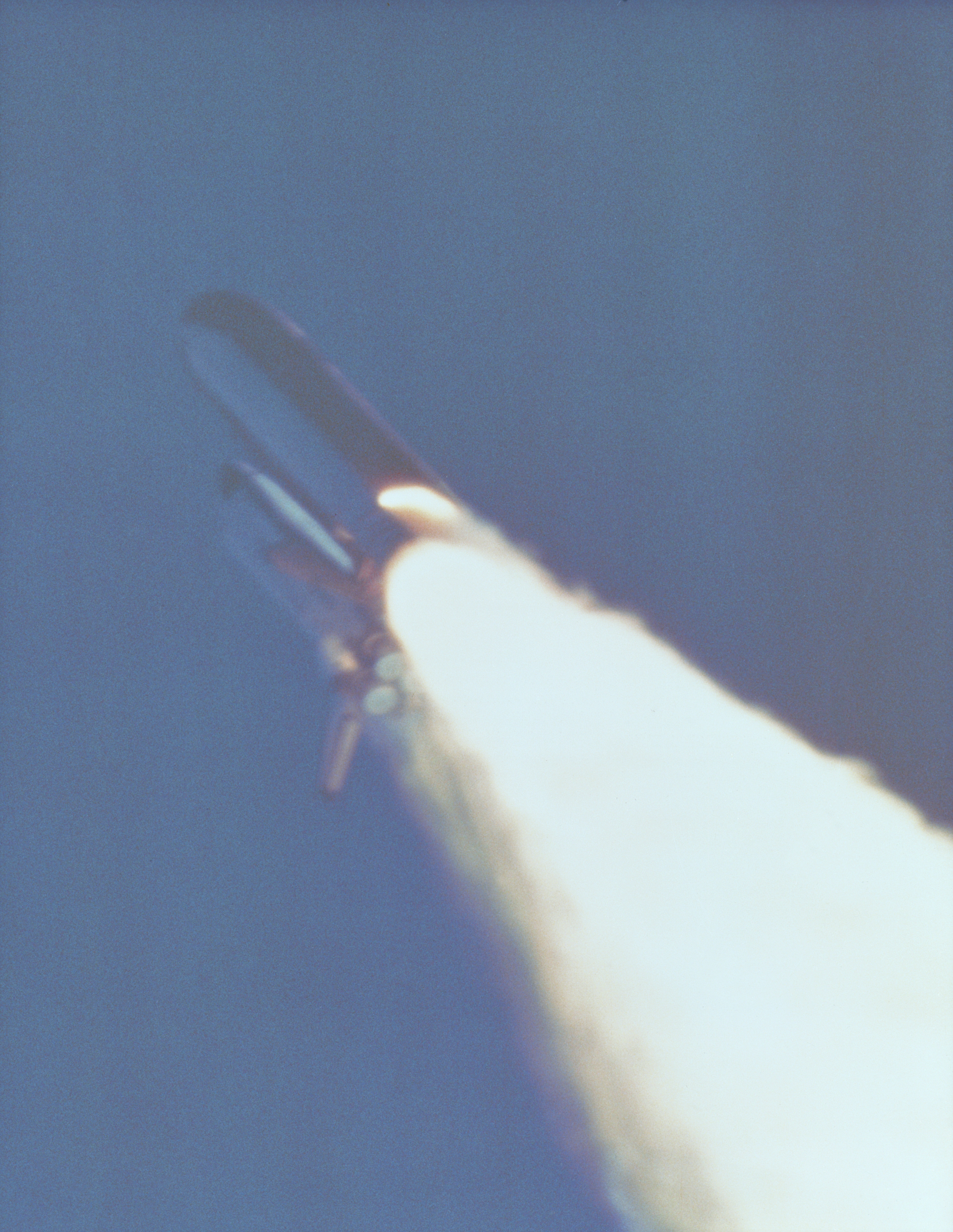
On January 28, 1986, Space Shuttle Challenger launched on mission STS-51L. It carried the first teacher in space, Christa McAuliffe, as well as astronauts Mike Smith, Dick Scobee, Ron McNair, Ellison Onizuka, Greg Jarvis, and Judy Resnick. At MET (Mission Elapsed Time) 00/00:01:13 (T+73sec), Challenger exploded. There were no survivors.


Some personal background

On January 28, 1986, I was about a month and a half into my first full-time job post-graduate school. I was the resident astronomer on a defense project that was in Phase 1 R&D. (I can't tell you much more than that, 'cuz then I'd have to kill ya. *jk* But you get the picture.) Phase 2 was to have been prototype development and testing, including prototype flight and testing aboard the Shuttle. They needed a payload specialist for that flight. My hat was in the ring and I was a likely candidate.

The Challenger disaster grounded the fleet indefinitely. This was a factor in the cancellation of Phase 2 of my project. So my PS candidacy dream exploded with that shuttle.

I ended up transferring over to the space programs division of my company and working for many years as a payload flight controller, scheduling activities for Shuttle missions, and even training astronauts (more about that next week). I fit in an entire career between two of only three major space disasters that NASA has had in its existence.

I remember the day clearly. I was sitting in my cubicle working when my friend from grad school and coworker, Jim, leaned over the top of the partition (Jim is really tall).

"Steph? Steph!"

"Yeah, Jim? What's up?"

"The Shuttle just blew up."

"Ha. Ha. Very funny."

"I'm serious."

It wasn't until he said that, that I truly diverted my full attention from my work and looked him in the face. And I knew. He really WAS serious.

I flung my pen at the desk, shoved my chair back, and rounded the cubicle partitions at a full sprint. Our boss had a small TV in his office, and when I got there, most of the branch was crammed in his office watching. There was nothing else on - everyone was covering it. We all sat in silence and watched the reports come in, and the replays of the explosion. To this day I can't stand to watch footage of that explosion anymore.

Later I went down the hall on some errand, and across the building to the cafeteria for lunch. All the halls were empty except for offices that had TVs, where people spilled out into the hall trying to watch said TV. One or two doors were closed and I thought I heard the sounds of weeping from behind them - or else similar sounds from behind restroom doors. It was not something I'll ever forget. Sometimes I wish I could.

So what happened?

This is something I know a fair amount about, because I used the Challenger disaster information as part of my research for writing my first book, Burnout: The mystery of Space Shuttle STS-281.

The gist of it is that the entire vehicle is only certified to to 40F, and they launched in 18F temperatures. Management felt it was a high profile mission with McAuliffe aboard, and ignored all warnings from the scientists and engineers who knew better.

What many do not know is that equipment on the launch pad also failed, possibly due to the cold. In the end, those were ruled out as part of the cause of the accident, but they so easily COULD have been, that it is worth mentioning. Now, on to what actually happened.

It had been discovered in previous flights that SRB ignition caused the first segment of the SRBs to warp, the casings ballooning out from the stress, and opening the joint between it and the next segment.

Wait. Back up, I hear you say. Why is the SRB in segments in the first place? Because the solid propellant has to be poured, cast, and cured like concrete. And just like concrete, if you pour too big a slab, it will crack during the curing process. This crack will act as a fuse for the fuel burn to travel along, and cause not only uneven thrust (a significant danger in a craft whose thrust must remain balanced on each side), but also a burn-through of the casing. So it's cast in segments, and those segments stacked.

Ok. So the joint opened up. Regularly. It was found, however, that the primary O-ring tended to shift, compensating for the warp and sealing the opening. This took a certain amount of time, but it was generally short enough to prevent anything but hot gases from escaping - no actual flame ever got past. Now granted, the hot gas was around 5000F, but it still wasn't flame, and it was only for fractions of a second, maybe a half-second at most, and all within 3-4 seconds of liftoff, so that was considered more or less okay. This behavior actually ended up being retroactively added into the specs.

However, the flexibility of the O-rings, as we all know now, is temperature-dependent. The colder the temperature, the less flexible the rings, and the longer it takes for them to shift into position to block the blow-by, as the escaping gas was termed. Turns out that 18F pretty much "de-flexed" the O-rings into rigidity. The primary O-ring didn't flex into the "new" position - evidently at all - and the secondary O-ring was unseated by the warping of the casing. There was nothing to stop the blow-by until the aluminum oxide components from the solid propellant essentially clogged the opening. By that time the O-rings had been burned away for nearly a quarter of the circumference of the starboard SRB. But the metal oxides had sealed the hole. No problem.

Not quite.

From approximately T+37sec (launch plus 37 sec) to T+74sec, the Shuttle encountered a layer of heavy wind shear, stronger than ever encountered before. This wind shear broke open the aluminum oxide seal that was holding the starboard SRB closed. A plume of exhaust immediately formed and became well defined as blow-by resumed. This in turn ate away at the casing, enlarging the hole and allowing for more and more blow-by. The thrust of the SRB began to drop, as part of it was being redirected out the hole in the side.
A recovered piece of the starboard SRB, showing the hole and blow-by scorching.


Soon the plume struck the external tank (ET) and began eating into it. (Hot gas and plasma has a way of doing that.)

The plume develops on the side of the SRB, near the ET.

It didn't take long (~T+66sec, two seconds after the ET plume formed) before the liquid hydrogen tank began leaking fuel, adding to the whole mess by burning as it entered the plasma exhaust stream. This led to two additional problems. One, the pressure in the LH2 tank was dropping steadily, which would cause problems in operation of the Shuttle main engines (SSMEs or Space Shuttle Main Engines). Two, this would cause an additional thrust vector - and remember what I said earlier about needing to have balanced thrust? Different thrust angles means that there are now torques (twisting forces) being applied to the Shuttle "stack" that it's never experienced, and is not designed to experience.

At this point neither the crew nor the flight controllers have registered that the drops in pressure are due to something other than normal ascent; the Shuttle is passing through "Max Q," the segment of the trajectory that experiences the maximum stress from the atmosphere, and breaks Mach 1. Once it has done this, the aerodynamic forces drop (the SSMEs have throttled back to about 65% for this, to minimize stress), and at T+68, CapCom Dick Covey called, "Challenger, you are go at throttle-up."

Commander Dick Scobee replied, "Roger, go at throttle-up," indicating that they would increase the SSME operations back to 104%. It would be the last words heard on the Air-to-Ground loop from Challenger.

At ~T+72, the rear strut attaching the starboard SRB to the ET... broke, pulled loose, whatever...and the inevitable accelerated into its awful climax. The craft slammed to the right, and the onboard black box recorder caught Pilot Mike Smith remarking, "Uh-oh." This appears to have been the first indication the crew had that anything was amiss. It was far too late.

At fractions of a second past T+73, the rear of the LH2 tank ruptured and the spilling LH2 apparently ignited, causing the tank to act like a rocket. It slammed forward into the rear of the liquid oxygen (LOX) tank. At the same time the starboard SRB pivoted on its remaining strut, slamming into the ET. The ET failed (aka "busted open") and the LH2 and LOX mingled, igniting and producing a huge cloud of water vapor. Everything went to hell in a handbasket as the Shuttle veered off course, experiencing forces far beyond its specs (20G as opposed to 5G), and it essentially shattered.

Interestingly, this did not indicate demise of the crew, only the Orbiter and stack. (The ET had already broken up, and once the Range Safety Officer determined the SRBs were in free, uncontrolled flight, he initiated detonation to protect ocean vessels and land inhabitants.) There is some debate about whether or not the mid-deck crew survived the breakup, as that area caught a considerable amount of force during the devastating disintegration. It is beyond doubt, however, that the flight deck did in fact emerge intact. Three of the four emergency oxygen systems for the flight crew were found activated, with sufficient oxygen used to just equate to the free fall. For the commander and pilot to be wearing them, it was necessary for the mission specialists to don theirs, unstrap, put on the masks for the CDR and PLT, then sit back down and strap in - they were found masked and strapped in. Also instrument settings on the console had been changed, and could only have been changed by the pilot in an effort to reaquire cabin electricity.

The crew cabin during free-fall.

However, the emergency oxygen system was not pressurized, and at that altitude unconsciousness would have occurred quickly. This is probably merciful because the impact on the ocean surface generated forces in excess of 200G, which neither the crew nor the remains of the cabin could survive.

Aftermath

The Shuttle Fleet was grounded for a significant period of time, approximately three years. During this time, investigations into exactly what happened and why were extensive. So were redesigns, including a new joint design for the SRB segments, which included a mortise and tang design that was significantly reinforced with thick layers of steel. A new bailout procedure and equipment was developed; this was actually depicted in the movie, Space Cowboys (but it would not have saved the crew of Challenger). A new abort procedure was developed, known as Return To Launch Site, or RTLS (which would also not have saved the Challenger crew). The Office of Safety, Reliability, and Quality Assurance was created within NASA. The crew returned to wearing pressure suits for ascent and re-entry. Numerous other changes were made within the organization of NASA, to foster a different attitude in the management. Those of us who worked the actual missions took it very seriously.

Unfortunately, as we'll see next week, NASA management failed to remember the lesssons learned from this catastrophe.

-Stephanie Osborn
http://www.stephanie-osborn.com

Monday, February 11, 2013

Remembrance: Apollo 1

by Stephanie Osborn
http://www.stephanie-osborn.com

You may remember that I started my career as a payload flight controller for first Shuttle, and then Station. And that I had a friend aboard Columbia during her final flight. For those who have read my all-too-painfully prescient book, Burnout: The mystery of Space Shuttle STS-281, you know I dedicated that book to my friend Kalpana Chawla, her crewmates, and all those who have died in pursuit of space. "Ad astra, per ardua." ("To the stars, through struggle/adversity.")

We've just passed through a period of time of which most people are unaware. You see, all of the major space disasters that America has experienced all occurred within a 2-3 week span on the calendar. And interestingly, they occurred in chronological order on the calendar.

Apollo 1 Fire - January 27

Space Shuttle Challenger disaster - January 28

Space Shuttle Columbia disaster - February 1

~~~

So what happened?

The Apollo 1 Fire

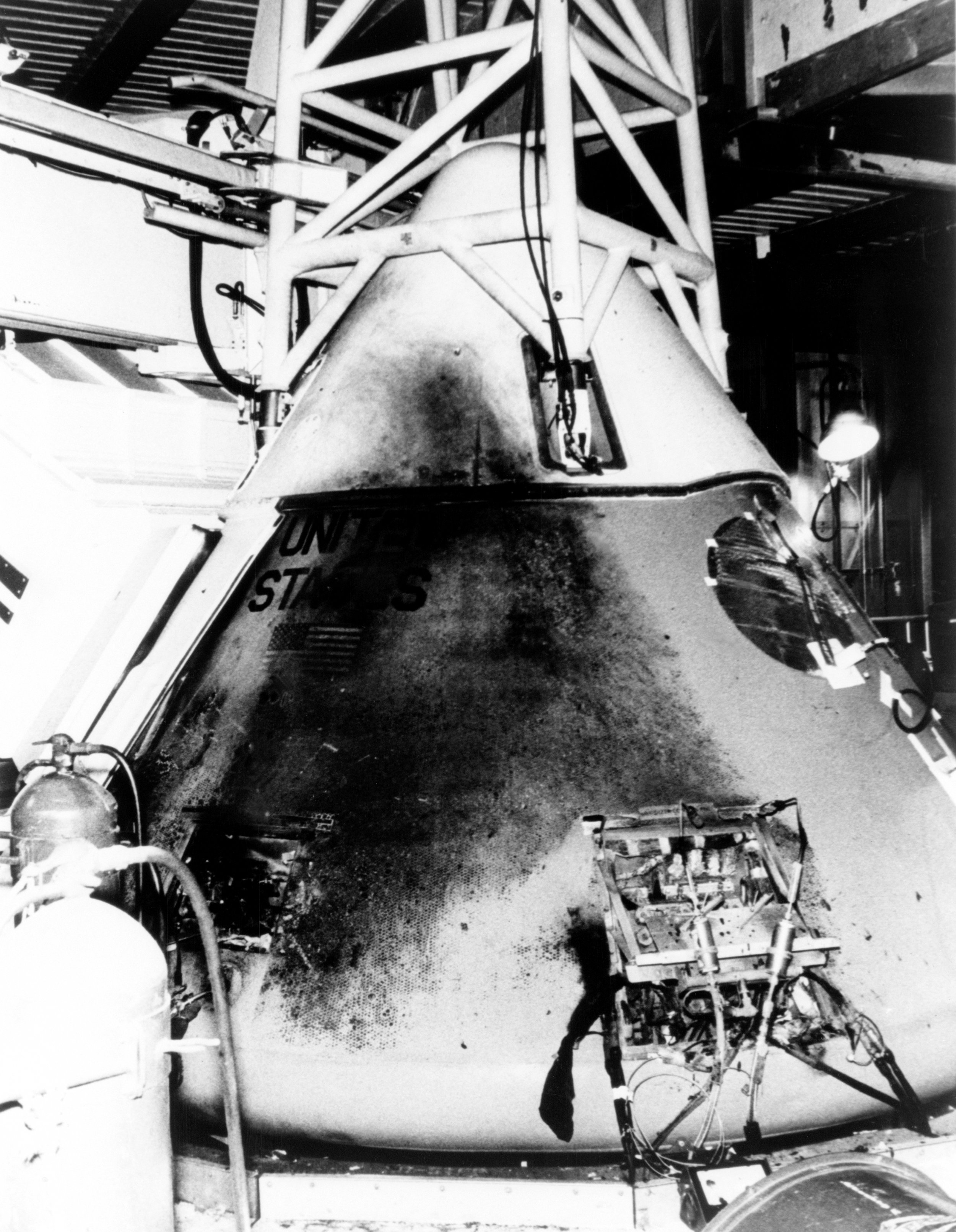
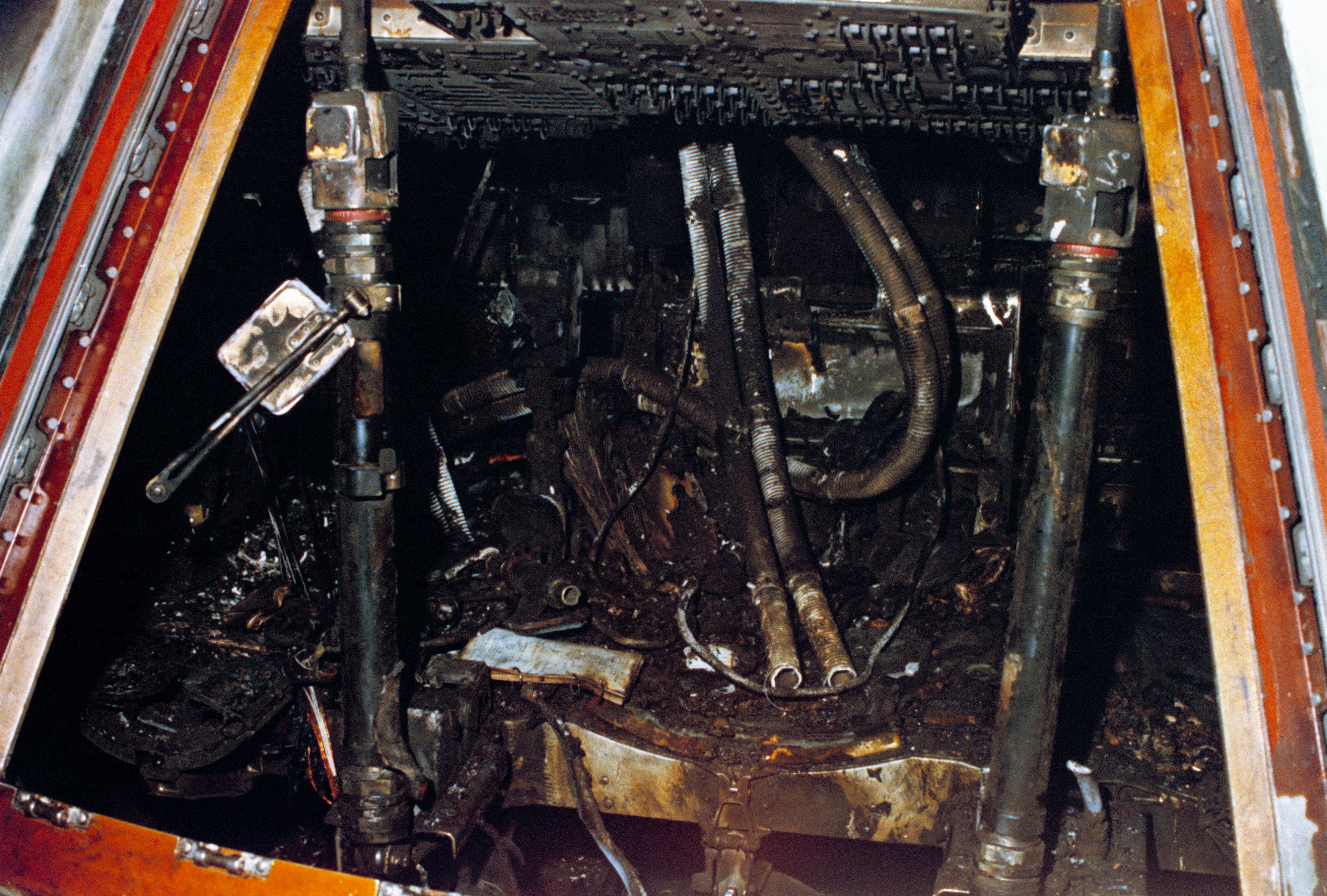
Apollo 1, originally designated Apollo/Saturn-204, was to have been the first manned mission of the Apollo program. It was scheduled to launch on February 21, 1967 with the crew component of Gus Grissom, Ed White, and Roger Chaffee. Frayed insulation allowed a spark from a cable to jump to flammable material in the cabin's pure oxygen atmosphere during a countdown checklist test. Velcro was a new product and the crew and especially the ground crew it seems, went crazy in using it inside the cabin to place things within easy reach. Unfortunately it is highly flammable, and in the pure oxygen atmosphere, went up like a blowtorch. The additional design modification of having an inward-opening inner hatch after the near-catastrophe of Gus Grissom's Liberty Bell 7 flight, rendered it impossible to open the hatch for escape. The crew was trapped inside and died in the fire, which created interior pressures so great that the capsule ruptured, sending flames outward and igniting part of the surrounding superstructure.

The timeline: at 6:30:54 (23:30:54 GMT) during a T-10min hold, a voltage transient was recorded. This was likely the initiating spark. At 6:31:04 (ten seconds later), Chaffee exclaimed, "Hey." The voice recorder picked up scuffling sounds, then Commander Grissom reported the fire. At 6:31:12 Chaffee officially reported, "We've got a fire in the cockpit." White responded. Twelve seconds later, Chaffee began urging his colleagues to get out.

Per Wikipedia's entry, "Some witnesses said they saw White on the television monitors, reaching for the inner hatch release handle as flames in the cabin spread from left to right and licked the window." There was also this official report: "Witnesses monitoring the television showing the hatch window reported that flames spread from the left to the right side of the command module and shortly thereafter covered the entire visible area." [Apollo 1: The Fire, http://history.nasa.gov/SP-4029/Apollo_01a_Summary.htm]

The last voice transmission was garbled and was variously interpreted by flight control witnesses to be, "They’re fighting a bad fire—let's get out. Open 'er up," "I'm reporting a bad fire. I'm getting out," or possibly, "We've got a bad fire—let's get out. We're burning up."

Transmission ceased suddenly at 6:31:21. Some witnesses "believe there was one sharp cry of pain. Loss of radio signal occurred a few seconds later." [NASA Memorandum, Report on Apollo 204 Review Board Discussions, http://www.hq.nasa.gov/pao/History/Apollo204/seamans.html]

"The oxygen supply to the astronaut suits, which had been holding nearly constant pressure and temperature, started to fluctuate at the time of signal loss. At 6:31:17 or 14 seconds after the fire was first detected, the cabin pressure reached a level of approximately 29 psi and the cabin ruptured." [NASA Memorandum, Report on Apollo 204 Review Board Discussions, http://www.hq.nasa.gov/pao/History/Apollo204/seamans.html]

Once the capsule ruptured, a kind of backdraft ensued and the fire expanded outside the cabin, setting various components of the superstructure afire. "Throughout this period, other pad personnel were fighting secondary fires on level A-8. There was considerable fear that the launch escape tower, mounted above the command module, would be ignited by the fires below and destroy much of the launch complex." [Apollo 1: The Fire, http://history.nasa.gov/SP-4029/Apollo_01a_Summary.htm] By the time the interior cabin could be safely reached, there was nothing that could be done to save the crew.

"The official death certificates for all three crew members list the cause of death as asphyxiation due to smoke inhalation due to the fire." [NASA Memorandum, Report on Apollo 204 Review Board Discussions, http://www.hq.nasa.gov/pao/History/Apollo204/seamans.html]

Recovery

"Three hatches were installed on the command module. The outermost hatch, called the boost protective cover (BPC) hatch, was part of the cover which shielded the command module during launch and was jettisoned prior to orbital operation. The middle hatch was termed the ablative hatch and became the outer hatch when the BPC was jettisoned after launch. The inner hatch closed the pressure vessel wall of the command module and was the first hatch to be opened by the crew in an unaided crew egress.

"On the day of the fire, the outer or BPC hatch was in place but not fully latched because of distortion in the BPC caused by wire bundles temporarily installed for the test. The middle hatch and inner hatch were in place and latched after crew ingress. Although the BPC hatch was not fully latched, it was necessary to insert a specially-designed tool into the hatch in order to provide a hand-hold for lifting it from the command module. By this time the White Room was filling with dense, dark smoke from the command module interior and from secondary fires throughout level A-8. While some personnel were able to locate and don operable gas masks, others were not. Some proceeded without masks while others attempted without success to render masks operable. Even operable masks were unable to cope with the dense smoke present because they were designed for use in toxic rather than dense smoke atmospheres.

"Visibility in the White Room was virtually nonexistent. It was necessary to work essentially by touch since visual observation was limited to a few inches at best. A hatch removal tool was in the White Room. Once the small fire near the BPC hatch had been extinguished and the tool located, the pad leader and an assistant removed the BPC hatch. Although the hatch was not latched, removal was difficult.

"The personnel who removed the BPC hatch could not remain in the White Room because of the smoke. They left the White Room and passed the tool required to open each hatch to other individuals. A total of five individuals took part in opening the three hatches. Each were forced to make several trips to and from the White Room in order to reach breathable air." [Apollo 1: The Fire, http://history.nasa.gov/SP-4029/Apollo_01a_Summary.htm]
 
Moreover,
 
"When the firefighters arrived, the positions of the crew couches and crew could be perceived through the smoke but only with difficulty. An unsuccessful attempt was made to remove the senior pilot from the command module.
 "Initial observations and subsequent inspection revealed the following facts. The command pilot’s couch (the left couch) was in the “170 degree” position, in which it was essentially horizontal throughout its length. The foot restraints and harness were released and the inlet and outlet oxygen hoses were connected to the suit. The electrical adapter cable was disconnected from the communications cable. The command pilot was lying supine on the aft bulkhead or floor of the command module, with his helmet visor closed and locked and with his head beneath the pilot’s head rest and his feet on his own couch. A fragment of his suit material was found outside the command module pressure vessel five feet from the point of rupture. This indicated that his suit had failed prior to the time of rupture (23:31:19.4 GMT), allowing convection currents to carry the suit fragment through the rupture.
 "The senior pilot’s couch (the center couch) was in the “96 degree” position in which the back portion was horizontal and the lower portion was raised. The buckle releasing the shoulder straps and lap belts was not opened. The straps and belts were burned through. The suit oxygen outlet hose was connected but the inlet hose was disconnected. The helmet visor was closed and locked and all electrical connections were intact. The senior pilot was lying transversely across the command module just below the level of the hatchway.
 "The pilot’s couch (the couch on the right) was in the “264 degree” position in which the back portion was horizontal and the lower portion dropped toward the floor. All restraints were disconnected, all hoses and electrical connections were intact and the helmet visor was closed and locked. The pilot was supine on his couch.
"From the foregoing, it was determined that the command pilot probably left his couch to avoid the initial fire, the senior pilot remained in his couch as planned for emergency egress, attempting to open the hatch until his restraints burned through. The pilot remained in his couch to maintain communications until the hatch could be opened by the senior pilot as planned. With a slightly higher pressure inside the command module than outside, opening the inner hatch was impossible because of the resulting force on the hatch. Thus the inability of the pressure relief system to cope with the pressure increase due to the fire made opening the inner hatch impossible until after cabin rupture. Following rupture, the intense and widespread fire, together with rapidly increasing carbon monoxide concentrations, further prevented egress." [Apollo 1: The Fire, http://history.nasa.gov/SP-4029/Apollo_01a_Summary.htm]
Grissom was the command pilot, White the senior pilot, and Chaffee the pilot.

Also, "When the command module had been adequately ventilated, the doctors returned to the White Room with equipment for crew removal. It became apparent that extensive fusion of suit material to melted nylon from the spacecraft would make removal very difficult. For this reason it was decided to discontinue removal efforts in the interest of accident investigation and to photograph the command module with the crew in place before evidence was disarranged.

"Photographs were taken and the removal efforts resumed at approximately 00:30 GMT, 28 January. Removal of the crew took approximately 90 minutes and was completed about seven and one-half hours after the accident." [Apollo 1: The Fire, http://history.nasa.gov/SP-4029/Apollo_01a_Summary.htm]


Translated, Grissom's body was found, unstrapped and out of his couch, collapsed on the deck. White was found, per his training, lying sideways on the deck next to the hatch; he had evidently tried valiantly to open it but failed. Chaffee was still strapped in, maintaining comm per his responsibility until White got the hatch open or the fire took him. All three were effectively welded into the interior by the melting of their nylon suits and umbilicals. It took nearly an hour and a half just to cut the bodies free and remove them.

Aftermath

Needless to say, the Apollo program went on hold while a complete redesign was performed on the Apollo capsule. This included a change to a 60/40 oxygen/nitrogen atmosphere for launch, increased safety procedures for construction, a complete change in material construction of the flight suits, and a completely redesigned hatch (already intended to be flown) which opened outward and took 10 seconds or less to open. Ironically, however, the very hatch design which nearly claimed Gus Grissom's life on the Liberty Bell 7 flight was the cause of the newer hatch design which sealed his fate in the Apollo 1 catastrophe.

Sometimes real life is stranger than anything we writers could possibly dream up.

Next week, the Challenger disaster.

-Stephanie Osborn
http://www.stephanie-osborn.com

Monday, June 25, 2012

Space Weather - The Carrington Event


In August of 1859, during historic Solar Cycle 10, something very strange began to happen. The Sun, as it neared solar max, grew unusually active. It produced prolific numbers of sunspots and flares, some of which were visible to the naked eye. This continued through the end of the month, until, just before noon on September 1, British astronomer Richard Carrington, just 33 and already acknowledged as one of England's premier solar astronomers, observed an incredibly brilliant solar flare – a flare that was easily visible to the naked eye. In later times, this single flare became known as The Carrington Super-Flare. In his own words from his scientific records:

“...Within the area of the great north group [of sunspots]...two patches of intensely bright and white light broke out...My first impression was that by some chance a ray of light had penetrated a hole in the [projection] screen...for the brilliancy was fully equal to that of direct sun-light; but by at once interrupting the current observation, and causing the image to move by turning the R.A. [right ascension, an astronomical coordinate akin to longitude] handle, I saw I was an unprepared witness to a very different affair...The instant of the first outburst was not 15 seconds different from 11h 18m Greenwich mean time, and 11h 23m was taken for the time of disappearance [from the telescope's view]. In this lapse of 5 minutes, the two patches of light traversed a space of about 35,000 miles...”

British amateur astronomer Richard Hodgeson also observed it; Balfour Steward at the Kew Observatory noted a “crochet” effect on the observatory's magnetometer. (A “crochet” is also sometimes called a Sudden Ionospheric Disturbance, or SID. It is when a solar event produces an abnormally high plasma density – remember, plasma is like the stuff in your fluorescent lights – in one layer of the ionosphere. This in turn creates literal electric currents running through the ionosphere, which magnetometers pick up. It creates something of an invisible lacy pattern in the atmosphere, hence, I suppose, the term “crochet.”)

And all of the previous flares and coronal mass ejections had fairly effectively cleared the interplanetary medium between the Sun and Earth.

The enormous coronal mass ejection produced by the super-flare slammed into Earth in only 17 hours.

The resulting effects lasted several days.

What kind of effects?

Worldwide aurorae for starters. These aurorae were most noted in the Caribbean, where they had never been seen before. Colorado gold miners, awakened by the brightening skies, got up and began cooking their breakfasts, because they thought it was dawn. In Europe and the northeastern United States, newspapers could be read by the light of the aurorae.

Speaking of newspapers, the Baltimore American and Commercial Advisor spoke of the ongoing event in poetic terms. “Those who happened to be out late on Thursday night had an opportunity of witnessing another magnificent display of the auroral lights. The phenomenon was very similar to the display on Sunday night, though at times the light was, if possible, more brilliant, and the prismatic hues more varied and gorgeous. The light appeared to cover the whole firmament, apparently like a luminous cloud, through which the stars of the larger magnitude indistinctly shone. The light was greater than that of the moon at its full, but had an indescribable softness and delicacy that seemed to envelop everything upon which it rested. Between 12 and 1 o'clock, when the display was at its full brilliancy, the quiet streets of the city resting under this strange light, presented a beautiful as well as singular appearance.”

Those dealing in the business of telegraphy did not think so highly of the display. The incredibly intense event, a maximal G5 and S5 by any definition, created induced currents in telegraph wires that were simply impossible to control. Lines and pylons threw sparks, telegraph batteries were blown, telegraphers received severe shocks, and telegraph “flimsy” paper burst into flames.

And yet some telegraph systems continued to function, despite having no batteries to power them. The induced current was simply that strong.

This was the Carrington Event, the most powerful solar/geomagnetic storm ever to occur in recorded history. It was before the advent of electricity, or electronics, or integrated grids and networks, save for telegraph systems, with which it wreaked havoc. Imagine what effect it would have today.


Dibs on the story.    ;-)


-Stephanie Osborn

Friday, October 28, 2011

R.I.P Comet Elenin (and rumors, too!)

It's dead, Jim.

Comet Elenin is no more.

According to both NASA and Sky and Telescope, Comet Elenin has disintegrated. A first-time comet, meaning it had never been into the inner Solary System before, Elenin was predicted by astronomers to be a bright, beautiful comet, if not quite in the same league as Hale-Bopp. It was simultaneously predicted by some (who didn't understand orbital mechanics) to be the end of the world. Instead, its falling inward toward the sun proved to be the end of the comet.

Coming in from outside the plane of the ecliptic, it would have made for a gorgeous sight for Northern Hemisphere observers, who haven't had a bright comet placed for good viewing in some time. The inclination of this comet relative to the ecliptic (plane of the solar system) would have changed that.

Instead, by April it was showing signs of coming apart at the seams. In August, it was hit broadside by a large coronal mass ejection from the sun, which blew away much of the volatile material that would have made it a lovely comet.

(Contrary to some claims, there was no "energy shield" which protected it from the CME. Any "sightings" of such a thing were likely inadvertent misinterpretations of a bow shock between the cometary material and the CME. Tetrahedral "shields" are unlikely in any event due to the difficulty in producing such a shape - spherical would be much more likely, IF such a shield had existed. I love the way the "true believers" shifted from "natural object" to "alien spacecraft" as soon as evidence for the former vanished in a puff of dust and gas.)

Three weeks before perihelion (closest approach to the Sun) which would have been on September 10, it completely disintegrated. According to comet expert John Bortle, "The decline/fade of Elenin was abrupt and dramatic."

All that's left of the once and never "planet-killer" is a loose, wispy cloud of gas and dust, rapidly dispersing, according to photographs.

Hopefully, so too will be the rumors of its threat.

-Stephanie Osborn
http://www.stephanie-osborn.com

Sunday, September 11, 2011

Ten Years. Not Forgotten. NEVER Forgotten.

September 11, 2001. A day that will live in infamy, if I may make so bold as to paraphrase a famous speech - and one that launched us into a war just as surely.

For though time has dulled the memory for some, it has sharpened it for others. And perhaps, on this tenth anniversary, it is time to refresh the memory, so that all may have sharp, poignant memories of that day. So that all may never forget - whether the families of the victims, whose hearts were ripped out that day; the terrorist perpetrators, who assuredly will one day receive their just deserts, whether at the hands of those they attacked or those of a Just Providence; and the rest of us, witnesses to the events of that horrible, dreadful day.

Ten years.

Two weeks before the attack, I myself flew out of the airport where the doomed flights originated; there but for the grace of God went I. The morning of the attack, I rose to prepare for work, turned on the television, saw one of the Twin Towers already ablaze and gaped in horror. As I watched, the second plane crashed into the other tower and I understood sufficient to know that we were being attacked. Since I was then working on a space defense program, I promptly called in and left a message for my boss to ensure that he and my coworkers would know what was going on. There was, in my mind, the possibility that our program could be called into active operations at any moment, though I considered it unlikely. Still, it is best to be prepared. Desperate times. Desperate measures.

Then I did my utmost to perform my morning ablutions in front of the bedroom television. So I saw, watching on in horror, when the towers collapsed. I knew they were full of both innocents and heroes, emergency responders who flung themselves into the heart of the catastrophe with no thought for themselves. I was helpless to do anything but pray. But that, I could do; and that, I did.

I saw the Pentagon attacked; heard of the fourth plane somewhere in the air. Considerably later I heard about the bravery of the men and women aboard it who prevented the terrorists from carrying out their evil deed. I also heard that the son of a friend, attending Penn, saw that crash take place with his own eyes and was deeply upset.

Eventually I made it in to work. By then all flights across the country had been grounded, and remained so for several days. Since the main Boeing campus, where I was assigned, was between the ends of the runways of Huntsville International Airport, and we were used to hearing all sorts of aircraft taking off and landing through the day, the silence was eerie. And ominous. One part of my brain longed for the familiar sound, but the other part knew that if I did, it likely foretold my imminent death.

Descriptions began coming back from people I knew who had either been in NYC at the time, or had to travel there shortly after the resumption of flight. The smoke, the stench of death, of decaying flesh that could not be alleviated: the realization that there were no bodies, really, left to recover. The victims - thousands of victims - had become integral parts of the rubble.

And the anger. The injustice. Crazed zealots determined to kill innocent people, men women and children, and themselves as well - simply because they could. Just because they hated this country. I could see performing a suicide mission in an act of desperation, to protect my family and loved ones. But just because I could?! Just to lash out at someone I disliked, someone with whom I disagreed, someone who didn't believe as I did? Dear GOD! I ask You - what were they thinking??

What ARE they thinking?

Since then, my friend Travis S. Taylor and I have written a science fiction novel revolving around futuristic terrorism and homeland security, called Extraction Point! In some ways I think it was our way of trying to put things into perspective, at least for oursleves. For my part, I don't think it succeeded, although by all accounts it certainly makes for a roller coaster of a read.

What are they THINKING?

I will never understand the thoughts of the terrorists responsible for 9-11.

But I can assure you, I will never forget.

-Stephanie Osborn
http://www.stephanie-osborn.com