Banner

Banner
Showing posts with label space program. Show all posts

Tuesday, August 16, 2016

An Op-Ed Guest Post

Today, please welcome my old NASA colleague, Larry Bauer. Currently retired, he and I worked numerous Shuttle missions together as payload flight controllers.
~Stephanie Osborn
http://www.stephanie-osborn.com


* * *


A Few Observations on Reusable Space Hardware,
or Why the Space Shuttle was an engineering masterpiece and a logistical nightmare.
by Larry Bauer

The National Space Transportation System, or what people commonly refer to as the Space Shuttle, was composed of four parts: the Shuttle itself, the three Shuttle main engines, the External Tank, and two Solid Rocket Boosters. In theory everything but the tank and its fuel were recoverable.

I was reminded of this when I saw an article noting the sixth successful landing of a SpaceX Falcon 9 rocket after the successful launch of the JCSAT-16 commercial communications satellite.


From a purely economical aspect it all comes down to what is the cheapest means to launch a payload into a desired orbit. On the face of it reusing hardware only makes sense. However there are a good many factors that mitigate against such as assumption.

With NSTS we salvaged everything except the ET. The Shuttle and engines landed and the SRB shells parachuted back into the sea for recovery. In theory maximum reuse of critical hardware. But let's look first at those boosters. They were made in sections far from the launch site, built and filled in sections so they could be transported by barge to Kennedy Space Center. From a logistics standpoint it would have made much more sense to build them as a single tube and fill them with solid propellant right there at the launch site. However that was not an option. The state of Florida would allow launches from KSC, but they refused permission to build the SRBs there. The solid propellant is nasty stuff and the process of filling the boosters violated too many state pollution restrictions. So the SRBs were built and filled originally by Thiokol of Brigham City, Utah, later bought out by ATK.

I will note that the recovery and remanufacture of the boosters was very cost- and labor-intensive, and there was always a debate over whether a cheaper throw-away design might have been more cost effective. I will also point out that a design incorporating a single continuous tube would have made the failure that caused the Challenger disaster impossible. Which does not mean something equally tragic might not have happened, but you cannot have a joint failure if there are no joints.


The high-performance Space Shuttle Main Engines, known as SSMEs or the Aerojet Rocketdyne RS-25, are an example where reuse of hardware only makes good sense. These are the pinnacle of the state of the art for liquid fuel rocket engines. With the help of the solid boosters, these engines, sucking immense quantities of liquid hydrogen and oxygen from the External Tank, could lift a combined vehicle and payload weight of roughly 2060 tons. Bringing these highly intricate and fine-tuned engines back for reuse only made sense.


And that does lead me to the subject of a rather controversial opinion of mine. As magnificent an engineering achievement as the NSTS was — and I spent the majority of my career at NASA doing ground support to on-orbit experiment operations so I have a great fondness for the beastie — the reason why it was a huge logistics failure rests in the numbers. The shuttle itself weighed in at 2030 tons. Its payload was 30 tons. The NSTS was a true heavy lift rocket, but most of what should have been useful payload mass to orbit was spent instead on creating the ability to land sort of like an airplane. A requirement imposed, by the way, by the Air Force — who withdrew from the project between the time the design was firmed up and the first launch. I will also observe that every astronaut pilot I've ever spoken with all described the shuttle as “that flying brick.” [I can confirm that astronaut description. —Steph]


And all of the above is explanation as to why we don't see any shuttle-like designs these days. It is ever so much more efficient to make as much of the upmass be useful payload as possible, with the crew compartment just sufficiently robust to carry the astronauts up and get them back to Earth safely.

* * *

Thanks much for that information, Larry! It squares pretty nicely with what I know of the various programs, as well.
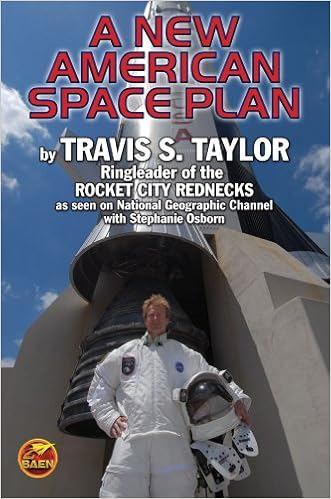
BOOK RECOMMENDATION:

A New American Space Plan, by Travis S. Taylor with Stephanie Osborn, available in print and ebook, discusses the history of space exploration, where we are, how we got there, and where we ought to be and be going. You can find a lot more detail on the Space Shuttle, how it worked, the main engines and how the whole system was designed, right in this book. There's also a good bit about the recent efforts to develop commercial space launch systems and why the epithet "commercial" is often a misnomer.

~Stephanie Osborn
http://www.stephanie-osborn.com

Monday, April 15, 2013

We Aren't The Only Ones, Part 5 and Final

by Stephanie Osborn
http://www.stephanie-osborn.com


As promised, the Chinese space failure. Excerpted from A New American Space Plan, by Travis S. Taylor and myself, from Baen Books.

It should be noted that the Chinese space program is considered a branch of their military, at least in part, and therefore is subject to much secrecy. In point of fact, it is only in recent years that there has even been a Chinese space program apart from that needed to develop ICBMs. In addition, upon the fall of the Soviet Union, much of that space agency's history came to light. We do not have this advantage in gleaning information about the Chinese space program, so this section is quite short relative to American and Russian space history.

~~~


China’s space program as such began in the late 1950s, under the auspices of their Ministry of Aerospace Industry, and Chairman Mao Tzedong. At that time it consisted mostly of work on intercontinental ballistic missiles, as we were at the height of the Cold War, and they were responding to what they considered potential threats from both the U.S. and Russia. They seemed to have no particular interest in manned space flight for several more decades.

Upon Mao’s death in 1976, Deng Xiaoping emerged as China’s leader, and canceled many missile programs and anti-missile defense programs considered important at the time. However, long range ICBM development did continue, as well as the Long March series of launch vehicles, enabling them to compete in the commercial launch industry. When the Cold War ended, Deng stepped up his commercialization of China, and moved away from the blatant use of communist revolution rhetoric in the naming of vehicles, and toward ancient Chinese religious and mystical names. This included, for example, renaming the Long March rockets “Divine Arrow.”

He split the Ministry into two parts in 1993: the China National Space Administration (CNSA), responsible for space policy and planning, and the China Aerospace Corporation (CASC), responsible for execution of the program.

Shortly thereafter, China had its first public space program disaster.

In February of 1996, the launch of the first Long March 3B heavy launch vehicle went drastically wrong. Carrying Intelsat 708, a commercial telecommunications satellite, the rocket failed almost immediately on liftoff as a result of an engineering defect, deviating drastically from its launch trajectory at the Xichang Satellite Launch Center. It crashed twenty-two seconds later and slightly more than one mile (slightly under two kilometers) from the launch facility—directly on top of a village. Xinhua, the official Chinese news agency, under government control, reported six killed and fifty-seven injured, with eighty houses destroyed. Unofficial reports, however, place the death toll at well over 500 people.

Three years after this disaster, Shenzhou 1 was successfully launched—unmanned—on the anniversary of the founding of the People’s Rebublic of China in 1999...China is a member of the UN Committee on the Peaceful Uses of Outer Space. However, its space program, despite the “corporate” designation of half of it, is entirely military-run, and in 2007 it shot down one of its own dead satellites.

~~~

So far, since the Long March disaster in 1996, the Chinese space program has been ambitious and successful. They have specified their intent to go to the Moon and to be the first humans to land on Mars. If they continue like this, they may well beat everyone in the doing; they seem to have the will and the political backing to advance, while the West is mired in political in-fighting and lack of apparent interest.

Despite our failures, I think it can safely be said that the US space program as put forth by NASA has hardly had quite so spectacular or horrific failures as have occurred elsewhere. We have not dropped any rockets on any small towns; we have never deliberately and with foreknowledge gone forward with completely inane designs. We have not wiped out a significant portion of our rocket team by requiring them to sit in the same field with the launch vehicle. Speaking as someone who has worked side by side with fellow American space flight controllers, I can honestly say that we have done the best we could do to keep our colleagues safe within reason - for space will never be completely safe. It is inherently an inimical environment, and one in which no human would live for a minute without layers of protection, whether that protection be physical, procedural, or otherwise. I have been a part of that protection, in a manner of speaking. It is a task that I strove to do to my utmost, and it is something of which I will always be proud.

-Stephanie Osborn
http://www.stephanie-osborn.com

Monday, April 8, 2013

We Aren't The Only Ones, Part 4

by Stephanie Osborn
http://www.stephanie-osborn.com

A bit more on the Soviet space program's failures, then on to China next week. Excerpted from A New American Space Plan, by Travis S. Taylor and myself, from Baen Books.

~~~


In 1971 the Soviets put up the world’s first space station, Salyut 1. Sort of like our Skylab, it was expendable and there was a whole series of these stations, military and nonmilitary. It was generally a successful program.

Except for the first flight to Salyut 1, Soyuz 11.

Soyuz 11 was the only manned mission to Salyut 1. All went nominally until it came time for reentry. At that time, the pyrotechnic bolts that were to release the service module from the reentry module fired simultaneously instead of sequentially. This in turn jolted open a breathing ventilation valve at an altitude of 104 miles (168 km) and bled the reentry vehicle’s atmosphere off into space. As it was located underneath the seats, the cosmonauts couldn’t locate and plug it fast enough to stop the loss of atmosphere. And due to the cramped conditions and the presence of 3 crew members, space suits were not worn for these early flights.

Flight recorder data later indicated the crew went into cardiac arrest within forty seconds. Within 212 seconds (less than four minutes) of the separation, the cabin pressure was zero. As a result, ground control lost communications with the crew long before the reentry comm blackout should have begun, realized that conditions were off-nominal, and began emergency preparations for the landing. The crew was found at the landing point, dead inside the cabin. Attempts were made to perform CPR by the service crew, but it was much too late.

In 1975 Soyuz 18a had the first ever manned launch abort. It’s forward momentum carriedit some thousands of miles downrange, nearly into China—which the Soviets were on particularly bad terms with at the time. It came down in the mountains again, sliding down the side of one, and nearly toppling off a cliff. This time, tangled parachutes saved the cosmonauts by snarling in the trees and preventing the sheer drop. The crew was pretty banged up.

In 1980 a Vostok rocket blew up on the launch pad. Forty-eight people died.

~~~

It should be noted that, since the dissolution of the Soviet Union, the Russian space program has, to my knowledge, not suffered a single major setback that has resulted in loss of life.

Next week as promised: The Chinese space program.

-Stephanie Osborn
http://www.stephanie-osborn.com

Monday, April 1, 2013

We Aren't The Only Ones, Part 3

by Stephanie Osborn
http://www.stephanie-osborn.com


Part 3 of this series takes us into the Russian manned program, specifically the Soyuz and the problems it experienced from the very beginning, as excerpted from A New American Space Plan, by Travis S. Taylor and myself.

~~~


Soyuz 1 was the first flight of the Soyuz spacecraft. It was also the Soviets’ first in-flight death. The craft was known to be faulty to begin with. The engineers reported over 203 design faults—not faulty equipment, not improperly installed, faulty design work, before the launch. Unfortunately, by this time Soviet leaders had caught moon fever. They wanted to beat the Americans to a manned landing, and they wanted to take advantage of the delay caused by the Apollo 1 fire. Oh, and they wanted to celebrate Vladimir Lenin's birthday with some fireworks. Big fireworks.


Vladimir Komarov was the primary, and Yuri Gagarin was his backup. The situation was so bad that Gagarin tried to get Komarov bumped from the primary position, because he knew that he was considered a national hero and therefore not expendable. He hoped to get the mission delayed until the problems could be fixed. He failed.

Soyuz 1 was launched, Komarov aboard. Its mission was to rendezvous and EVA with Soyuz 2. As soon as it got on orbit, one of the solar panels failed to unfurl, so the spacecraft was running on low power from the get-go.

The Soyuz 2 crew prepped themselves for a repair mission. Thunderstorms overnight at Baikonur fried the Soyuz electrical systems, so Soyuz 1 was on its own.

Then the “orientation detectors” (I assume this means gyroscopes or star trackers or some such, or maybe not) decided to malfunction, rendering maneuvering difficult. Then the automatic maneuvering system died entirely, and the manual system went on the fritz.

Once the maneuvering system went down, the flight director decided to abort the mission. At this point, everything looked like a happy ending.

Except this was a new ship. With new details. Like a thicker heat shield, and a correspondingly larger parachute. Remember those design flaws? Guess what? Nobody bothered to make the chute receptacle any bigger. In their brilliance, technicians used wooden mallets to beat the parachute into place.


So the drogue chute came out, but the main parachute didn’t. Simple enough: Komarov deployed the manual parachute. Which promptly tangled in the drogue chute. He hit the ground at an estimated 89 mph (140 km/hr).

The ship exploded.
 
The Soviets didn’t have too many manned firsts after that, and they never made it to the moon with a crewed lander. The same year we landed on the moon, they managed a docking and crew exchange of Soyuz 4 and 5. (The Soviets claimed that this was the world’s first space station.) Unfortunately when it came time to come home, Soyuz 5’s service module failed to separate, and the capsule with service module reentered nose first. The cosmonaut inside, Boris Volnyov, hung from his straps until the module’s struts burned through and it broke away, enabling the capsule to right itself before the hatch also burned through—the gaskets were already burning and filling the cabin with noxious fumes. But then the parachute lines tangled, and the landing retros failed, and while Volnyov walked away from that landing, he broke his teeth. He landed in—yes, you guessed it—the Ural Mountains instead of Khazakhstan, and with the temperature outside at -36°F (-38°C), he was forced to walk several kilometers to the cabin of a local.


~~~
 
-Stephanie Osborn

Monday, March 25, 2013

We Aren't The Only Ones, Part 2

by Stephanie Osborn
http://www.stephanie-osborn.com


Just by way of reminder, we've been talking about space program disasters. We started off in memoriam of the Apollo 1, Challenger, and Columbia disasters, all of whose anniversaries fall within about a 2-week timespan on the calendar. Then we went on to begin talking about the space disasters of other countries, beginning with the Nedelin disaster in Soviet Russia in 1960. Let's keep talking about the USSR space program and its problems this week.

Again, we are excerpting from A New American Space Plan by Travis S. Taylor and myself, from Baen Books.

~~~


...The Soviets suffered another setback in 1961. In a tragedy eerily similar to the Apollo 1 fire, but six years earlier, Valentin Bondarenko died in a high-oxygen (but low-pressure) environment during a training session. Yuri Gagarin kept vigil at his hospital bedside, where he died a few hours after extrication.

Shortly thereafter, aboard Vostok 1, that same Yuri Gagarin became the first human in space, completing a single full orbit of Earth. In the same year, the USSR launched Venera I to Venus, and put Gherman Titov into orbit for a full day aboard Vostok 2...In 1965, Voshkod 2 crewmen conducted the first extra-vehicular activity (EVA)—although not successfully. Their airlock was an inflatable, attached to the side of their craft, and it didn’t work quite as well as envisioned. The Voshkod was a redesign of the Vostok, and not a particularly good one. It was cramped, it contained two crewmen instead of one without expanding the volume at all, and it had no provision for emergency escape. As if that weren’t bad enough, after a little over twelve minutes of EVA, Alexei Leonov found that his spacesuit had ballooned out to a point where he had become inflexible. He simply did not have the strength to bend, even at the waist. When he attempted to reenter his vehicle, his suit became wedged and he couldn’t reach anything to free himself!

In the end he had to vent atmosphere from his suit, risking the bends, in order to get it small enough to re-enter his spacecraft and rejoin his crewman Pavel Belyayev. Then the hatch wouldn’t close
properly. Once they got that fixed, the spacecraft was so cramped that, after orienting for deorbit burn, it took them an additional forty-six seconds to navigate their inflated spacesuits back into their seats. This threw off the center of gravity during the initial stages of reentry. The automatic landing system failed, and they had to resort to manual backup— and the orbital module didn’t disconnect when it should have! They spun crazily until the module finally jettisoned at an altitude of only 62 miles (100 km).

The whole mess caused them to miss their designated landing area by a good 240 miles (386 km) in the middle of the Ural Mountains of Siberia. The location was cold, it was snow-covered, it was filled with bears and wolves—and it was the animals’ mating season, the time when said bears and wolves were in their foulest moods. The Soviet control center had no idea where they were—and the hatch’s pyro bolts had blown it off. As was common in the early days of the space program for both Soviet and American, there was a pistol and ammunition aboard, and the men were trained for that terrain, but they had little in the way of shelter save the open Voskhod capsule. Aircraft located them, but it was too heavily forested for helicopters, so the men settled down for the night in their spacesuits— after stripping and wringing perspiration out of their soaked underwear. After a frigid -22°F (-30°C) night, a rescue party on skis arrived the next morning.

Not exactly a successful mission.
...
The N-1 rocket, the Soviet counterpart to the Saturn V, began development in 1965. Unfortunately its principal architect, Sergei Korolev, by this time known only by the enigmatic title “Chief Designer,” as his very existence was a state secret, died abruptly in 1966 of medical reasons which are still debated. Cancer was certainly a factor, as was his known heart condition, but a botched operation, coupled with the inability to intubate him due to jaw damage from beatings dating from his days in the gulag, may well have contributed. This left the N-1 program leaderless. It floundered badly, and after four failed launch attempts, the program was suspended, then cancelled in 1976.
 
~~~
 
More Russian problems next week.
 
-Stephanie Osborn
 

Monday, March 18, 2013

We Aren't The Only Ones, Part 1

by Stephanie Osborn
http://www.stephanie-osborn.com


Just so you know, while NASA has had its horrible accidents, it is far from the only space program to have had them. And it IS the safest, hands down. There is nothing wrong with NASA that I have not seen in other big institutions, whether private enterprise or government agency. And while terrible, Apollo 1, Challenger, and Columbia all put together don't equal some of the space program disasters that other nations have had.

Travis S. Taylor and I wrote this book that came out in late 2012, called A New American Space Plan. It's about what we should be doing to get back on track for the stars. The reason I bring it up is because I already chronicled said disasters in it, and with the permission of Baen Books, the publisher, I'm going to excerpt Space Plan here with respect to those disasters.

First up, let's talk about the Soviet space program. Yes, I know the USSR doesn't exist any more, but the space program the Russians have is founded upon that started by the USSR. Here we go!

~~~


The Russian space program can be traced back to at least the early part of the twentieth century, when Konstantin Tsiolkovsky, a contemporary of America’s Robert Goddard, proposed the notion that space flight was possible and began developing the modern science of rocketry. This was furthered by the Group for the Study of Reactive Motion, or “GIRD,” as it worked out in Cyrillic. This group contained, among others, Sergei Korolev, who would eventually wind up becoming one of the Soviet’s premier rocket scientists. In 1933 this Soviet team launched their first liquid fueled rocket, the GIRD-09, and a few months later, the hybrid fueld GIRD-X. It seemed Soviet rocketry was off to a great start.

 
It received a grave setback during the Stalin era, however. Stalin’s Great Purge killed or imprisoned most rocket scientists of the day. It targeted the intelligentsia and professionals, among others, as presumably a threat to the Communist Party. Those who were not executed by firing squad were sent to the gulags. Many of the stories bear resemblances to atrocities being carried out at the same time but a little farther west. The only developments in the field of any significance occurred during World War II with the invention of the Katyusha multiple rocket launcher.

 
It was that “little farther west” that proved the reinvigoration of the Soviet space program, however. At the end of World War II, not all of Wernher von Braun’s team ended up in the United States. He had purposely split his team in hopes that one or the other might make it to a safe haven with the Allies. The other group ended up with the Soviets, who looked over what von Braun’s team had wrought at Peenemunde and were impressed.

 
Once in their new home in the Soviet Union, the German rocket scientists set to work helping the Soviets replicate the V-2. This Russian version was dubbed the R-1. But it was not powerful enough to carry the large, heavy nuclear warheads of the day—which was the principal Soviet concern at the time. What the Russians wanted was a true intercontinental ballistic missile. That was always the whole point of their rocket program, as it turned out.
 
Nevertheless, the dreamers still got the dregs of the military’s desire. Somehow having managed to survive internment in a gulag during the Purge, Korolev came out on top as one of the principal designers. But he had his enemies; the Soviet space program, unlike the American one, was not centralized, and there was much internal competition...In short order, the USSR began making reasonably regular launches. Oddly enough, it has in recent years been determined that Kruschev had no particular interest in the space program. It was not a high political priority, he did not desire to compete with the Americans to the moon, and he saw its only benefit as propagandistic. Nevertheless the “propagandistic” program kept bringing home world firsts. In 1959, no less than three lunar probes were launched: Luna I, II, and III. These were, respectively, a flyby, an impactor, and a single slingshot orbit around the moon that returned the first images of the lunar far side. And in 1960 they returned living dogs from Earth orbit.
 
But 1960 also saw possibly their greatest space disaster. It is commonly known as the Nedelin catastrophe after the manager who oversaw it. Some say he was cocky. Some say he ordered his subordinates into fatal position. It is likely that we will never know because there was only one survivor of this disaster.

In October 1960, a launch pad test for a prototype of the R-16 ICBM was in preparation. This test was overseen by Soviet Marshal Mitrofan Nedelin. The rocket was on the launch pad at the Baikonur Cosmodrome, and fully fueled with what they called “Devil’s Venom,” a particularly nasty hypergolic fuel system consisting of unsymmetrical dimethyhydrazine (UDMH) and nitric acid. The fuel mix is highly corrosive and toxic, but extremely powerful. However, even its exhaust is poisonous, and the nitric acid cannot be in the oxidizer tank for more than two days without eating through the tank.

It was the very nature of Devil’s Venom, it seems, that led to the disaster. Late on the day before the test, the technicians preparing the rocket accidentally breached a line from the fuel tank, allowing a small amount of fuel into the combustion chamber. This in itself was not dangerous. So rather than go through weeks of untanking, repair, rebuilding the engine, and refitting, the decision was made to move up the launch to the next day. Meanwhile Nedelin notified many military and political dignitaries of the upcoming launch, in case they wanted to watch—and who doesn’t want to watch a rocket launch?

Then on October 24th, engineers, scientists and technicians rushed to complete launch preparation, often performing tasks simultaneously rather than sequentially per checklist. The result was a delay. Nedelin, impatient and perhaps embarrassed, left the dignitaries at the observation stand and went to oversee the final preparation. Word has it he even brought a chair to sit down beside the launch pad.


For reasons unknown—or unreleased—the second stage engines fired prematurely. The flames acted as a blowtorch on the hypergolic tanks in the first stage, cutting through them. As soon as the UDMH and the nitric acid combined, as is the nature of hypergolic fuels, they self-ignited. The resulting explosion cremated everyone near the pad.


Those farther away were burned to death; those who had run away encountered the perimeter fence and were either burned or poisoned by the fumes. The entire horrific debacle was captured on film for posterity by automated cameras. Only one man survived—Mikhail Yangel, an associate (and competitor) of Korolev’s, and that only because he left the viewing area and went into a bunker to smoke a cigarette. He had been the military’s rocket engine designer and a proponent of hypergolic fuels. After this he was directed to concentrate strictly on ICBM design.
 
~~~
 
More next week.
 
-Stephanie Osborn
 

Monday, September 24, 2012

And The Last Goes Home

by Stephanie Osborn
http://www.stephanie-osborn.com


Endeavor was the replacement orbiter for the lost Challenger. Many of us in the program (at least in my area of payload flight control) were in favor of naming it Phoenix, “out of the ashes,” but either that was not submitted in the school naming contest, or NASA headquarters was in favor of staying away from references to the lost orbiter and its crew, and the name Endeavor was selected. Endeavor was somewhat different from the other shuttles in the fleet, since previous experience in constructing the others enabled some “lessons learned” to be incorporated into its design, most notably a difference in the shape and application of the heat shielding tiles.


I worked payload control for STS-47, which was Endeavor's second mission and the 50th mission of the program (flight numbers notwithstanding; launch delays often scrambled the number sequencing, so eventually the numbers became more about the order of manifesting rather than launch). It carried the Spacelab Japan payload, an all-NASDA payload, as well as the first Japanese astronaut, Mamoru Mohri, the first black astronaut, Mae Jemison, and the first husband/wife astronaut team, Mark Lee and Jan Davis. Ground-breaking life- and materials-sciences experiments were performed aboard, and considerable information was gleaned about extremely long duration space flights upon organisms as well as details of materials manufacturing in the microgravity environment.


It was a good bird. It performed well and reliably.


Each final flight of a given Shuttle pained me considerably. Somewhere along the way, I started personifying them. They were almost as much old friends as some of the astronauts were to me. Once they were decommissioned, the process began of stripping them of internal components, preparatory to being sent to their respective sites. Someone sent me newspaper clippings of the process, and others emailed photos, which I have filed for historical purposes, but truthfully I could hardly stand to look at the imagery. It was, for me, something akin to watching a friend's autopsy.


And above all, it was the end of an era. The end of MY era.

Stephanie Osborn
http://www.stephanie-osborn.com

Monday, July 18, 2011

My husband is a keeper

by Stephanie Osborn
http://www.stephanie-osborn.com

I just returned from Libertycon, one of several major SF conventions in Chattanooga TN. There, I was delighted to be this year's Science Guest of Honor. These are good people, down-home, loving and friendly. As usual, they not only ran my standard bio in their program book, they also asked some people to give them their stories about me. Due to some crossed wires, they got two: one from my good friend Sara Harvey, and one from my husband, Darrell Osborn.

Now, Darrell and I have been married quite awhile, and like most married couples of long standing, we know we love each other and that's that. The busyness of life and the knowledge of belonging - as well as some reticence on both sides to be able to say the things that we feel deepest - means that the knowing is felt, not said.

Until the convention. And then my dear husband laid it all on the line for everyone to see. And I am so proud I can't stop reading it. So I'm going to share it with the world:

Let's start at the beginning. Decades ago, before many of you were born, my friend Danny and I were walking through the theater building on the campus of Austin Peay [State University] in Clarksville, TN. We were passing through the "Green Room" on our way to the stage when we saw an attractive blonde sitting on the couch. We looked at each other and then did what any red-blooded theatre geek would do. We hit on her. That was the first time I met Stephanie Gannaway. She was finishing her last year at APSU and preparing to graduate with a triple major in Math, Physics, and Chemistry. She was also picking up minors in Geology and Computer Science. My first thought was, "At last, someone I can talk to."

Fast forwarding a couple of years finds us married and living in student housing on the campus of Vanderbilt in Nashville. Stephanie was working on a Masters in Astronomy and I was creating havoc in the Live Entertainment Department at Opryland [back when it was a theme park -Steph]. One day word came down that Carl Sagan was coming to give a talk. You've got to remember, at this time Carl Sagan was a science rock star. Everyone knew "Cosmos" and he was a regular on Carson's Tonight Show. We later find out that Max, one of her professors, and Sagan were college buddies. The talk was great and we went to reception afterward. We progressed through the greeting line until we reached Max and Sagan. Max introduced Stephanie as one of the two astronomy graduate students. As Stephanie shook his hand, Max leaned over and whispered to Sagan, "She's one of the good ones." Sagan gave a knowing little smile and nod. That was our Sagan moment. Although brief, I think that short phrase and nod meant more to her than any of the degrees she had gotten.

A few decades have passed and so has Sagan. Now Stephanie has moved from science and her involvement in the space program to its symbiote science fiction. I have no doubt that the time will come again when she will stand before some sci-fi writer rock star and once again hear the words, "She's a good one." (That reminds me of the time we ran into Ray Bradbury; a story for another time.)

Last year I re-connected with Danny. He's now an Associate Dean at the University of Memphis. That's a great accomplishment, but I got the girl.

-Darrell "Doc" Osborn


Yep. I always knew Darrell was a keeper. <3

-Stephanie Osborn
http://www.stephanie-osborn.com