Banner

Banner
Showing posts with label coronal holes. Show all posts

Tuesday, August 23, 2016

AURORA ALERT 23/24 August 2016

by Stephanie Osborn
http://www.stephanie-osborn.com

According to the various solar/geomagnetic data (collected in one convenient place by SolarHam.com; I actively support them with contributions), we are currently experiencing minor geomagnetic storming. This is likely being caused by a combination of a favorably-oriented local interplanetary magnetic field, as well as an enhanced wind stream from a coronal hole.


This is a Solar Dynamics Observatory image 
from 23 August 2016. It depicts the coronal holes 
on that date (yesterday). Holes were numbered by 
SolarHam. Coronal Hole #07 likely produced the
solar wind stream creating the current geomag storming.

The planetary K-index is a NOAA Space Weather Prediction Center (SWPC) product created using magnetometers around the world. According to the SWPC, "The K-index quantifies disturbances in the horizontal component of earth's magnetic field with an integer in the range 0-9 with 1 being calm and 5 or more indicating a geomagnetic storm. It is derived from the maximum fluctuations of horizontal components observed on a magnetometer during a three-hour interval. The planetary 3-hour-range index Kp is the mean standardized K-index from 13 geomagnetic observatories between 44 degrees and 60 degrees northern or southern geomagnetic latitude. The label 'K' comes from the German word 'Kennziffer' meaning 'characteristic digit.' The K-index was introduced by Julius Bartels in 1938. SWPC has used the K-index since the forecast center began operations." 

Any time the K-index reaches 5, geomagnetic storming is occurring. We have been experiencing K=5 for at least 9 hours at the time of this writing.


K-index graph captured as of approximately 10:25pm CDT, 23 Aug 2016.

The higher the K-index, the farther away from the geomagnetic poles the aurora can be seen, and the more effects can be seen. Generally coronal hole wind streams produce only minor storming; it takes a moderate to strong coronal mass ejection (CME) impact to reach the upper levels of the K-index.


The NOAA SWPC Geomagnetic Storm Scale.

We are currently experiecing a G1 Minor geomagnetic storm.

It takes something around an X-class flare producing a large, strong CME to hit an 8-9 on the K-index scale, and that's up around Carrington-event class. So we aren't going to have anything like that, but higher latitudes might have a nice aurora tonight or the next few nights.

Here are maps (posted to SolarHam, but obtained from NOAA SWPC) that will show you where aurorae are possible. Find the line marked Kp=5 for our current condition, then look from that line poleward. If you are in that region, keep a watch out for aurorae. If you are near but outside the region, keep an eye peeled poleward, just in case.


K-index map of North America.
K-index map of South America/Antarctica.
K-index map of Eurasia.
K-index map of Australia/extreme South Pacific.

Good viewing!

~Stephanie Osborn
http://www.stephanie-osborn.com


Monday, August 22, 2016

Some Solar Updates

by Stephanie Osborn
http://www.stephanie-osborn.com

Just a few tidbits today, guys.

FYI we had another spotless couple days. Scarcely two, but there was nothing yesterday and today there is a spot rotating around from the far side. According to the NOAA Space Weather Prediction Center there is one already on the near side continuing to decay — yet it doesn't show up — and the one rotating to the near side is one that rotated completely around. Judging by the STEREO imagery, however, there isn't another spot on the entire solar surface.


That said, there are some interesting magnetic field patterns in the inner corona in the Solar Dynamics Observatory's 211b channel, and that might indicate where the mysterious unseen spot group is supposed to be. Have a look at this image and look just over coronal hole 07, and you'll see it:


Said SDO channel image also shows the coronal holes, but they're moderate currently. We had a passage through an enhanced solar wind stream from one over the weekend, but it wasn't impressive and only mildly unsettled the geomagnetic field.

This magnetogram (also from SDO) shows that, plus the group rotating around, plus ANOTHER that also isn't showing up.


So yes, there's some activity, but it isn't a lot.


BOOK RECOMMENDATION:
The Weather Out There Is Frightful: Solar/Space Weather and What It Means for the Earth and You

Our Sun is an active star. It may even be a variable star. Sunspots, flares, coronal mass ejections, all are signs of its activity. What kind of effect does it have on Earth? Other than the occasional sunburn, could it be dangerous? Has it been dangerous in the past? What can we expect in the near future?


OFF-TOPIC ADDENDUM:
With any luck, while it isn't about solar/space weather, I should have some exciting news for my fans sometime this week!

~Stephanie Osborn
http://www.stephanie-osborn.com

Friday, August 12, 2016

A Couple Quick Updates

by Stephanie Osborn
http://www.stephanie-osborn.com

SOLAR UPDATE:
The Sun has definitely awakened for the time. (Finally.) There are currently half a dozen spot groups on the solar near side; 2571 is about to rotate to the far side, but there are also 2573-7 as well, which range from a simple single spot to a multi-spot complex.


Solar Dynamics Observatory imagery
Labeling by Solarham.com
Note how the spots tend to cluster around the equatorial region. This is pretty typical for late in a solar cycle. Sunspots tend to start out at higher latitudes, closer to the poles, then drift equatorward.

Very minor C-class flares are occurring, but there is little chance for anything stronger. A filament did lift, and this may produce a small coronal mass ejection, or CME. We're waiting on LASCO (Large Angle and Spectrometric Coronagraph, an instrument on SOHO, the Solar and Heliospheric Observatory) imagery to determine if it made a CME or not. Such CMEs tend not to be as strong as those associated with large flares, so even if it is Earth-directed, expect pretty aurorae and a few high-latitude effects, but nothing of significance.

There are some coronal holes, but they aren't "geoeffective" (aimed at Earth). Geomagnetic activity is quiet.


Solar Dynamics Observatory imagery
Labeling by Solarham.com

More data as it comes in.

* * *

PERSEID METEOR SHOWER:
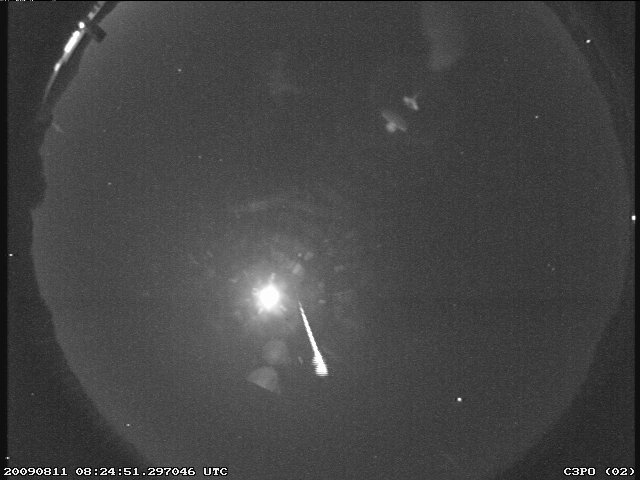
Well, the night of August 11/12 was the absolute peak of the Perseids. I've just come in from spending about 20 minutes outside, having a look. (It's currently 4am local time.)

I have to say that I was underwhelmed, especially given the hype given to the predictions of "up to 200 meteors/hour." That comes out to be over 3 meteors per minute, or about one meteor every 15-20 seconds. So in 20 minutes, I should have seen around 66 meteors.

I saw about 1/10 that.

Now, granted, I'm in a subdivision and my skies are not the darkest. And we had some light patchy clouds moving through. But  I waited until after the moon had set before I went out, to have the darkest possible skies for my location. And I picked the clearest patches of sky to observe, and ensured I blocked any light sources. Keep in mind that I've observed this shower from this location numerous times before, as well, so I know what I'm looking for. And I've seen the Perseids storm, the year after the parent comet, Swift-Tuttle, came through -- both from a rural dark-sky site, and my yard, where I was tonight.

 
Bill Cooke, NASA Meteoroid Environment Office,
Huntsville, AL
August 10, 2009

I undoubtedly would have seen more meteors had I been in a dark-sky site. But ten times more? Really?

It's possible, also, that I simply picked a time when, coincidentally, we were going through a sparse patch -- I was busy writing, and lost track of time, or I'd have been out there earlier, for longer. I'll be interested to see what other observers have to say.

As for me -- I love the Perseids; they're gorgeous, bright fireball meteors. But this didn't come anywhere close to the spectacle I remember right after Swift-Tuttle came through. That was one I'll always remember. Tonight, not so much.

If you were out observing the Perseids, I'd love to hear your observations in the comments.

* * *

BOOK RECOMMENDATIONS:

For more information on solar activity, check out my ebook, The Weather Out There Is Frightful: Solar/Space Weather and What It Means for the Earth and You.


Just a quick promo for me and my fellow scientists, for those of you who are interested in such things: A new anthology will be released in September (we hope!) called Science Fiction By Scientists. Every short story in it is "hard SF" written by an actual scientist, along with a quick primer at the end of each story on the science involved. It's available for preorder now!


~Stephanie Osborn
http://www.stephanie-osborn.com

Wednesday, August 3, 2016

Solar/Geomagnetic Activity!

by Stephanie Osborn
http://www.stephanie-osborn.com
HEADS UP, SPACE FANS!

Earth is currently experiencing a GEOMAGNETIC STORM! These occur when a sudden influx of plasma (a gas cloud of charged particles) enters Earth's magnetic field from outside, most often from solar activity (a coronal mass ejection aka CME, or an enhanced wind stream from a coronal hole). They can be mild, strong, or severe, depending upon how dense the plasma cloud is.

Okay, for those of you just tuning in, let's work on explaining some terms.

~~~
      We are also sitting inside the atmosphere of the Sun, which is called the corona. Yes, we are, even at 93 million miles distant. It generates a wind, usually coming out from the Sun and spiraling away – yeah, the “solar wind.” Granted, the corona isn't very dense, but it's dense enough to create some effects, and we're working on using it to our benefit, like in solar sails and such, which can use the solar wind as much as light pressure (different topic) to maneuver around the Solar System like the spaceborne clipper ships of old. 
      But when the Sun gets... agitated, we'll say... the solar wind can get a lot denser. Coronal holes tend to move gradually from the poles down to lower latitudes, and the Sun's face develops an astronomical case of acne. This usually occurs around the time of solar maximum.
~The Weather Out There Is Frightful, Stephanie Osborn, ©2011
~~~

Now, a coronal hole is just a place in the magnetic field where the field lines stretch out to infinity, rather than looping back around, like the poles of a bar magnet. That means that the plasma can channel outward along those field lines, deep into the solar system.
This is an image of the inner corona of the Sun, taken by the Solar Dynamics Observatory on August 2, 2016, at a wavelength of 211 Angstroms. The dark regions are the coronal holes, which show up nicely at this spectral region.

If Earth happens to run into one of these "enhanced solar wind streams," as they're called, if it's strong enough, it slams into our magnetic field like a bow wave from a ship. This compressed the magnetic field on the sunward side, and stretches out the "tail" on the anti-sunward side. If the tail is stretched enough, it can snap off, and "magnetic reconnection" occurs, when the field lines reattach closer in. But magnetic reattachment itself generates a HUGE surge of energy, which is fed back into Earth along our own poles.
~~~
      So what are the effects of coronal hole winds and Coronal Mass Ejections (CMEs)? 
      They can actually raise the temperature of the outer layers of the Earth's atmosphere (the thermosphere, aptly named) sufficient to cause it to expand. This affects us, because that increases drag on satellites and spacecraft, and can cause the orbits of satellites to decay and re-enter well before they were intended... 
     Disruption of the Earth's magnetic field can be a problem. It can disrupt radio communication (including cell phones) rather severely. It can damage satellites that remain in orbit. It can generate “induced current” in any lengthy conductor...And it causes the aurorae. Most of you reading this have heard of the Northern Lights, properly termed the Aurora Borealis, but there are also the Southern Lights, the Aurora Australis. These are actually ovals that circle the magnetic poles of Earth (and most other planets with magnetic fields, by the way. They've been photographed on Jupiter.) They are where the charged particles that have been caught up from the solar wind or CME into the geomagnetic field follow the field lines down into the atmosphere. The gas molecules become excited into a higher energy state, then discharge that extra energy as light. This is very similar–in fact, essentially the same–as a fluorescent light bulb, only natural and not contained. The colors are determined mostly by the main gas that is fluorescing. Carbon dioxide produces white light; nitrogen, pink or red; oxygen, green or blue. (It can also generate ozone.)
~The Weather Out There Is Frightful, Stephanie Osborn, ©2011

~~~

So what we've got, space fans, is a big ol' coronal hole generating an enhanced solar wind stream, and the Earth ran smack into it. Currently the planetary K-index (a rough measure of the strength of the disturbance in the planetary mag field) is oscillating between 5 and 4, and at 5, we start geomagnetic storming. It's minor, so far, but it's there. So we are under an official NOAA GEOMAGNETIC STORM ALERT for MINOR GEOMAGNETIC STORMING.

This in turn means that there will be some heating of the upper atmosphere, and it can induce some currents in conductive materials near the poles. Communications may be affected in high latitudes, and migratory animals may briefly become confused.

But what it ALSO means is that we have an AURORA ALERT for high latitudes! Now, NOAA doesn't put out aurora alerts. But I do! My followers on Facebook know that whenever conditions are right, I issue an aurora alert, and give a heads-up to the regions who can reasonably expect to see one. This is not a guarantee that you WILL, only that the probability is GOOD. Therefore --

Residents of Canada, Greenland, extreme northern Russia, Finland, Sweden, Norway, Iceland, possibly extreme northern Scotland, Antarctica and the islands in the Antarctic oceans, Australia's state of Tasmania, the southern tip of New Zealand's south island, and the northern regions of the following USA states: Maine, Michigan, Minnesota, parts of North Dakota, and essentially all of Alaska --

Keep an eye to the skies tonight! You just might see an aurora!

~Stephanie Osborn
http://www.stephanie-osborn.com


Monday, June 11, 2012

Solar-Earth DefCon Levels, Part 1

As I told you last week, NOAA has a scale of geomagnetic activity that ranges from G0 to G5, where G0 is quiescent, and G5 is the worst geomagnetic storm around. Now, we've already talked a little bit about what geomagnetic storms do...

No, we didn't, you say?

Ah, but we did. Back when I told you about all the effects that Coronal Mass Ejections can have. (Solar, Space, and Geomagnetic Weather, Part 4.) Because those sorts of things are what cause the geomagnetic storms.

But probably the best way I can tell you about the effects is simply to quote from NOAA's scale itself (which can be found here: http://www.swpc.noaa.gov/NOAAscales/#GeomagneticStorms).

As I mentioned last week, a G0 is the normal, quiescent geomagnetic field. This holds until the Kp index reaches 5, and then we begin minor geomagnetic storming, with the scale hitting G1. According to NOAA, “Power systems: weak power grid fluctuations can occur. Spacecraft operations: minor impact on satellite operations possible. Other systems: migratory animals are affected at this and higher levels; aurora is commonly visible at high latitudes (northern Michigan and Maine).” These are fairly frequent, with on average close to 2000 per 11-year solar cycle.

At Kp=6, G2 is considered a moderate storm. “Power systems: high-latitude power systems may experience voltage alarms, long-duration storms may cause transformer damage. Spacecraft operations: corrective actions to orientation may be required by ground control; possible changes in drag affect orbit predictions. Other systems: HF radio propagation can fade at higher latitudes, and aurora has been seen as low as New York and Idaho (typically 55° geomagnetic lat.).” These are a little less frequent than G1, but still occur at a rate of about 600 every solar cycle.

When Kp=7, G3 is a strong geomagnetic storm. “Power systems: voltage corrections may be required, false alarms triggered on some protection devices. Spacecraft operations: surface charging [static electricity buildup; this can lead to arcing]may occur on satellite components, drag may increase on low-Earth-orbit satellites, and corrections may be needed for orientation problems. Other systems: intermittent satellite navigation and low-frequency radio navigation problems may occur, HF radio may be intermittent, and aurora has been seen as low as Illinois and Oregon (typically 50° geomagnetic lat.).” These are less frequent still, with on average 200 per solar cycle. Also, as the geomagnetic storms increase in strength, their likelihood of occurrence tends to concentrate around solar maximum, though this is not a hard and fast rule.

At Kp=8, G4 is a severe geomagnetic storm. “Power systems: possible widespread voltage control problems and some protective systems will mistakenly trip out key assets from the grid. Spacecraft operations: may experience surface charging and tracking problems, corrections may be needed for orientation problems. Other systems: induced pipeline currents affect preventive measures, HF radio propagation sporadic, satellite navigation degraded for hours, low-frequency radio navigation disrupted, and aurora has been seen as low as Alabama and northern California (typically 45° geomagnetic lat.). These are rarer still, with only about 100 seen per solar cycle.

And then there's the big boys. Kp=9 means a G5 extreme geomagnetic storm. “Power systems: widespread voltage control problems and protective system problems can occur, some grid systems may experience complete collapse or blackouts. Transformers may experience damage. Spacecraft operations: may experience extensive surface charging, problems with orientation, uplink/downlink and tracking satellites. Other systems: pipeline currents can reach hundreds of amps, HF (high frequency) radio propagation may be impossible in many areas for one to two days, satellite navigation may be degraded for days, low-frequency radio navigation can be out for hours, and aurora has been seen as low as Florida and southern Texas (typically 40° geomagnetic lat.).” These are the rarest of all, but still occur on average 4 per solar cycle.


-Stephanie Osborn


Monday, June 4, 2012

Solar Activity and the Activity Indices

Okay, back to bar magnets again. Because the Earth has one. But of course it's three-dimensional, not like our iron filings on paper example. Imagine picking up the bar magnet with the iron filings and paper attached, and rotating it 360º, letting the iron filings remain in the areas they move through. Now you have an image of what a three-dimensional dipolar (2-pole) magnetic field looks like – sort of like a giant pumpkin. With the solar wind (which is probably the largest influence on the interplanetary magnetic field) pushing on it from the Sun direction, the side of the pumpkin facing the Sun tends to smush in, but the side away from the Sun tends to stretch out and form a long tail. (You can see a really good animation of how this works here: http://en.wikipedia.org/wiki/File:Animati3.gif) This is all to say that you HAVE to think of the geomagnetic field three-dimensionally. And if it is three-dimensional, then each part of the field has an x-, a y-, and a z-coordinate component.

Let's simplify for a minute. Let's say that we're going to look at the component of the geomagnetic field that is running horizontally to the Earth's surface at any given point. Now because the Earth is curved, this is a tangent line that is continually changing as you move around the Earth. Now let's look at the disturbances from normal, caused by solar weather – coronal holes, CMEs, what have you.

So we have these variations, that are going to be different for different parts of the Earth for the same event. How do we measure it? It's a little like a Richter scale for geosolar storms. It runs from zero to nine, and there's a special formula that enables it to be calculated regardless of the location of the observatory, just like the Richter magnitude of a quake can be determined from seismographs on the opposite side of the globe. This scale for solar-induced geomagnetic activity is called the K-index. Zero is essentially no activity; anything above 5 is considered a storm level of activity. The bigger the number, the greater the effects seen on the ground, and the farther south the auroral oval can be seen. At a K=9, the aurora can be seen...in the TROPICS.

(Just for the sake of more information, the letter K was derived from the German word “kennziffer,” which apparently means “characteristic number.” Us scientists, we love our imaginative names, you know?)
Now if we reference the Kp index, we're talking about the interplanetary K index, not the geomagnetic K index. This is an average of all the K indices from all of the observatories, weighted as appropriate (remember, you won't get the same measurements from the various observation sites, so you have to factor that in, as well as the fact that the geomagnetic field is constantly changing). This gives us an indication of what the interplanetary magnetic field (IMF) is doing. BUT – not all of the stations report in at the same time. So then scientists have to calculate something called the “estimated Kp” which is just what it sounds like – an estimate for those stations that haven't reported in yet. This can sometimes be a very good predictor of what the magnetic field is going to do, and sometimes not so much. We're still very much learning this particular science.

But we're not done with indexes. There's also something called the a index. This is based on the AMPLITUDES (yep, there's the reason for using an a) of the deviations from geomagnetic normal, taken over a three-hour period. Then there's the A index, which is an AVERAGE (yep, that's where the A came from) of all the a-indices for a 24-hour period.
One more index we need to look at is the G scale, which is the National Oceanic and Atmospheric Administration's (NOAA) way of quantifying the strength of the geomagnetic disturbance. For any K index of 4 or less, the scale shows G0. At K=5, we jump to G1 – minor storming. For K=6, we have G2. For K=7, G3. At K=8, we have a storm level of G4, and at the maximum K=9, we have maximum storming of G5. Think of it like the Earth's solar DefCon level.

Next week we'll go into those DefCon levels in detail.


-Stephanie Osborn

Monday, May 14, 2012

Solar, Space, and Geomagnetic Weather, Part 3

So what are the effects of coronal hole winds and Coronal Mass Ejections (CMEs)?

They can actually raise the temperature of the outer layers of the Earth's atmosphere (the thermosphere, aptly named) sufficient to cause it to expand. This affects us, because that increases drag on satellites and spacecraft, and can cause the orbits of satellites to decay and re-enter well before they were intended. This is really bad if it's something important, like a weather satellite during hurricane season. After all, if the people of Galveston had had weather satellites in 1900, the city could have been evacuated well before it got hit, because they would have known it was coming for days. If we DON'T have weather satellites because we've lost 'em to increased atmospheric drag, we might as well go back to those days, as far as weather prediction is concerned. Ditto communications satellites. Don't even mention GPS.

Disruption of the Earth's magnetic field can be a problem. It can disrupt radio communication (including cell phones) rather severely. It can damage satellites that remain in orbit. It can generate “induced current” in any lengthy conductor. Let's pause for a moment and talk about that.

Induced current is a way of using magnetic fields to generate electicity. Remember how I said, in part 1, that the “current” of plasma created by the Sun's rotation on its axis generated a magnetic field? The reverse is also true. A moving magnetic field can generate an electrical current in any conductor placed within the field. So the disruption of the geomagnetic field constitutes a “moving” magnetic field and will induce electrical currents in everything from power lines to pipes and conduits.

When these truly huge induced currents hit things like transformers and circuit breakers and power stations, they can quickly overload them. This, in turn, can (and has) cause(d) blackouts and brownouts, particularly in parts of the country/world where the power grid is not robust enough to handle significant surges.

Long pipelines, like the Alaskan Pipeline, can be affected as well. In fact corrosion is occurring at a higher rate than expected because its northerly location exposes it to such induced currents all the time (remember that the ends of a bar magnet's field are open).

And it causes the aurorae. Most of you reading this have heard of the Northern Lights, properly termed the Aurora Borealis, but there are also the Southern Lights, the Aurora Australis. These are actually ovals that circle the magnetic poles of Earth (and most other planets with magnetic fields, by the way. They've been photographed on Jupiter.) They are where the charged particles that have been caught up from the solar wind or CME into the geomagnetic field follow the field lines down into the atmosphere. The gas molecules become excited into a higher energy state, then discharge that extra energy as light. This is very similar – in fact, essentially the same – as a fluorescent light bulb, only natural and not contained. The colors are determined mostly by the main gas that is fluorescing. Carbon dioxide produces white light; nitrogen, pink or red; oxygen, green or blue. (It can also generate ozone.)

Now, having talked about all of this radiation that an increased solar wind and coronal mass ejections pump into our Earth's system in general, and the fact that there are more of these things when there are more sunspots, when do you think the Sun is sending out more energy, Solar Max, or Solar Min? Yup, despite the logic of sunspots being cooler, the Sun actually sends out more energy during Solar Max, when there are the most sunspots.

-Stephanie Osborn
http://www.stephanie-osborn.com