Banner

Banner
Showing posts with label Travis S. Taylor. Show all posts

Tuesday, August 16, 2016

An Op-Ed Guest Post

Today, please welcome my old NASA colleague, Larry Bauer. Currently retired, he and I worked numerous Shuttle missions together as payload flight controllers.
~Stephanie Osborn
http://www.stephanie-osborn.com


* * *


A Few Observations on Reusable Space Hardware,
or Why the Space Shuttle was an engineering masterpiece and a logistical nightmare.
by Larry Bauer

The National Space Transportation System, or what people commonly refer to as the Space Shuttle, was composed of four parts: the Shuttle itself, the three Shuttle main engines, the External Tank, and two Solid Rocket Boosters. In theory everything but the tank and its fuel were recoverable.

I was reminded of this when I saw an article noting the sixth successful landing of a SpaceX Falcon 9 rocket after the successful launch of the JCSAT-16 commercial communications satellite.


From a purely economical aspect it all comes down to what is the cheapest means to launch a payload into a desired orbit. On the face of it reusing hardware only makes sense. However there are a good many factors that mitigate against such as assumption.

With NSTS we salvaged everything except the ET. The Shuttle and engines landed and the SRB shells parachuted back into the sea for recovery. In theory maximum reuse of critical hardware. But let's look first at those boosters. They were made in sections far from the launch site, built and filled in sections so they could be transported by barge to Kennedy Space Center. From a logistics standpoint it would have made much more sense to build them as a single tube and fill them with solid propellant right there at the launch site. However that was not an option. The state of Florida would allow launches from KSC, but they refused permission to build the SRBs there. The solid propellant is nasty stuff and the process of filling the boosters violated too many state pollution restrictions. So the SRBs were built and filled originally by Thiokol of Brigham City, Utah, later bought out by ATK.

I will note that the recovery and remanufacture of the boosters was very cost- and labor-intensive, and there was always a debate over whether a cheaper throw-away design might have been more cost effective. I will also point out that a design incorporating a single continuous tube would have made the failure that caused the Challenger disaster impossible. Which does not mean something equally tragic might not have happened, but you cannot have a joint failure if there are no joints.


The high-performance Space Shuttle Main Engines, known as SSMEs or the Aerojet Rocketdyne RS-25, are an example where reuse of hardware only makes good sense. These are the pinnacle of the state of the art for liquid fuel rocket engines. With the help of the solid boosters, these engines, sucking immense quantities of liquid hydrogen and oxygen from the External Tank, could lift a combined vehicle and payload weight of roughly 2060 tons. Bringing these highly intricate and fine-tuned engines back for reuse only made sense.


And that does lead me to the subject of a rather controversial opinion of mine. As magnificent an engineering achievement as the NSTS was — and I spent the majority of my career at NASA doing ground support to on-orbit experiment operations so I have a great fondness for the beastie — the reason why it was a huge logistics failure rests in the numbers. The shuttle itself weighed in at 2030 tons. Its payload was 30 tons. The NSTS was a true heavy lift rocket, but most of what should have been useful payload mass to orbit was spent instead on creating the ability to land sort of like an airplane. A requirement imposed, by the way, by the Air Force — who withdrew from the project between the time the design was firmed up and the first launch. I will also observe that every astronaut pilot I've ever spoken with all described the shuttle as “that flying brick.” [I can confirm that astronaut description. —Steph]


And all of the above is explanation as to why we don't see any shuttle-like designs these days. It is ever so much more efficient to make as much of the upmass be useful payload as possible, with the crew compartment just sufficiently robust to carry the astronauts up and get them back to Earth safely.

* * *

Thanks much for that information, Larry! It squares pretty nicely with what I know of the various programs, as well.
BOOK RECOMMENDATION:

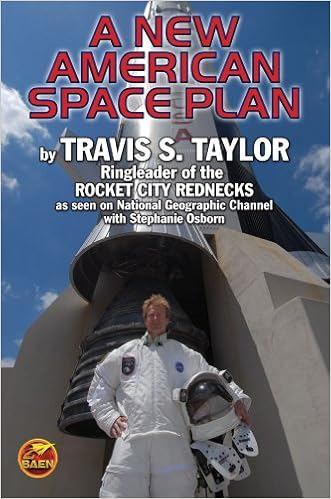
A New American Space Plan, by Travis S. Taylor with Stephanie Osborn, available in print and ebook, discusses the history of space exploration, where we are, how we got there, and where we ought to be and be going. You can find a lot more detail on the Space Shuttle, how it worked, the main engines and how the whole system was designed, right in this book. There's also a good bit about the recent efforts to develop commercial space launch systems and why the epithet "commercial" is often a misnomer.

~Stephanie Osborn
http://www.stephanie-osborn.com

Monday, August 1, 2016

A New Direction

by Stephanie Osborn
http://www.stephanie-osborn.com
1 August 2016

Effective today, I'm taking Comet Tales in a new direction.

Many of you know me as an author. Many know me as a scientist. Oddly, many do NOT know me as BOTH.

So I'm going to show y'all how it works! Starting today, Comet Tales is going to feature the latest information in solar weather, and space weather and news! Alongside that will be information on my latest book releases, and any titles of mine that pertain to the space news of the day!

I won't be posting on a completely regular basis; rather, I'll post on an as-needed basis to ensure you have the most up-to-date information I've got! That might be once a day, it might be once a week, depending on what's happening. It may be a longish post, detailing and explaining a solar event, or it may be a link to a detailed article, with a few comments. So keep up with the blog! Follow me, and you'll always know the latest going on in the space above our atmosphere!


Today's space news:


Asteroid Bennu

We've got a little time, but asteroid 101955 Bennu could cause problems in about 120 years:
http://news.sky.com/story/asteroid-strike-could-cause-immense-suffering-10519054

It's unlikely but not impossible.

Can we do anything about it? Yes.

Travis S. Taylor and I discussed that in our nonfiction book, A New American Space Plan. There are many possible ways to redirect an asteroid or comet, and we cover them all in our book. Check it out!


Sunspots/Solar Activity

Also we have yet another day with no visible sunspots. If the active sunspots that rotated off about 5 days ago have survived, they would seem to be the only spots on the solar surface. The most recent imagery from the STEREO website (which is NOT on the Solarham website, which has begun updating less and less frequently in recent weeks) indicates that they have indeed survived and are nearing the center of the solar farside disk.

Spot group 2570, which showed up to end the last no-spot run, dissipated on Saturday; another short-lived binary spot group showed up on Sunday but didn't even stay around long enough to be numbered, and now, officially August 2nd GMT/UTC, we are back to no spots.

If I count the "dinky" spots as being essentially no spots, then 30 out of the last 63 days have had little to no sunspots visible (47.6%). 22 out of 63 were unequivocally spotless (34.9%).

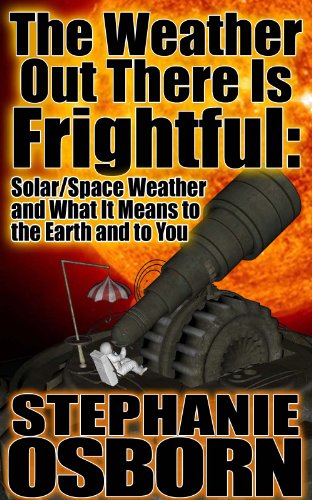
And yes, I do know a thing or two about this -- my graduate work was in spotted variable star astronomy. I have an ebook out about solar variability called The Weather Out There Is Frightful, and it talks about spots, flares, coronal mass ejections, the solar cycle, extended minima, and more. 


~Stephanie Osborn
http://www.stephanie-osborn.com

Monday, April 22, 2013

Hey there

by Stephanie Osborn
http://www.stephanie-osborn.com


April has shaped up to be a VERY busy month for me! "It's Elementary!" Month has seen me speaking at the Gathering of Southern Sherlockians at the historic Read House Hotel in downtown Chattanooga TN, where I spoke on the research I did into the Victorian era for my Displaced Detective novels, as well as a sneak peek reading of an excerpt from a new steampunk novel that's not out yet. It's also seen me the busiest panelist at 221bCon, which was described as a "paradigm shift" in Sherlockian fandom! Yet to come are a couple of talks at the Huntsville-Madison County Alabama Public Libraries. It seems that they are reading Conan Doyle's The Adventures of Sherlock Holmes this month, and want me to come in and discuss my views of Holmes and the research I did for my books as well!

In fact, I'm staying SO busy that I haven't had a chance to throw down some cool new blog posts. I'm sorry about that. I'll try to do better in future, but every blog post written is less energy/creative spur to write a chapter of a new book. No, the well isn't infinite in depth, I'm afraid. One of my best buds, Travis S. Taylor, well - I swear the man is really The Flash in disguise. I honestly don't know how he does all he does! He seems to have boundless energy. I don't. I love to write, and when the words are flowing, I will lose all track of time. I will push and push to get to the end (or rather, the middle, because I don't write in sequence, but rather like movies are filmed). But when I'm done, I'm wiped. It'll be time for a break, in order to generate enough energy to write the NEXT book. Even Travis has told me it's normal for that to happen, and he occasionally emails or texts me with word that he's letting the steam and smoke out of his computer (aka taking a break)!

So, since it IS "It's Elementary!" Month for me AND the local public libraries, next week I'll put up some Displaced Detective excerpts!

-Stephanie Osborn
http://www.stephanie-osborn.com

Monday, April 15, 2013

We Aren't The Only Ones, Part 5 and Final

by Stephanie Osborn
http://www.stephanie-osborn.com


As promised, the Chinese space failure. Excerpted from A New American Space Plan, by Travis S. Taylor and myself, from Baen Books.

It should be noted that the Chinese space program is considered a branch of their military, at least in part, and therefore is subject to much secrecy. In point of fact, it is only in recent years that there has even been a Chinese space program apart from that needed to develop ICBMs. In addition, upon the fall of the Soviet Union, much of that space agency's history came to light. We do not have this advantage in gleaning information about the Chinese space program, so this section is quite short relative to American and Russian space history.

~~~


China’s space program as such began in the late 1950s, under the auspices of their Ministry of Aerospace Industry, and Chairman Mao Tzedong. At that time it consisted mostly of work on intercontinental ballistic missiles, as we were at the height of the Cold War, and they were responding to what they considered potential threats from both the U.S. and Russia. They seemed to have no particular interest in manned space flight for several more decades.

Upon Mao’s death in 1976, Deng Xiaoping emerged as China’s leader, and canceled many missile programs and anti-missile defense programs considered important at the time. However, long range ICBM development did continue, as well as the Long March series of launch vehicles, enabling them to compete in the commercial launch industry. When the Cold War ended, Deng stepped up his commercialization of China, and moved away from the blatant use of communist revolution rhetoric in the naming of vehicles, and toward ancient Chinese religious and mystical names. This included, for example, renaming the Long March rockets “Divine Arrow.”

He split the Ministry into two parts in 1993: the China National Space Administration (CNSA), responsible for space policy and planning, and the China Aerospace Corporation (CASC), responsible for execution of the program.

Shortly thereafter, China had its first public space program disaster.

In February of 1996, the launch of the first Long March 3B heavy launch vehicle went drastically wrong. Carrying Intelsat 708, a commercial telecommunications satellite, the rocket failed almost immediately on liftoff as a result of an engineering defect, deviating drastically from its launch trajectory at the Xichang Satellite Launch Center. It crashed twenty-two seconds later and slightly more than one mile (slightly under two kilometers) from the launch facility—directly on top of a village. Xinhua, the official Chinese news agency, under government control, reported six killed and fifty-seven injured, with eighty houses destroyed. Unofficial reports, however, place the death toll at well over 500 people.

Three years after this disaster, Shenzhou 1 was successfully launched—unmanned—on the anniversary of the founding of the People’s Rebublic of China in 1999...China is a member of the UN Committee on the Peaceful Uses of Outer Space. However, its space program, despite the “corporate” designation of half of it, is entirely military-run, and in 2007 it shot down one of its own dead satellites.

~~~

So far, since the Long March disaster in 1996, the Chinese space program has been ambitious and successful. They have specified their intent to go to the Moon and to be the first humans to land on Mars. If they continue like this, they may well beat everyone in the doing; they seem to have the will and the political backing to advance, while the West is mired in political in-fighting and lack of apparent interest.

Despite our failures, I think it can safely be said that the US space program as put forth by NASA has hardly had quite so spectacular or horrific failures as have occurred elsewhere. We have not dropped any rockets on any small towns; we have never deliberately and with foreknowledge gone forward with completely inane designs. We have not wiped out a significant portion of our rocket team by requiring them to sit in the same field with the launch vehicle. Speaking as someone who has worked side by side with fellow American space flight controllers, I can honestly say that we have done the best we could do to keep our colleagues safe within reason - for space will never be completely safe. It is inherently an inimical environment, and one in which no human would live for a minute without layers of protection, whether that protection be physical, procedural, or otherwise. I have been a part of that protection, in a manner of speaking. It is a task that I strove to do to my utmost, and it is something of which I will always be proud.

-Stephanie Osborn
http://www.stephanie-osborn.com

Monday, April 8, 2013

We Aren't The Only Ones, Part 4

by Stephanie Osborn
http://www.stephanie-osborn.com

A bit more on the Soviet space program's failures, then on to China next week. Excerpted from A New American Space Plan, by Travis S. Taylor and myself, from Baen Books.

~~~


In 1971 the Soviets put up the world’s first space station, Salyut 1. Sort of like our Skylab, it was expendable and there was a whole series of these stations, military and nonmilitary. It was generally a successful program.

Except for the first flight to Salyut 1, Soyuz 11.

Soyuz 11 was the only manned mission to Salyut 1. All went nominally until it came time for reentry. At that time, the pyrotechnic bolts that were to release the service module from the reentry module fired simultaneously instead of sequentially. This in turn jolted open a breathing ventilation valve at an altitude of 104 miles (168 km) and bled the reentry vehicle’s atmosphere off into space. As it was located underneath the seats, the cosmonauts couldn’t locate and plug it fast enough to stop the loss of atmosphere. And due to the cramped conditions and the presence of 3 crew members, space suits were not worn for these early flights.

Flight recorder data later indicated the crew went into cardiac arrest within forty seconds. Within 212 seconds (less than four minutes) of the separation, the cabin pressure was zero. As a result, ground control lost communications with the crew long before the reentry comm blackout should have begun, realized that conditions were off-nominal, and began emergency preparations for the landing. The crew was found at the landing point, dead inside the cabin. Attempts were made to perform CPR by the service crew, but it was much too late.

In 1975 Soyuz 18a had the first ever manned launch abort. It’s forward momentum carriedit some thousands of miles downrange, nearly into China—which the Soviets were on particularly bad terms with at the time. It came down in the mountains again, sliding down the side of one, and nearly toppling off a cliff. This time, tangled parachutes saved the cosmonauts by snarling in the trees and preventing the sheer drop. The crew was pretty banged up.

In 1980 a Vostok rocket blew up on the launch pad. Forty-eight people died.

~~~

It should be noted that, since the dissolution of the Soviet Union, the Russian space program has, to my knowledge, not suffered a single major setback that has resulted in loss of life.

Next week as promised: The Chinese space program.

-Stephanie Osborn
http://www.stephanie-osborn.com

Monday, April 1, 2013

We Aren't The Only Ones, Part 3

by Stephanie Osborn
http://www.stephanie-osborn.com


Part 3 of this series takes us into the Russian manned program, specifically the Soyuz and the problems it experienced from the very beginning, as excerpted from A New American Space Plan, by Travis S. Taylor and myself.

~~~


Soyuz 1 was the first flight of the Soyuz spacecraft. It was also the Soviets’ first in-flight death. The craft was known to be faulty to begin with. The engineers reported over 203 design faults—not faulty equipment, not improperly installed, faulty design work, before the launch. Unfortunately, by this time Soviet leaders had caught moon fever. They wanted to beat the Americans to a manned landing, and they wanted to take advantage of the delay caused by the Apollo 1 fire. Oh, and they wanted to celebrate Vladimir Lenin's birthday with some fireworks. Big fireworks.


Vladimir Komarov was the primary, and Yuri Gagarin was his backup. The situation was so bad that Gagarin tried to get Komarov bumped from the primary position, because he knew that he was considered a national hero and therefore not expendable. He hoped to get the mission delayed until the problems could be fixed. He failed.

Soyuz 1 was launched, Komarov aboard. Its mission was to rendezvous and EVA with Soyuz 2. As soon as it got on orbit, one of the solar panels failed to unfurl, so the spacecraft was running on low power from the get-go.

The Soyuz 2 crew prepped themselves for a repair mission. Thunderstorms overnight at Baikonur fried the Soyuz electrical systems, so Soyuz 1 was on its own.

Then the “orientation detectors” (I assume this means gyroscopes or star trackers or some such, or maybe not) decided to malfunction, rendering maneuvering difficult. Then the automatic maneuvering system died entirely, and the manual system went on the fritz.

Once the maneuvering system went down, the flight director decided to abort the mission. At this point, everything looked like a happy ending.

Except this was a new ship. With new details. Like a thicker heat shield, and a correspondingly larger parachute. Remember those design flaws? Guess what? Nobody bothered to make the chute receptacle any bigger. In their brilliance, technicians used wooden mallets to beat the parachute into place.


So the drogue chute came out, but the main parachute didn’t. Simple enough: Komarov deployed the manual parachute. Which promptly tangled in the drogue chute. He hit the ground at an estimated 89 mph (140 km/hr).

The ship exploded.
 
The Soviets didn’t have too many manned firsts after that, and they never made it to the moon with a crewed lander. The same year we landed on the moon, they managed a docking and crew exchange of Soyuz 4 and 5. (The Soviets claimed that this was the world’s first space station.) Unfortunately when it came time to come home, Soyuz 5’s service module failed to separate, and the capsule with service module reentered nose first. The cosmonaut inside, Boris Volnyov, hung from his straps until the module’s struts burned through and it broke away, enabling the capsule to right itself before the hatch also burned through—the gaskets were already burning and filling the cabin with noxious fumes. But then the parachute lines tangled, and the landing retros failed, and while Volnyov walked away from that landing, he broke his teeth. He landed in—yes, you guessed it—the Ural Mountains instead of Khazakhstan, and with the temperature outside at -36°F (-38°C), he was forced to walk several kilometers to the cabin of a local.


~~~
 
-Stephanie Osborn

Monday, March 25, 2013

We Aren't The Only Ones, Part 2

by Stephanie Osborn
http://www.stephanie-osborn.com


Just by way of reminder, we've been talking about space program disasters. We started off in memoriam of the Apollo 1, Challenger, and Columbia disasters, all of whose anniversaries fall within about a 2-week timespan on the calendar. Then we went on to begin talking about the space disasters of other countries, beginning with the Nedelin disaster in Soviet Russia in 1960. Let's keep talking about the USSR space program and its problems this week.

Again, we are excerpting from A New American Space Plan by Travis S. Taylor and myself, from Baen Books.

~~~


...The Soviets suffered another setback in 1961. In a tragedy eerily similar to the Apollo 1 fire, but six years earlier, Valentin Bondarenko died in a high-oxygen (but low-pressure) environment during a training session. Yuri Gagarin kept vigil at his hospital bedside, where he died a few hours after extrication.

Shortly thereafter, aboard Vostok 1, that same Yuri Gagarin became the first human in space, completing a single full orbit of Earth. In the same year, the USSR launched Venera I to Venus, and put Gherman Titov into orbit for a full day aboard Vostok 2...In 1965, Voshkod 2 crewmen conducted the first extra-vehicular activity (EVA)—although not successfully. Their airlock was an inflatable, attached to the side of their craft, and it didn’t work quite as well as envisioned. The Voshkod was a redesign of the Vostok, and not a particularly good one. It was cramped, it contained two crewmen instead of one without expanding the volume at all, and it had no provision for emergency escape. As if that weren’t bad enough, after a little over twelve minutes of EVA, Alexei Leonov found that his spacesuit had ballooned out to a point where he had become inflexible. He simply did not have the strength to bend, even at the waist. When he attempted to reenter his vehicle, his suit became wedged and he couldn’t reach anything to free himself!

In the end he had to vent atmosphere from his suit, risking the bends, in order to get it small enough to re-enter his spacecraft and rejoin his crewman Pavel Belyayev. Then the hatch wouldn’t close
properly. Once they got that fixed, the spacecraft was so cramped that, after orienting for deorbit burn, it took them an additional forty-six seconds to navigate their inflated spacesuits back into their seats. This threw off the center of gravity during the initial stages of reentry. The automatic landing system failed, and they had to resort to manual backup— and the orbital module didn’t disconnect when it should have! They spun crazily until the module finally jettisoned at an altitude of only 62 miles (100 km).

The whole mess caused them to miss their designated landing area by a good 240 miles (386 km) in the middle of the Ural Mountains of Siberia. The location was cold, it was snow-covered, it was filled with bears and wolves—and it was the animals’ mating season, the time when said bears and wolves were in their foulest moods. The Soviet control center had no idea where they were—and the hatch’s pyro bolts had blown it off. As was common in the early days of the space program for both Soviet and American, there was a pistol and ammunition aboard, and the men were trained for that terrain, but they had little in the way of shelter save the open Voskhod capsule. Aircraft located them, but it was too heavily forested for helicopters, so the men settled down for the night in their spacesuits— after stripping and wringing perspiration out of their soaked underwear. After a frigid -22°F (-30°C) night, a rescue party on skis arrived the next morning.

Not exactly a successful mission.
...
The N-1 rocket, the Soviet counterpart to the Saturn V, began development in 1965. Unfortunately its principal architect, Sergei Korolev, by this time known only by the enigmatic title “Chief Designer,” as his very existence was a state secret, died abruptly in 1966 of medical reasons which are still debated. Cancer was certainly a factor, as was his known heart condition, but a botched operation, coupled with the inability to intubate him due to jaw damage from beatings dating from his days in the gulag, may well have contributed. This left the N-1 program leaderless. It floundered badly, and after four failed launch attempts, the program was suspended, then cancelled in 1976.
 
~~~
 
More Russian problems next week.
 
-Stephanie Osborn
 

Monday, March 18, 2013

We Aren't The Only Ones, Part 1

by Stephanie Osborn
http://www.stephanie-osborn.com


Just so you know, while NASA has had its horrible accidents, it is far from the only space program to have had them. And it IS the safest, hands down. There is nothing wrong with NASA that I have not seen in other big institutions, whether private enterprise or government agency. And while terrible, Apollo 1, Challenger, and Columbia all put together don't equal some of the space program disasters that other nations have had.

Travis S. Taylor and I wrote this book that came out in late 2012, called A New American Space Plan. It's about what we should be doing to get back on track for the stars. The reason I bring it up is because I already chronicled said disasters in it, and with the permission of Baen Books, the publisher, I'm going to excerpt Space Plan here with respect to those disasters.

First up, let's talk about the Soviet space program. Yes, I know the USSR doesn't exist any more, but the space program the Russians have is founded upon that started by the USSR. Here we go!

~~~


The Russian space program can be traced back to at least the early part of the twentieth century, when Konstantin Tsiolkovsky, a contemporary of America’s Robert Goddard, proposed the notion that space flight was possible and began developing the modern science of rocketry. This was furthered by the Group for the Study of Reactive Motion, or “GIRD,” as it worked out in Cyrillic. This group contained, among others, Sergei Korolev, who would eventually wind up becoming one of the Soviet’s premier rocket scientists. In 1933 this Soviet team launched their first liquid fueled rocket, the GIRD-09, and a few months later, the hybrid fueld GIRD-X. It seemed Soviet rocketry was off to a great start.

 
It received a grave setback during the Stalin era, however. Stalin’s Great Purge killed or imprisoned most rocket scientists of the day. It targeted the intelligentsia and professionals, among others, as presumably a threat to the Communist Party. Those who were not executed by firing squad were sent to the gulags. Many of the stories bear resemblances to atrocities being carried out at the same time but a little farther west. The only developments in the field of any significance occurred during World War II with the invention of the Katyusha multiple rocket launcher.

 
It was that “little farther west” that proved the reinvigoration of the Soviet space program, however. At the end of World War II, not all of Wernher von Braun’s team ended up in the United States. He had purposely split his team in hopes that one or the other might make it to a safe haven with the Allies. The other group ended up with the Soviets, who looked over what von Braun’s team had wrought at Peenemunde and were impressed.

 
Once in their new home in the Soviet Union, the German rocket scientists set to work helping the Soviets replicate the V-2. This Russian version was dubbed the R-1. But it was not powerful enough to carry the large, heavy nuclear warheads of the day—which was the principal Soviet concern at the time. What the Russians wanted was a true intercontinental ballistic missile. That was always the whole point of their rocket program, as it turned out.
 
Nevertheless, the dreamers still got the dregs of the military’s desire. Somehow having managed to survive internment in a gulag during the Purge, Korolev came out on top as one of the principal designers. But he had his enemies; the Soviet space program, unlike the American one, was not centralized, and there was much internal competition...In short order, the USSR began making reasonably regular launches. Oddly enough, it has in recent years been determined that Kruschev had no particular interest in the space program. It was not a high political priority, he did not desire to compete with the Americans to the moon, and he saw its only benefit as propagandistic. Nevertheless the “propagandistic” program kept bringing home world firsts. In 1959, no less than three lunar probes were launched: Luna I, II, and III. These were, respectively, a flyby, an impactor, and a single slingshot orbit around the moon that returned the first images of the lunar far side. And in 1960 they returned living dogs from Earth orbit.
 
But 1960 also saw possibly their greatest space disaster. It is commonly known as the Nedelin catastrophe after the manager who oversaw it. Some say he was cocky. Some say he ordered his subordinates into fatal position. It is likely that we will never know because there was only one survivor of this disaster.

In October 1960, a launch pad test for a prototype of the R-16 ICBM was in preparation. This test was overseen by Soviet Marshal Mitrofan Nedelin. The rocket was on the launch pad at the Baikonur Cosmodrome, and fully fueled with what they called “Devil’s Venom,” a particularly nasty hypergolic fuel system consisting of unsymmetrical dimethyhydrazine (UDMH) and nitric acid. The fuel mix is highly corrosive and toxic, but extremely powerful. However, even its exhaust is poisonous, and the nitric acid cannot be in the oxidizer tank for more than two days without eating through the tank.

It was the very nature of Devil’s Venom, it seems, that led to the disaster. Late on the day before the test, the technicians preparing the rocket accidentally breached a line from the fuel tank, allowing a small amount of fuel into the combustion chamber. This in itself was not dangerous. So rather than go through weeks of untanking, repair, rebuilding the engine, and refitting, the decision was made to move up the launch to the next day. Meanwhile Nedelin notified many military and political dignitaries of the upcoming launch, in case they wanted to watch—and who doesn’t want to watch a rocket launch?

Then on October 24th, engineers, scientists and technicians rushed to complete launch preparation, often performing tasks simultaneously rather than sequentially per checklist. The result was a delay. Nedelin, impatient and perhaps embarrassed, left the dignitaries at the observation stand and went to oversee the final preparation. Word has it he even brought a chair to sit down beside the launch pad.


For reasons unknown—or unreleased—the second stage engines fired prematurely. The flames acted as a blowtorch on the hypergolic tanks in the first stage, cutting through them. As soon as the UDMH and the nitric acid combined, as is the nature of hypergolic fuels, they self-ignited. The resulting explosion cremated everyone near the pad.


Those farther away were burned to death; those who had run away encountered the perimeter fence and were either burned or poisoned by the fumes. The entire horrific debacle was captured on film for posterity by automated cameras. Only one man survived—Mikhail Yangel, an associate (and competitor) of Korolev’s, and that only because he left the viewing area and went into a bunker to smoke a cigarette. He had been the military’s rocket engine designer and a proponent of hypergolic fuels. After this he was directed to concentrate strictly on ICBM design.
 
~~~
 
More next week.
 
-Stephanie Osborn
 

Monday, March 4, 2013

Remembrance: Columbia (Part 2)

by Stephanie Osborn


It is perhaps best if I simply let the timeline of the catastrophe speak for itself. Due to my familiarity with the subject, one of the crewmembers, and the bird itself, perhaps my readers will forgive me if I pull from the Wikipedia article on the matter [http://en.wikipedia.org/wiki/Columbia_disaster]. Having read the CAIB (Columbia Accident Investigation Board) Report in some detail, I find it to be accurate in the essentials.

~~~

The following is a timeline of Columbia's re-entry. The shuttle was scheduled to land at 9:16 a.m. EST.

2:30 a.m. EST, February 1, 2003 – The Entry Flight Control Team began duty in the Mission Control Center.

The Flight Control Team had not been working on any issues or problems related to the planned de-orbit and re-entry of Columbia. In particular, the team had indicated no concerns about the debris impact to the left wing during ascent, and treated the re-entry like any other. The team worked through the de-orbit preparation checklist and re-entry checklist procedures. Weather forecasters, with the help of pilots in the Shuttle Training Aircraft, evaluated landing-site weather conditions at the Kennedy Space Center.

8:00 – Mission Control Center Entry Flight Director LeRoy Cain polled the Mission Control room for a GO/NO-GO decision for the de-orbit burn.

All weather observations and forecasts were within guidelines set by the flight rules, and all systems were normal.

8:10 – The Capsule Communicator (CAPCOM) notified the crew that they were GO for de-orbit burn.

8:15:30 (EI-1719) – Husband and McCool executed the de-orbit burn using Columbia’s two Orbital Maneuvering System engines.

The Orbiter was upside down and tail-first over the Indian Ocean at an altitude of 175 miles (282 km) when the burn was executed. The de-orbit maneuver was performed on the 255th orbit, and the 2-minute, 38-second burn slowed the Orbiter from 17,500 miles per hour (7.8 km/s) to begin her re-entry into the atmosphere. During the de-orbit burn, the crew felt about 10% of the effects of gravity. There were no problems during the burn, after which Husband maneuvered Columbia into a right-side-up, forward-facing position, with the Orbiter's nose pitched up.

8:44:09 (EI+000) – Entry Interface (EI), arbitrarily defined as the point at which the Orbiter enters the discernible atmosphere at 400,000 feet (120 km; 76 mi), occurred over the Pacific Ocean.

As Columbia descended from outer space into the atmosphere, the heat produced by air molecules colliding with the Orbiter typically caused wing leading-edge temperatures to rise steadily, reaching an estimated 2,500 °F (1,370 °C) during the next six minutes. (As former Space Shuttle Program Manager Wayne Hale stated in a press briefing, about 90% of this heating is the result of compression of the atmospheric gas caused by the orbiter's supersonic flight, rather than the result of friction.)

Columbia at approximately 8:57. Debris is visible coming from the left wing (bottom).

8:48:39 (EI+270) – A sensor on the left wing leading edge spar showed strains higher than those seen on previous Columbia re-entries.

This was recorded only on the Modular Auxiliary Data System, which is similar in concept to a flight data recorder, and was not telemetered to ground controllers or displayed to the crew.

8:49:32 (EI+323) – Columbia executed a planned roll to the right. Speed: Mach 24.5.

Columbia began a banking turn to manage lift and therefore limit the Orbiter's rate of descent and heating.

8:50:53 (EI+404) – Columbia entered a 10-minute period of peak heating, during which the thermal stresses were at their maximum. Speed: Mach 24.1; altitude: 243,000 feet (74 km; 46 mi).

8:52:00 (EI+471) – Columbia was approximately 300 miles (480 km) west of the California coastline. The wing leading-edge temperatures usually reached 2,650 °F (1,450 °C) at this point.

8:53:26 (EI+557) – Columbia crossed the California coast west of Sacramento. Speed: Mach 23; altitude: 231,600 feet (70.6 km; 43.9 mi).

8:53:46 (EI+577) – Signs of debris being shed were sighted by people out to watch the re-entry. Speed: Mach 22.8; altitude: 230,200 feet (70.2 km; 43.6 mi).

The superheated air surrounding the Orbiter suddenly brightened, causing a streak in the Orbiter's luminescent trail that was quite noticeable in the pre-dawn skies over the West Coast. Observers witnessed another four similar events during the following 23 seconds. Dialogue on some of the amateur footage indicates the observers were aware of the abnormality of what they were filming.

8:54:24 (EI+615) – The Maintenance, Mechanical, and Crew Systems (MMACS) officer informed the Flight Director that four hydraulic sensors in the left wing were indicating "off-scale low." In Mission Control, re-entry had been proceeding normally up to this point.

"Off-scale low" is a reading that falls below the minimum capability of the sensor, and it usually indicates that the sensor has failed (stopped functioning, due to internal or external factors), rather than that the quantity it measures is actually below the sensor's minimum response value. The Entry Team continued to discuss the failed indicators.

8:54:25 (EI+616) – Columbia crossed from California into Nevada airspace. Speed: Mach 22.5; altitude: 227,400 feet (69.3 km; 43.1 mi).

Witnesses observed a bright flash at this point and 18 similar events in the next four minutes.

8:55:00 (EI+651) – Nearly 11 minutes after Columbia re-entered the atmosphere, wing leading-edge temperatures normally reached nearly 3,000 °F (1,650 °C).

8:55:32 (EI+683) – Columbia crossed from Nevada into Utah. Speed: Mach 21.8; altitude: 223,400 feet (68.1 km; 42.3 mi).

8:55:52 (EI+703) – Columbia crossed from Utah into Arizona.

8:56:30 (EI+741) – Columbia initiated a roll reversal, turning from right to left over Arizona.

8:56:45 (EI+756) – Columbia crossed from Arizona to New Mexico. Speed: Mach 20.9; altitude: 219,000 feet (67 km; 41 mi).

8:57:24 (EI+795) – Columbia passed just north of Albuquerque.

8:58:00 (EI+831) – At this point, wing leading-edge temperatures typically decreased to 2,880 °F (1,580 °C).

8:58:20 (EI+851) – Columbia crossed from New Mexico into Texas. Speed: Mach 19.5; altitude: 209,800 feet (63.9 km; 39.7 mi).

At about this time, the Orbiter shed a Thermal Protection System tile, the most westerly piece of debris that has been recovered. Searchers found the tile in a field in Littlefield, Texas, just northwest of Lubbock.

8:59:15 (EI+906) – MMACS informed the Flight Director that pressure readings had been lost on both left main landing-gear tires. The Flight Director then told the Capsule Communicator (CAPCOM) to let the crew know that Mission Control saw the messages and was evaluating the indications, and added that the Flight Control Team did not understand the crew's last transmission. [I believe that it was around this point that the pressurized landing-gear tires likely exploded from the heat. At the very least it would have torn a huge hole in the underbelly of the wing, if not outright sheared off a substantial portion thereof. Note that the next several entries occur in fractions of a second. --Osborn]

8:59:32 (EI+923) – A broken response from the mission commander was recorded: "Roger, uh, bu – [cut off in mid-word] ..." It was the last communication from the crew and the last telemetry signal received in Mission Control.

8:59:37 (EI+928) – Hydraulic pressure, which is required to move the flight control surfaces, was lost at approximately

8:59:37. At that time, the Master Alarm would have sounded for the loss of hydraulics, and the shuttle began to lose control, beginning to roll and yaw uncontrollably, and the crew would have become aware of the serious problem.

9:00:18 (EI+969) – Videos and eyewitness reports by observers on the ground in and near Dallas revealed that the Orbiter had disintegrated overhead, continuing to break up into more and smaller pieces, and leaving multiple contrails, as it continued eastward. In Mission Control, while the loss of signal was a cause for concern, there was no sign of any serious problem. Prior to orbiter breakup at 9:00:18, the Columbia cabin pressure was nominal and the crew was capable of conscious actions. The crew module remained mostly intact through the breakup, though it had lost enough structural integrity that it lost pressure, and was completely depressurized no later than 9:00:53.

9:00:57 (EI+1008) - The still intact crew module was seen breaking into small subcomponents. It disappeared from view at 9:01:10. The crew, if not already dead, were dead no later than this point. [I will take issue with this statement later. -Osborn]

9:05 – Residents of north central Texas, particularly near Tyler, reported a loud boom, a small concussion wave, smoke trails and debris in the clear skies above the counties east of Dallas.

9:12:39 (EI+1710) – After hearing of reports of the shuttle being seen to break apart, the NASA flight director declared a contingency (events leading to loss of the vehicle) and alerted search and rescue teams in the debris area. He made a call to the Ground Controller: "GC; flight, GC; flight. Lock the doors." Two minutes later Mission Control put contingency procedures into effect. Nobody was permitted to enter or leave the room, and flight controllers had to preserve all the mission data for later investigation.

~~~

The morning of the disaster was about 3 months after my husband had had emergency heart bypass surgery. It had been a grueling recovery for both of us, and I clearly recall that it was the weekend (I believe it was Saturday) and we had slept in. I got up, wandered into the den, grabbed the remote, and hit the power. The television came on to the last channel we'd watched – the Weather Channel – and even they were reporting that “...Space Shuttle Columbia is twelve minutes late exiting the re-entry comm blackout.” I knew what that meant; I worked too long on those birds – on THAT bird – not to. Twelve seconds...maybe. Twelve minutes, there was no doubt. I turned and yelled down the hall, “HONEY! Get in here! We've lost a Shuttle!”

In retrospect, probably not the wisest thing to do to a recovering heart patient.

But he survived. They didn't.

It was so very surreal for me, and still is. I worked with Columbia more than any other shuttle in the fleet. I had a friend on board her – I helped train Kalpana Chawla for her first mission, back in '97. I'd kept up with her, popping into the Astronaut Office to look for her whenever I was in Houston. We'd have a cup of coffee, sit down and catch up, laughing and chatting. But I was doing DOD work at that point, and had lost track of who was scheduled for which flights. It wasn't until my husband asked me if I'd known any of the crew that I thought to check. And I was horrified. KC had one of the widest smiles, the most cheerful demeanors, of anyone I have known, before or since. To think she went through that...it was, and is, hard for me to accept.

I'd written a book, entitled Burnout:The mystery of Space Shuttle STS-281. It was fiction, every bit of it. It was in the hands of my writing mentor, and later sometime co-author, Travis S. Taylor, to read and critique. He was going to help me polish it, then help me find a publisher. I'd researched using the information from the Challenger disaster, but decided to make it very obviously NOT that incident; I'd chosen a re-entry scenario instead. The disaster which now played out before my eyes was precisely what I'd written into the book. Travis had to talk me out of trashing it instead.

In the end, life went on for some of us. My book, and numerous more, have been published. In January 2012, I was invited to return to my undergraduate alma mater, Austin Peay State University, to help support the library and to give a talk and a book-signing. It was a messy, cold, stormy night with torrents of rain falling when I arrived at the location and began setting up. The Friends of the Library were setting up around me for a reception before the talk, when a gentleman showed up. In all honesty I cannot recall his name because what came next was very...I'm not sure the English language has the word for what I felt in those ensuing minutes.

Because he told me he had been one of the 3 field coroners for the Columbia disaster. He had come, partly to answer the questions I had about it that I'd never been able to answer, and partly to hear my perspective on it. He had copies of the autopsy reports which I was allowed to flip through – though I can't recall a word on any page. And he gave me the answer I didn't want to hear: my friend KC had been alive through the breakup – they all had. In fact, he told me, at least one crewman was found on the ground, body intact, death due to multiple blunt force traumas. He didn't say so outright, but I can interpret that – he died when he hit the ground.

A recent presentation I made on scientific and engineering work done since then included a summation of that chat. I was later gently challenged on the matter of the crew's deaths. This upset me because, unable to remember the man's name, I hadn't a way to verify his credentials. (If you're out there, mystery man, please contact me through this blog.) But today, as I refreshed my memory on the details of the catastrophe, I found a newspaper report that took its information from the final version of the CAIB report, and I quote:

The Working Group found no irregularities in its extensive review of all applicable medical records and crew health data. The Armed Forces Institute of Pathology and the Federal Bureau of Investigation conducted forensic analyses on the remains of the crew of Columbia after they were recovered. It was determined that the acceleration levels the crew module experienced prior to its catastrophic failure were not lethal. The death of the crew members was due to blunt trauma and hypoxia. The exact time of death - sometime after 9:00:19 a.m. Eastern Standard Time - cannot be determined because of the lack of direct physical or recorded evidence.” [http://www.spaceflightnow.com/columbia/report/030826crew/]

As a result of all this, some colleagues and I from SIGMA, the science fiction think tank [www.sigmaforum.org], are in process of developing a new system called SPEARED – Single Person Emergency Atmospheric Re-Entry Device. (This is the “scientific and engineering work” I mentioned earlier.) We have patents pending and hope that someday soon this new system will prevent deaths such as those aboard Columbia, and maybe even Challenger.

I'll keep you posted.


-Stephanie Osborn

Monday, December 3, 2012

Ten Interview Questions for the Next Big Thing

by Stephanie Osborn
http://www.stephanie-osborn.com


I was recently tagged as part of The Next Big Thing, a writers' blog journey, by Herika Raymer. Her blog can be found at http://herikarraymer.webs.com/apps/blog/entries/new. She, in turn, was tagged by Selah Janel, at http://selahjanel.wordpress.com/.


As per Herika, who gave it to me:

Hey there! Here are the questions for The Next Big Thing...your post will go up not this Monday, but next Monday. :)

Rules of the Next Big Thing

***Use this format for your post

***Answer the ten questions about your current WIP (work in progress)

***Tag five other writers/bloggers and add their links so we can hop over and meet them.

Well, this could keep me busy for awhile, since I have several works in progress.


Ten Interview Questions for the Next Big Thing:


1) What is the working title of your book?
Work in progress #1 is book 4 of the Cresperian Saga, and the working title is Heritage.


2) Where did the idea come from for the book?
Travis Taylor and Darrell Bain started the series, and I've inherited it, so I'm kind of following along from there as best I understand it.


3) What genre does your book fall under?
Science fiction – military science fiction, mostly.


4) Which actors would you choose to play your characters in a movie rendition?
That's a good question. I think that Robert Downey Jr. would probably do a very good job of the male lead in this book (each book has different “stars” in the same universe and events). Maybe Reese Witherspoon for the female lead. She has the right “pixie-ish” look for how I envision that character.


5) What is the one-sentence synopsis of your book?
“Earth's first contact wasn't quite what we thought.”


6) Will your book be self-published or represented by an agency?
Neither. I will deal directly with the publisher, Twilight Times Books.


7) How long did it take you to write the first draft of your manuscript?
Heh. I'm still working on it! As I “inherited” it, it's proving a bit more difficult to write than I would have expected. Finding my own footing in that world, my own ideas, and making them work within someone else's world can be hard.
 

8) What other books would you compare this story to within your genre?
Oy. These questions.
Probably some of Travis Taylor's work, since he started the series, and I'm trying to keep it in a similar vein. Also he and I have comparable writing styles.


9) Who or what inspired you to write this book?
I would say Nikola Tesla. I've been using a lot of Tesla's concepts in the series once I stepped into it.


10) What else about your book might pique the reader’s interest?
This one actually HAS Tesla in it!

* * *

Ten Interview Questions for the Next Big Thing, Take Two:


1) What is the working title of your book?
Work in progress #2 is book 5 of the Displaced Detective series, and the working title is A Case of Spontaneous Combustion. Work in progress #3 is book 6, A Little Matter of Earthquakes, and #4 is book 7, The Adventure of Shining Mountain Lodge, which is complete but being polished.


2) Where did the idea come from for the book?
You know, I really don't know where the Displaced Detective books are coming from. I get these ideas and they just sort of develop on their own. The characters are so real to me, I just have to watch how they react and then describe what I “see and hear.”


3) What genre does your book fall under?
Science fiction and mystery. A touch of action, a hint of thriller, a soupçon of romance.


4) Which actors would you choose to play your characters in a movie rendition?
Johnny Lee Miller, the Sherlock Holmes of CBS' Elementary series, looks a lot like how I envision “my” Holmes. But he'd need to clean up a bit. My Holmes is clean-shaven, neat and tidy.
To play Skye Chadwick? That's tougher. Cameron Diaz is about the right age and height, I think. I'm not sure if she's how I “see” Skye or not, but she could do the part readily enough.


5) What is the one-sentence synopsis of your book?
Let's go with series instead of book. “Sherlock Holmes meets the X-Files.”


6) Will your book be self-published or represented by an agency?
Sullivan-Maxx Literary Agency represents the Displaced Detective books.


7) How long did it take you to write the first draft of your manuscript?
Heh. I'm still working on books 5 & 6! I don't recall how long it took on book 7.
Now, if you're talking about the very first book of the series, that's different. I wrote a 215,000 rough draft in two months. A normal novel length is about 80,000-100,000 words. We ended up breaking it into two volumes, The Case of the Displaced Detective: The Arrival and The Case of the Displaced Detective: At Speed. When the plot bunny bites, I can but write.


8) What other books would you compare this story to within your genre?
That would be kind of hard. Not a lot of people blend science fiction and mystery in the way that I do. That's not to say that the two genres haven't been blended; they have and quite effectively by some of the grand masters. But none of them seem to have quite my “take” on such things. Maybe someone else could come up with a comparison, but off the top of my head, I can't.

My hope is to, using my own style, evoke a hint of Conan Doyle in the background, though. I even go to the extreme of having Holmes' dialogue and thoughts written in British English, as well as any other Brit characters, such as the MI5 lot. It gets confusing from time to time, but I have a great editor who understands and likes what I'm doing with it, and she's a huge help.


9) Who or what inspired you to write this book?
I've been a Sherlock Holmes fan since I was a kid. I started this whole series with the concept of, “What if?” What if Holmes got dragged into an alternate future and couldn't go home again? What would he do? How would he react? How far can the great detective stretch before he breaks? What sorts of things would he be interested in? So really the reader should be aware that these books are character-driven as much as plot/science-driven. I'm constantly adding things to poke around in Holmes' psyche, so don't expect to just jump into the usual action, and expect an extended denoument as Holmes and Skye [Chadwick, the co-protagonist] wind down and assimilate matters after a case.


10) What else about your book(s) might pique the reader’s interest?
Holmes has found, in Dr. Skye Chadwick, a woman who is his equal in almost every respect, and whom he can trust completely into the bargain; a woman that he can, and does, make an integral part of his life.

* * *
Ten Interview Questions for the Next Big Thing, Take 3:


1) What is your working title of your book?
Well, this one is my (counts on fingers) fifth work in progress, and it's the sequel to Burnout, tentatively titled Escape Velocity.


2) Where did the idea come from for the book?
From the realization that, after the Columbia disaster, I couldn't let the story end in Burnout, couldn't let it be a one-shot. I had to create some sort of closure.


3) What genre does your book fall under?
Science fiction and mystery, once again. I have a tendency to like combining those two genres. Strong element of suspense and thriller too. A good mystery has to have some suspense, in my opinion.


4) Which actors would you choose to play your characters in a movie rendition?
When I was originally writing it, I had in mind a whole cast of characters – Tommy Lee Jones for Crash Murphy, Hugo Weaving for Dr. Mike Anders, Sissy Spacek for Gayle, and so on. The movie project for Burnout is probably going to go with a revamp and younger actors; that's out of my hands now.


5) What is the one-sentence synopsis of your book?
“If you don't take 'em out the first time, better keep looking over your shoulder.”


6) Will your book be self-published or represented by an agency?
Neither. It's already under contract to Twilight Times Books.


7) How long did it take you to write the first draft of your manuscript?
How is it a work in progress if I've finished it...? Still working. Taking awhile, unfortunately, because of my own emotional involvement in the Columbia disaster, and the fact I worked in the space program for so many years. Please be patient; I WILL get there.


8) What other books would you compare this story to within your genre?
Well, Burnout got compared to Michael Crichton, E. E. “Doc” Smith, and Robert Heinlein. I'm not sure what to draw out of all that.


9) Who or what inspired you to write this book?
Well, like I said earlier, I wrote Burnout, and then lost a friend aboard the Columbia disaster, which Burnout predicted in detail saving that the real historical event was truly an accident, and the fictional disaster was sabotage. I had planned – up to that point – to make Burnout a standalone novel, but after the disaster I couldn't do it. I had to have, needed to have, more closure than the end of the book provided. And so I decided to keep on writing the story and see what happened.


10) What else about your book might pique the reader’s interest?
Oh, there are always surprises when I write a mystery...


I'm tagging Maria De Vivo, Leia Barrett Durham, Grady Glover, and Dellani Oakes!


-Stephanie Osborn
http://www.stephanie-osborn.com

Saturday, December 1, 2012

A New American Space Plan launches!

by Stephanie Osborn
http://www.stephanie-osborn.com


On November 27, Travis Taylor, Pete Erbach, and Rog Jones of the Rocket City Rednecks appeared on The Tonight Show with Jay Leno! Among other things they did, they promoted the new book, A New American Space Plan, by Travis S. Taylor with Stephanie Osborn!

Now, Travis is one of my best buddies. He's also my writing mentor and (obviously) occasionally co-author. We communicate one way or another not infrequently.

That sneak Travis did not EVEN tell me!

I am SO EXCITED!!!!!!!

Per one of my publishers November 29th: "Now # 4 in Aeronautics & Astronautics and # 9 in Astrophysics & Space Science. # 45 in Physics"

I checked, and found it was currently #29 in ALL of Science & Math! It had moved up to #3 in Aeronautics & Astronautics! (My old friend and colleague Homer Hickam had the #1 spot there, I'm pleased to say.)

We're still high on the lists! Travis will be appearing on Fox & Friends Monday morning about 8-ish, and will be promoting the book there too! Look for him and our book!

Folks, let's keep getting the word out! I think we have a science best-seller on our hands!

To purchase, go here!


-Stephanie Osborn
http://www.stephanie-osborn.com

Monday, November 5, 2012

General news

by Stephanie Osborn
http://www.stephanie-osborn.com


Well, Dr. Woosley has been on travel and hasn't been able to follow up on his Higgs boson guest posts, so I thought you might enjoy hearing about how the writing world is going for me lately.

It's been going pretty darn good, actually.

I mentioned in a post here that Eric Flint's wife and many of the 1632 authors were very "into" my books, and continue to be! That in itself is quite exciting. (I hope Mr. Flint likes them too!)

Travis S. Taylor (aka "Doc" Taylor, aka Ringleader of the Rocket City Rednecks) and I have a new nonfiction book being released through Baen in just a couple of days! That book is A New American Space Plan, and it's a look at the space programs of the world, where they've been, where they are, where they're going, and where our national space program ought to be aimed but ain't. It's written from the point of view of people who have worked the program (Travis and myself), in language the non-rocket-scientist can easily comprehend. That doesn't mean we don't get technical, it just means you can understand it because we didn't use a lotta technical jargon in it, we used regular words. Preliminary copies are already finding their way into some rather distinguished hands, and we have hopes that the words we wrote will be taken to heart.

Book 4 of the Displaced Detective series, The Case of the Cosmological Killer: Endings and Beginnings, should be released in ebook form through Twilight Times Books sometime in the next week also. Print versions should come out in December - JUST in time for Christmas gifts!

Recent releases through Chromosphere Press include the SF ebook, The More Things Change, and the children's fantasy, StarSong. The first is a fun little romp that will hopefully stretch your reality a little bit. The second is rather exciting for me; I've never written a book specifically for children before. It's also a first for Chromosphere Press, which heretofore has only released ebooks, because StarSong is available in print as well as ebook! The publishers and editors were pleased enough with the way it turned out that they thought it was time to strike out into print. I've already been asked about sequelae, but I think we'll wait and see.

And last but by NO MEANS least, The Fetish (a short story from the Burnout universe) has become an EPIC Award Finalist! What's that? EPIC is the Electronic Publishing Industry Coalition, and the EPIC Awards are their marks of achievement for ebooks! It's quite possibly the most prestigious international award of its kind, so much so that just becoming a Finalist is a considerable honor. The Fetish is one of only four finalists in the Short Story category. And I'm fortunate enough to have been a Finalist twice, because The Y Factor with Darrell Bain was an EPIC Award Finalist for SF Novel in 2010! (It was also an ebook best-seller when it was released!)

Sometime in the next month or two, I should be releasing another ebook short or two through Chromosphere Press, and yes, folks, I'm working as hard as I can on the 4th book in the Cresperian Saga (tentatively titled Heritage), and the sequel to Burnout (tentatively called Escape Velocity). You'll have to be patient with me on that last, though, because in the last year I've had some experiences that have sort of ripped open the emotional wound from the Columbia tragedy, and it's proving harder than I anticipated to write Escape Velocity. This past week a musician I met at this year's Con*Stellation contacted me to let me hear some songs she had written at the times of the Columbia disaster and Neil Armstrong's death. I was very deeply touched, and asked and was given permission to place a link on Burnout's webpage to the Columbia song. I hope to have this up soon; Catherine Faber, the musician, is setting up a hosting site that I can link to from my page. I cried like a baby when I heard them; I think you'll appreciate it too.

And that's more or less the state of things in my world. I'll be attending the Memphis Comic and Fantasy Con at the Hilton "soda can" (LOL!) this coming weekend, and then I believe I'm off for the holidays (except for writing, of course!), only to return at ChattaCon next January! Oh, friends, look for me at a specfic convention near you next year; the schedule looks to be hot and heavy!

-Stephanie Osborn
http://www.stephanie-osborn.com