
You
may remember that I started my career as a payload flight controller
for first Shuttle, and then Station. And that I had a friend aboard
Columbia
during her final flight. For those who have read my all-too-painfully
prescient book, Burnout:
The mystery of Space Shuttle STS-281,
you know I dedicated that book to my friend Kalpana Chawla, her
crewmates, and all those who have died in pursuit of space. "Ad
astra, per ardua." ("To the stars, through
struggle/adversity.")
We've
just passed through a period of time of which most people are
unaware. You see, all of the major space disasters that America has
experienced all occurred within a 2-3 week span on the calendar. And
interestingly, they occurred in chronological order on the calendar.
Apollo
1 Fire - January 27
Space
Shuttle Challenger
disaster - January 28
Space
Shuttle Columbia
disaster - February 1
~~~
Columbia
- What happened?
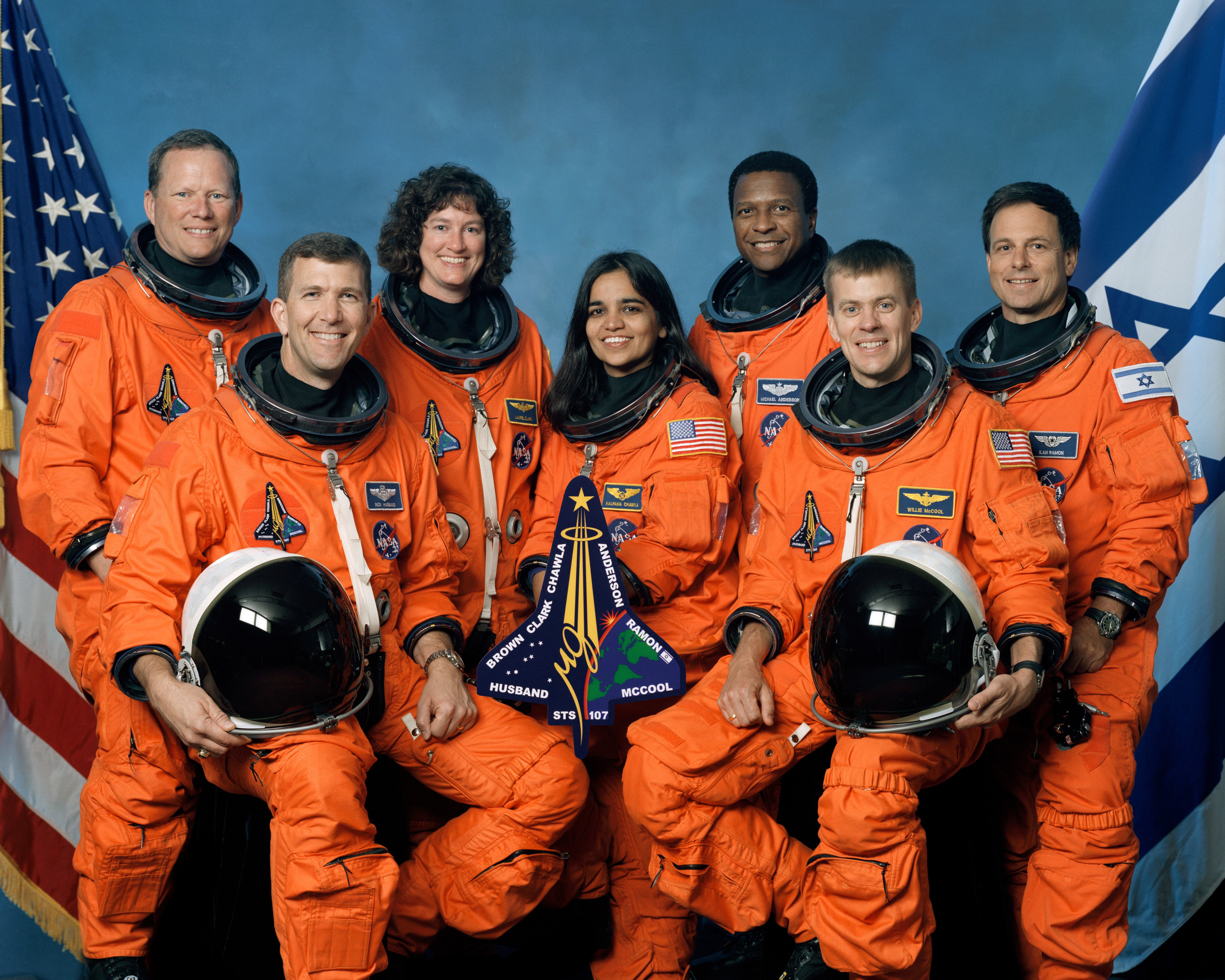
On
February 1, 2003, space shuttle Columbia
experienced a catastrophic malfunction during re-entry. This
was a result of damage sustained during lift-off 17 days earlier, on
16 January. Debris – specifically, a briefcase-sized piece of
insulating foam from the external tank (ET) penetrated the leading
edge of the port wing, and gouged
a groove the length of the wing, possibly dislodging and at least
damaging the flashing surrounding the port landing gear, and driving
part of the carbon-carbon composite heat shielding on the leading
edge into the wing’s interior.
The
combination resulted in softening the wing struts, shearing
off the wing when hydraulic pressure failed, resulting in a loss of
control.
The
resulting total loss of aerodynamic stability as well as wing loss
caused
a failure of structural integrity of the vessel, which broke apart
around the crew at ~Mach17 or higher.
Kalpana
Chawla, my friend, was a crew member.
First
of all, remember when we talked about the Challenger
disaster, how the SRBs (solid rocket boosters) had to be cast in
segments like concrete? It's sorta like that for the external tank,
too. Oh, it doesn't have to be done in segments, but it's next to
impossible not to, because the thing is so durn big. So you spray
your container for as far as it'll go, then you get another and pick
up where you left off. That still results in a kind of segmentation,
because there's a slight discontinuity in the uniformity of the foam
at the point where you stopped and switched to a fresh container. At
that discontinuity, you can get tiny cracks, you can get bubbling,
you can get ice crystal formation, especially given the ET's function
of holding cryogenic fuels. Unfortunately there's just no other way
to do it with current technology. And while it had been noticed in
several previous Shuttle missions that bits of foam would spall,
nothing serious had ever come of it.
Until
Columbia's
last voyage, of course.
So
how the blazes (pardon the rather dark pun) did a hunk of foam do
this?


The foam is largely
composed of a variety of dichlorofluoroethane. That stuff has a
density of 1.25g/cc at 20°C.
For a suitcase-sized piece, we'll assume dimensions of roughly 3in x
12in x 15in – this just happens to be the size of one of my laptop
cases, and a reasonable approximation. That translates to 7.62cm x
30.48cm x 38.10cm. This yields a volume of 8849cc. This gives a mass
for that little chunk of foam of just a smidge over 11kg (24lb and
change)! At the time it detached, the Shuttle was moving at a little
under Mach 2.5, about 840m/s or 1,870mph. Engineers estimated the
impact occurred with a closing speed of ~530mph (~883km/hr or 245m/s)
Therefore the kinetic energy of the impact was ½mv2,
which is 0.5 x 11kg x (245m/s)2,
which comes to roughly 330,000J. Put a simpler way, over a falling
distance of about one meter, that is the equivalent of about 37 tons
of force.
Not
exactly a light tap.
So,
at T + 82s, a chunk of foam fell off the left bipod foam ramp, hit
the leading edge of the wing – one of the most crucial areas, as
the only thing to take more friction heat during re-entry is the nose
– and punched a hole in it, and according to the information I had,
may also have gouged a scratch down the bottom of the wing.


During
the mission, something was observed floating away from Columbia's
underside on orbit. It is still not known for certain if this was a
piece of the reinforced carbon-carbon heat shielding, or if it was a
piece of flashing from the landing gear bay door, or something else.
Also during the mission, the ground reviewed footage of the launch,
specifically that from the camera which had become routine only 2
launches prior, to look for evidence of possible damage due to foam
spalling. Concern was raised, but NASA management refused despite
multiple requests for DOD viewing assistane from the engineers and
scientists who worked on the heat management system. In this respect,
the Columbia Accident Investigation Board (CAIB) reached the same
conclusions that the Rogers Commission reached after Challenger – a
difference in the views of management and the working engineers and
scientists. To quote Richard Feynman from the Rogers Commission, "It
appears that there are enormous differences of opinion as to the
probability of a failure with loss of vehicle and of human life. The
estimates range from roughly 1 in 100 to 1 in 100,000. The higher
figures come from the working engineers, and the very low figures
from management. What are the causes and consequences of this lack of
agreement? … we could properly ask, 'What is the cause of
management's fantastic faith in the machinery?'"
But
that is precisely what happened. Per the blog of Wayne Hale, one of
the Flight Directors on that mission, JSC's Director of Mission
Operations, John Harpold, told him, “You know, there is nothing we
can do about damage to the TPS. If it has been damaged it’s
probably better not to know. I think the crew would rather not know.
Don’t you think it would be better for them to have a happy
successful flight and die unexpectedly during entry than to stay on
orbit, knowing that there was nothing to be done, until the air ran
out?”
[http://waynehale.wordpress.com/2013/01/13/after-ten-years-working-on-the-wrong-problem/]
Unfortunately,
according to Hale, the Astronaut Office agreed. Everyone in charge
agreed. And so nothing was done, no attempt was even made to find out
if there was anything seriously wrong.
At
the point in time when management decided to let the crew fly blind,
the end game was set.
Next
week we'll chronicle Columbia's final moments.
-Stephanie
Osborn


