Banner

Banner
Showing posts with label space shuttle. Show all posts

Tuesday, August 16, 2016

An Op-Ed Guest Post

Today, please welcome my old NASA colleague, Larry Bauer. Currently retired, he and I worked numerous Shuttle missions together as payload flight controllers.
~Stephanie Osborn
http://www.stephanie-osborn.com


* * *


A Few Observations on Reusable Space Hardware,
or Why the Space Shuttle was an engineering masterpiece and a logistical nightmare.
by Larry Bauer

The National Space Transportation System, or what people commonly refer to as the Space Shuttle, was composed of four parts: the Shuttle itself, the three Shuttle main engines, the External Tank, and two Solid Rocket Boosters. In theory everything but the tank and its fuel were recoverable.

I was reminded of this when I saw an article noting the sixth successful landing of a SpaceX Falcon 9 rocket after the successful launch of the JCSAT-16 commercial communications satellite.


From a purely economical aspect it all comes down to what is the cheapest means to launch a payload into a desired orbit. On the face of it reusing hardware only makes sense. However there are a good many factors that mitigate against such as assumption.

With NSTS we salvaged everything except the ET. The Shuttle and engines landed and the SRB shells parachuted back into the sea for recovery. In theory maximum reuse of critical hardware. But let's look first at those boosters. They were made in sections far from the launch site, built and filled in sections so they could be transported by barge to Kennedy Space Center. From a logistics standpoint it would have made much more sense to build them as a single tube and fill them with solid propellant right there at the launch site. However that was not an option. The state of Florida would allow launches from KSC, but they refused permission to build the SRBs there. The solid propellant is nasty stuff and the process of filling the boosters violated too many state pollution restrictions. So the SRBs were built and filled originally by Thiokol of Brigham City, Utah, later bought out by ATK.

I will note that the recovery and remanufacture of the boosters was very cost- and labor-intensive, and there was always a debate over whether a cheaper throw-away design might have been more cost effective. I will also point out that a design incorporating a single continuous tube would have made the failure that caused the Challenger disaster impossible. Which does not mean something equally tragic might not have happened, but you cannot have a joint failure if there are no joints.


The high-performance Space Shuttle Main Engines, known as SSMEs or the Aerojet Rocketdyne RS-25, are an example where reuse of hardware only makes good sense. These are the pinnacle of the state of the art for liquid fuel rocket engines. With the help of the solid boosters, these engines, sucking immense quantities of liquid hydrogen and oxygen from the External Tank, could lift a combined vehicle and payload weight of roughly 2060 tons. Bringing these highly intricate and fine-tuned engines back for reuse only made sense.


And that does lead me to the subject of a rather controversial opinion of mine. As magnificent an engineering achievement as the NSTS was — and I spent the majority of my career at NASA doing ground support to on-orbit experiment operations so I have a great fondness for the beastie — the reason why it was a huge logistics failure rests in the numbers. The shuttle itself weighed in at 2030 tons. Its payload was 30 tons. The NSTS was a true heavy lift rocket, but most of what should have been useful payload mass to orbit was spent instead on creating the ability to land sort of like an airplane. A requirement imposed, by the way, by the Air Force — who withdrew from the project between the time the design was firmed up and the first launch. I will also observe that every astronaut pilot I've ever spoken with all described the shuttle as “that flying brick.” [I can confirm that astronaut description. —Steph]


And all of the above is explanation as to why we don't see any shuttle-like designs these days. It is ever so much more efficient to make as much of the upmass be useful payload as possible, with the crew compartment just sufficiently robust to carry the astronauts up and get them back to Earth safely.

* * *

Thanks much for that information, Larry! It squares pretty nicely with what I know of the various programs, as well.

BOOK RECOMMENDATION:

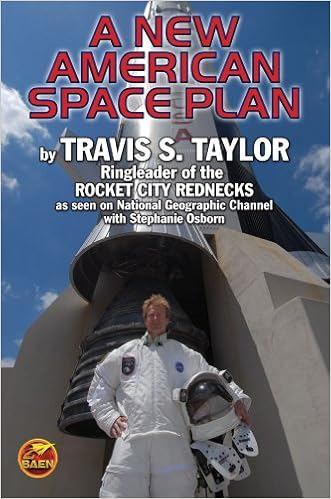
A New American Space Plan, by Travis S. Taylor with Stephanie Osborn, available in print and ebook, discusses the history of space exploration, where we are, how we got there, and where we ought to be and be going. You can find a lot more detail on the Space Shuttle, how it worked, the main engines and how the whole system was designed, right in this book. There's also a good bit about the recent efforts to develop commercial space launch systems and why the epithet "commercial" is often a misnomer.

~Stephanie Osborn
http://www.stephanie-osborn.com

Monday, November 10, 2014

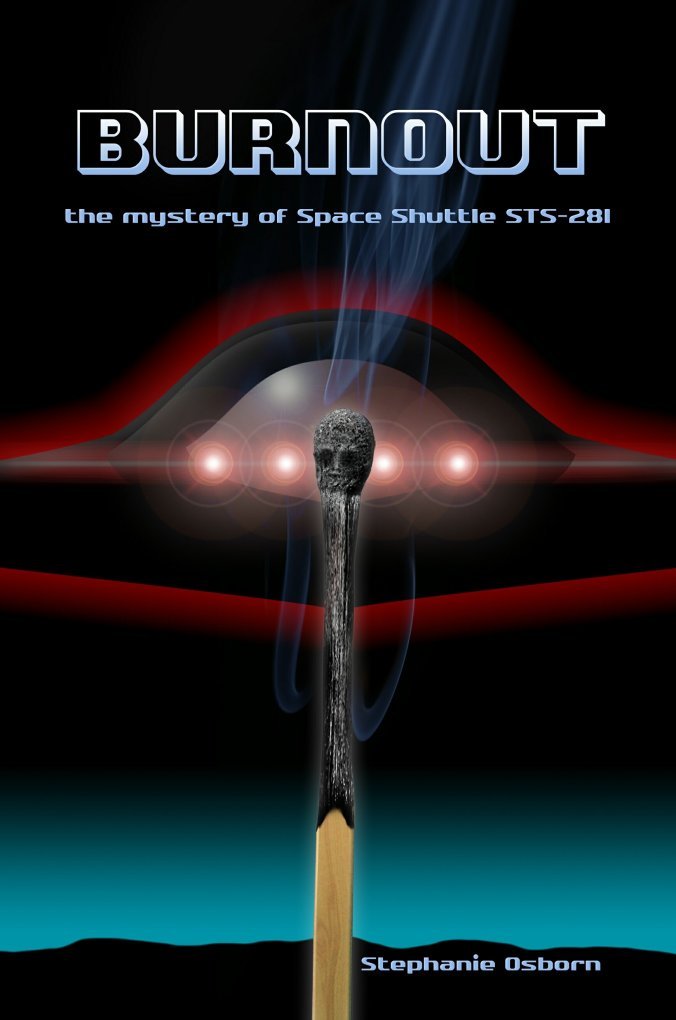
Interlude: Burnout: The mystery of Space Shuttle STS-281, by Stephanie Osborn

by Stephanie Osborn
http://www.stephanie-osborn.com

How do you react when you discover that the next Shuttle disaster has happened...
...right on schedule?

Burnout is a science fiction mystery about a Space Shuttle disaster that turns out to be no accident. As the true scope of the disaster is gradually uncovered by the principal investigators, "Crash" Murphy and Dr. Mike Anders, they find themselves running for their lives, as lovers, friends and coworkers involved in the investigation perish around them. What happened to the Shuttle? Who is responsible and why? Why is the government calling it an accident? Why is someone willing to kill to keep it a secret? And how big is the conspiracy?

They say, "Write what you know," and I did. I finished the first draft and gave it to my writing mentor, Travis S. Taylor...and then Columbia went down. And I found that I pretty much nailed it in my fictional disaster scenario: orbital inclination, incoming trajectory, overflown states, intended approach to the Cape, region of breakup, debris field, I nailed it all. The only difference was a slight extension of the debris field into the Gulf of Mexico off the Texas coast, and this was due to the fact that my fictional scenario was no accident.

And right now, Burnout is on sale in all ebook formats! More, if you buy the print book at Amazon, for a limited time you can get the ebook too, for only $0.99! 

Why is this happening, you may ask? Simple. The December issue of Analog magazine, on store shelves right now, carries an article I co-authored with my partners, detailing our SPEARED concept and materials research -- a concept that was inspired by the Columbia disaster, killing a friend of mine aboard her, and my having just completed the Burnout rough draft when the disaster occurred. 

So in honor of my friend Kalpana Chawla, and SPEARED, which I hope will prevent anyone else from dying like she did, Burnout is on sale until the end of November.

Here. Have a "taste."

~~~


...Overhead, the sky was a deep, rich, star-spangled Prussian blue; along the western horizon could be seen the faintest hint of deep teal. “Lessee…” he glanced at the TV, to the ground track Mission Control was displaying on the big front screen, then looked at the night sky, trying to correlate the two. “She oughta show up… somewhere over in there.” He waved a hand heavenward, in a vaguely northwestern direction.

Conversation in the back yard of the ranch house ceased as everyone clustered together in the darkness, searching the west-northwestern sky. The only artificial illumination came from the TV screen, and the NASA Public Affairs Office Commentator could be heard in the background as he delivered general remarks about the landing.

“…and this is a somewhat unusual re-entry pattern over North America, due to the successful efforts to retrieve the multi-million-dollar Next Generation Tethered Satellite, dubbed NexGen or NTS, which was co-manifested on STS-281 with the Mission to Planet Earth payload, Gaia-1. This nighttime landing will make for spectacular observations by residents of California, Nevada, southern Utah, Arizona, New Mexico, and Texas. Coastal residents of the Gulf States may also be able to observe…”

“Hey, big brother,” Jimmy remarked curiously, “isn’t the commander of this flight an old friend of yours?”

“Yup,” Crash replied, still scanning the star-strewn, blue-black sky. “Lawrence Jackson. Jet. He and I flew in the same squadron in ‘Nam. Been buddies ever since. There’s almost nothing we wouldn’t do for each other—except give up a slot in the astronaut corps.” Crash pulled a wry face.

“Yeah, that’s right,” Ham Carter remembered. “He beat you out for the slot, didn’t he?”

“Uh-huh, he did—only because Jackson comes before Murphy in the alphabet.”

“Look! There it is!” Sally exclaimed, pointing into the western sky, and all but jumping up and down. “Crash! Isn’t that it?” she urged her brother-in-law.

“Yeah, Sally, I—” Crash did a double take and surveyed the blazing spark as it shot through the black velvet sky, then gave a swift glance at Hamilton Carter. “Ham, have they got a re-entry DTO on this flight?”

“No, Crash—I see it, too,” Ham acknowledged, forehead creasing with worry. “Listen… can I use—”

“Cell phone right here,” Crash scooped the instrument off the corner of the picnic table and shoved it into Carter’s hands as he looked back up. “Damn, Jet, get it in gear, old buddy!” he exclaimed with increasing concern.

“What’s wrong, Crash? What’s happening?” Jimmy asked his suddenly worried brother, as the flaming speck, growing larger and larger, flew almost straight overhead. Smaller sparks could now be seen peeling off the main object.

“Dammit! Jet, flare out, man! Shit! Break it out! NOW!!” Crash began shouting into the sky. Tracy, the “fourth team” relief FAO, was frozen, staring upward in shock, and Ham stood stiffly, head tilted back, listening to the cell phone he held to his ear. They all watched dumbly as the white-hot streak shot by overhead and disappeared behind the house, trailing flaming sparks in its wake.

Crash ran around the house to the front, trying to keep the airborne conflagration in view, and the others followed. “Damn, Jimmy, she’s comin’ in hot,” he belatedly answered his little brother. “Jet’s not bleeding off velocity in the roll reversals like he’s supposed to…” Crash paused, horrified. “Not that it looks like it would do much good, anyway…”

The gathered celebrants watched in stunned disbelief as the fireball plunged toward the southeastern horizon, flickered, and burned out.

~~~

Interested? Have a go at it on Amazon, then! (Here's Barnes-Noble and Books-A-Million too, if you'd rather.) Remember, I spent over two decades working in the civilian (NASA) and military (DoD) space programs, and put my knowledge to good use in this book. 

Happy Holidays!

-Stephanie Osborn
http://www.stephanie-osborn.com

Monday, March 4, 2013

Remembrance: Columbia (Part 2)

by Stephanie Osborn


It is perhaps best if I simply let the timeline of the catastrophe speak for itself. Due to my familiarity with the subject, one of the crewmembers, and the bird itself, perhaps my readers will forgive me if I pull from the Wikipedia article on the matter [http://en.wikipedia.org/wiki/Columbia_disaster]. Having read the CAIB (Columbia Accident Investigation Board) Report in some detail, I find it to be accurate in the essentials.

~~~

The following is a timeline of Columbia's re-entry. The shuttle was scheduled to land at 9:16 a.m. EST.

2:30 a.m. EST, February 1, 2003 – The Entry Flight Control Team began duty in the Mission Control Center.

The Flight Control Team had not been working on any issues or problems related to the planned de-orbit and re-entry of Columbia. In particular, the team had indicated no concerns about the debris impact to the left wing during ascent, and treated the re-entry like any other. The team worked through the de-orbit preparation checklist and re-entry checklist procedures. Weather forecasters, with the help of pilots in the Shuttle Training Aircraft, evaluated landing-site weather conditions at the Kennedy Space Center.

8:00 – Mission Control Center Entry Flight Director LeRoy Cain polled the Mission Control room for a GO/NO-GO decision for the de-orbit burn.

All weather observations and forecasts were within guidelines set by the flight rules, and all systems were normal.

8:10 – The Capsule Communicator (CAPCOM) notified the crew that they were GO for de-orbit burn.

8:15:30 (EI-1719) – Husband and McCool executed the de-orbit burn using Columbia’s two Orbital Maneuvering System engines.

The Orbiter was upside down and tail-first over the Indian Ocean at an altitude of 175 miles (282 km) when the burn was executed. The de-orbit maneuver was performed on the 255th orbit, and the 2-minute, 38-second burn slowed the Orbiter from 17,500 miles per hour (7.8 km/s) to begin her re-entry into the atmosphere. During the de-orbit burn, the crew felt about 10% of the effects of gravity. There were no problems during the burn, after which Husband maneuvered Columbia into a right-side-up, forward-facing position, with the Orbiter's nose pitched up.

8:44:09 (EI+000) – Entry Interface (EI), arbitrarily defined as the point at which the Orbiter enters the discernible atmosphere at 400,000 feet (120 km; 76 mi), occurred over the Pacific Ocean.

As Columbia descended from outer space into the atmosphere, the heat produced by air molecules colliding with the Orbiter typically caused wing leading-edge temperatures to rise steadily, reaching an estimated 2,500 °F (1,370 °C) during the next six minutes. (As former Space Shuttle Program Manager Wayne Hale stated in a press briefing, about 90% of this heating is the result of compression of the atmospheric gas caused by the orbiter's supersonic flight, rather than the result of friction.)

Columbia at approximately 8:57. Debris is visible coming from the left wing (bottom).

8:48:39 (EI+270) – A sensor on the left wing leading edge spar showed strains higher than those seen on previous Columbia re-entries.

This was recorded only on the Modular Auxiliary Data System, which is similar in concept to a flight data recorder, and was not telemetered to ground controllers or displayed to the crew.

8:49:32 (EI+323) – Columbia executed a planned roll to the right. Speed: Mach 24.5.

Columbia began a banking turn to manage lift and therefore limit the Orbiter's rate of descent and heating.

8:50:53 (EI+404) – Columbia entered a 10-minute period of peak heating, during which the thermal stresses were at their maximum. Speed: Mach 24.1; altitude: 243,000 feet (74 km; 46 mi).

8:52:00 (EI+471) – Columbia was approximately 300 miles (480 km) west of the California coastline. The wing leading-edge temperatures usually reached 2,650 °F (1,450 °C) at this point.

8:53:26 (EI+557) – Columbia crossed the California coast west of Sacramento. Speed: Mach 23; altitude: 231,600 feet (70.6 km; 43.9 mi).

8:53:46 (EI+577) – Signs of debris being shed were sighted by people out to watch the re-entry. Speed: Mach 22.8; altitude: 230,200 feet (70.2 km; 43.6 mi).

The superheated air surrounding the Orbiter suddenly brightened, causing a streak in the Orbiter's luminescent trail that was quite noticeable in the pre-dawn skies over the West Coast. Observers witnessed another four similar events during the following 23 seconds. Dialogue on some of the amateur footage indicates the observers were aware of the abnormality of what they were filming.

8:54:24 (EI+615) – The Maintenance, Mechanical, and Crew Systems (MMACS) officer informed the Flight Director that four hydraulic sensors in the left wing were indicating "off-scale low." In Mission Control, re-entry had been proceeding normally up to this point.

"Off-scale low" is a reading that falls below the minimum capability of the sensor, and it usually indicates that the sensor has failed (stopped functioning, due to internal or external factors), rather than that the quantity it measures is actually below the sensor's minimum response value. The Entry Team continued to discuss the failed indicators.

8:54:25 (EI+616) – Columbia crossed from California into Nevada airspace. Speed: Mach 22.5; altitude: 227,400 feet (69.3 km; 43.1 mi).

Witnesses observed a bright flash at this point and 18 similar events in the next four minutes.

8:55:00 (EI+651) – Nearly 11 minutes after Columbia re-entered the atmosphere, wing leading-edge temperatures normally reached nearly 3,000 °F (1,650 °C).

8:55:32 (EI+683) – Columbia crossed from Nevada into Utah. Speed: Mach 21.8; altitude: 223,400 feet (68.1 km; 42.3 mi).

8:55:52 (EI+703) – Columbia crossed from Utah into Arizona.

8:56:30 (EI+741) – Columbia initiated a roll reversal, turning from right to left over Arizona.

8:56:45 (EI+756) – Columbia crossed from Arizona to New Mexico. Speed: Mach 20.9; altitude: 219,000 feet (67 km; 41 mi).

8:57:24 (EI+795) – Columbia passed just north of Albuquerque.

8:58:00 (EI+831) – At this point, wing leading-edge temperatures typically decreased to 2,880 °F (1,580 °C).

8:58:20 (EI+851) – Columbia crossed from New Mexico into Texas. Speed: Mach 19.5; altitude: 209,800 feet (63.9 km; 39.7 mi).

At about this time, the Orbiter shed a Thermal Protection System tile, the most westerly piece of debris that has been recovered. Searchers found the tile in a field in Littlefield, Texas, just northwest of Lubbock.

8:59:15 (EI+906) – MMACS informed the Flight Director that pressure readings had been lost on both left main landing-gear tires. The Flight Director then told the Capsule Communicator (CAPCOM) to let the crew know that Mission Control saw the messages and was evaluating the indications, and added that the Flight Control Team did not understand the crew's last transmission. [I believe that it was around this point that the pressurized landing-gear tires likely exploded from the heat. At the very least it would have torn a huge hole in the underbelly of the wing, if not outright sheared off a substantial portion thereof. Note that the next several entries occur in fractions of a second. --Osborn]

8:59:32 (EI+923) – A broken response from the mission commander was recorded: "Roger, uh, bu – [cut off in mid-word] ..." It was the last communication from the crew and the last telemetry signal received in Mission Control.

8:59:37 (EI+928) – Hydraulic pressure, which is required to move the flight control surfaces, was lost at approximately

8:59:37. At that time, the Master Alarm would have sounded for the loss of hydraulics, and the shuttle began to lose control, beginning to roll and yaw uncontrollably, and the crew would have become aware of the serious problem.

9:00:18 (EI+969) – Videos and eyewitness reports by observers on the ground in and near Dallas revealed that the Orbiter had disintegrated overhead, continuing to break up into more and smaller pieces, and leaving multiple contrails, as it continued eastward. In Mission Control, while the loss of signal was a cause for concern, there was no sign of any serious problem. Prior to orbiter breakup at 9:00:18, the Columbia cabin pressure was nominal and the crew was capable of conscious actions. The crew module remained mostly intact through the breakup, though it had lost enough structural integrity that it lost pressure, and was completely depressurized no later than 9:00:53.

9:00:57 (EI+1008) - The still intact crew module was seen breaking into small subcomponents. It disappeared from view at 9:01:10. The crew, if not already dead, were dead no later than this point. [I will take issue with this statement later. -Osborn]

9:05 – Residents of north central Texas, particularly near Tyler, reported a loud boom, a small concussion wave, smoke trails and debris in the clear skies above the counties east of Dallas.

9:12:39 (EI+1710) – After hearing of reports of the shuttle being seen to break apart, the NASA flight director declared a contingency (events leading to loss of the vehicle) and alerted search and rescue teams in the debris area. He made a call to the Ground Controller: "GC; flight, GC; flight. Lock the doors." Two minutes later Mission Control put contingency procedures into effect. Nobody was permitted to enter or leave the room, and flight controllers had to preserve all the mission data for later investigation.

~~~

The morning of the disaster was about 3 months after my husband had had emergency heart bypass surgery. It had been a grueling recovery for both of us, and I clearly recall that it was the weekend (I believe it was Saturday) and we had slept in. I got up, wandered into the den, grabbed the remote, and hit the power. The television came on to the last channel we'd watched – the Weather Channel – and even they were reporting that “...Space Shuttle Columbia is twelve minutes late exiting the re-entry comm blackout.” I knew what that meant; I worked too long on those birds – on THAT bird – not to. Twelve seconds...maybe. Twelve minutes, there was no doubt. I turned and yelled down the hall, “HONEY! Get in here! We've lost a Shuttle!”

In retrospect, probably not the wisest thing to do to a recovering heart patient.

But he survived. They didn't.

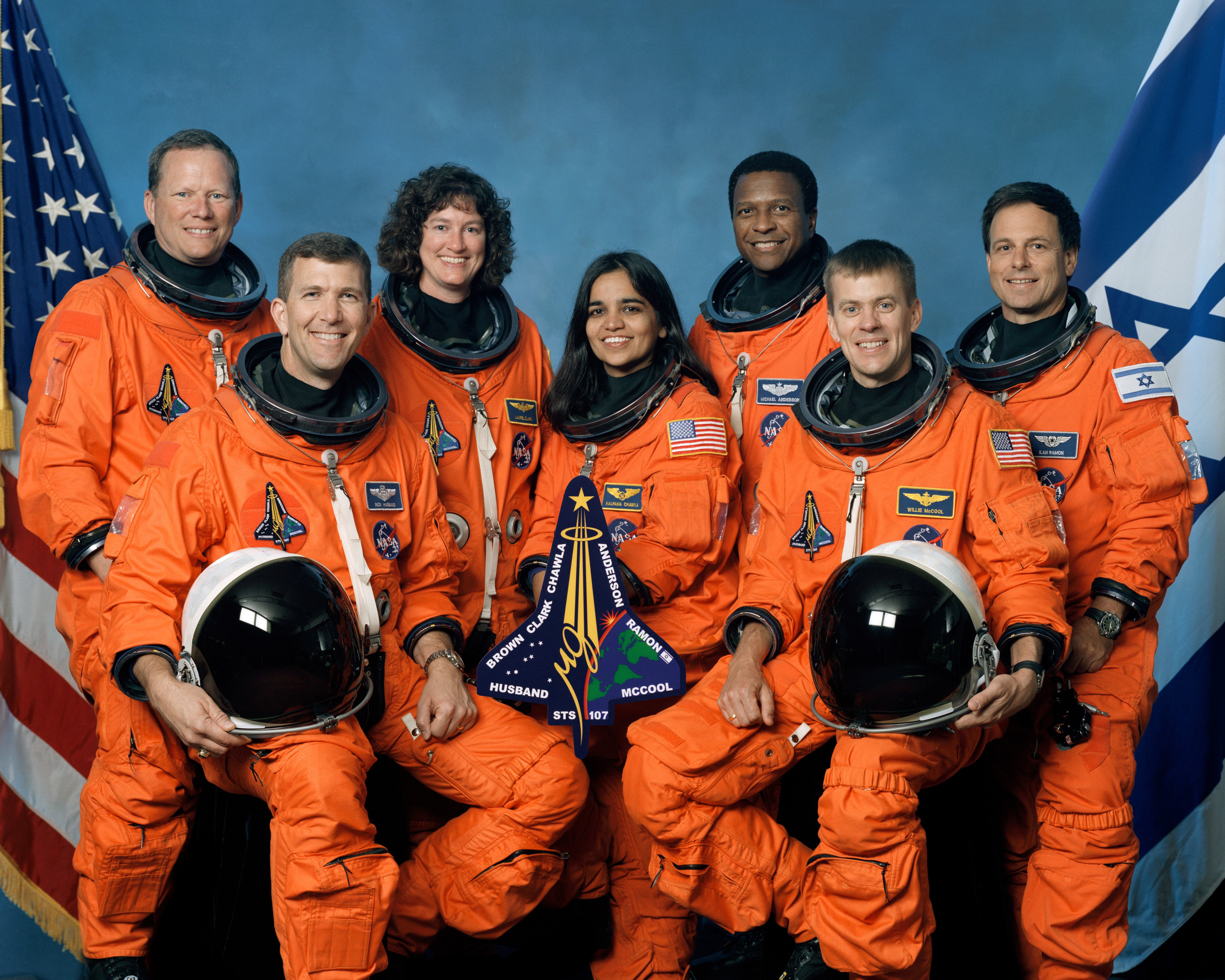
It was so very surreal for me, and still is. I worked with Columbia more than any other shuttle in the fleet. I had a friend on board her – I helped train Kalpana Chawla for her first mission, back in '97. I'd kept up with her, popping into the Astronaut Office to look for her whenever I was in Houston. We'd have a cup of coffee, sit down and catch up, laughing and chatting. But I was doing DOD work at that point, and had lost track of who was scheduled for which flights. It wasn't until my husband asked me if I'd known any of the crew that I thought to check. And I was horrified. KC had one of the widest smiles, the most cheerful demeanors, of anyone I have known, before or since. To think she went through that...it was, and is, hard for me to accept.

I'd written a book, entitled Burnout:The mystery of Space Shuttle STS-281. It was fiction, every bit of it. It was in the hands of my writing mentor, and later sometime co-author, Travis S. Taylor, to read and critique. He was going to help me polish it, then help me find a publisher. I'd researched using the information from the Challenger disaster, but decided to make it very obviously NOT that incident; I'd chosen a re-entry scenario instead. The disaster which now played out before my eyes was precisely what I'd written into the book. Travis had to talk me out of trashing it instead.

In the end, life went on for some of us. My book, and numerous more, have been published. In January 2012, I was invited to return to my undergraduate alma mater, Austin Peay State University, to help support the library and to give a talk and a book-signing. It was a messy, cold, stormy night with torrents of rain falling when I arrived at the location and began setting up. The Friends of the Library were setting up around me for a reception before the talk, when a gentleman showed up. In all honesty I cannot recall his name because what came next was very...I'm not sure the English language has the word for what I felt in those ensuing minutes.

Because he told me he had been one of the 3 field coroners for the Columbia disaster. He had come, partly to answer the questions I had about it that I'd never been able to answer, and partly to hear my perspective on it. He had copies of the autopsy reports which I was allowed to flip through – though I can't recall a word on any page. And he gave me the answer I didn't want to hear: my friend KC had been alive through the breakup – they all had. In fact, he told me, at least one crewman was found on the ground, body intact, death due to multiple blunt force traumas. He didn't say so outright, but I can interpret that – he died when he hit the ground.

A recent presentation I made on scientific and engineering work done since then included a summation of that chat. I was later gently challenged on the matter of the crew's deaths. This upset me because, unable to remember the man's name, I hadn't a way to verify his credentials. (If you're out there, mystery man, please contact me through this blog.) But today, as I refreshed my memory on the details of the catastrophe, I found a newspaper report that took its information from the final version of the CAIB report, and I quote:

The Working Group found no irregularities in its extensive review of all applicable medical records and crew health data. The Armed Forces Institute of Pathology and the Federal Bureau of Investigation conducted forensic analyses on the remains of the crew of Columbia after they were recovered. It was determined that the acceleration levels the crew module experienced prior to its catastrophic failure were not lethal. The death of the crew members was due to blunt trauma and hypoxia. The exact time of death - sometime after 9:00:19 a.m. Eastern Standard Time - cannot be determined because of the lack of direct physical or recorded evidence.” [http://www.spaceflightnow.com/columbia/report/030826crew/]

As a result of all this, some colleagues and I from SIGMA, the science fiction think tank [www.sigmaforum.org], are in process of developing a new system called SPEARED – Single Person Emergency Atmospheric Re-Entry Device. (This is the “scientific and engineering work” I mentioned earlier.) We have patents pending and hope that someday soon this new system will prevent deaths such as those aboard Columbia, and maybe even Challenger.

I'll keep you posted.


-Stephanie Osborn

Monday, February 25, 2013

Remembrance: Columbia (Part 1)

by Stephanie Osborn


You may remember that I started my career as a payload flight controller for first Shuttle, and then Station. And that I had a friend aboard Columbia during her final flight. For those who have read my all-too-painfully prescient book, Burnout: The mystery of Space Shuttle STS-281, you know I dedicated that book to my friend Kalpana Chawla, her crewmates, and all those who have died in pursuit of space. "Ad astra, per ardua." ("To the stars, through struggle/adversity.")

We've just passed through a period of time of which most people are unaware. You see, all of the major space disasters that America has experienced all occurred within a 2-3 week span on the calendar. And interestingly, they occurred in chronological order on the calendar.


Apollo 1 Fire - January 27

Space Shuttle Challenger disaster - January 28

Space Shuttle Columbia disaster - February 1


~~~

Columbia - What happened?


On February 1, 2003, space shuttle Columbia experienced a catastrophic malfunction during re-entry. This was a result of damage sustained during lift-off 17 days earlier, on 16 January. Debris – specifically, a briefcase-sized piece of insulating foam from the external tank (ET) penetrated the leading edge of the port wing, and gouged a groove the length of the wing, possibly dislodging and at least damaging the flashing surrounding the port landing gear, and driving part of the carbon-carbon composite heat shielding on the leading edge into the wing’s interior.

The combination resulted in softening the wing struts, shearing off the wing when hydraulic pressure failed, resulting in a loss of control.

The resulting total loss of aerodynamic stability as well as wing loss caused a failure of structural integrity of the vessel, which broke apart around the crew at ~Mach17 or higher.

Kalpana Chawla, my friend, was a crew member.

But why did all this happen? Why did the foam turn loose? How could FOAM damage the wing?

First of all, remember when we talked about the Challenger disaster, how the SRBs (solid rocket boosters) had to be cast in segments like concrete? It's sorta like that for the external tank, too. Oh, it doesn't have to be done in segments, but it's next to impossible not to, because the thing is so durn big. So you spray your container for as far as it'll go, then you get another and pick up where you left off. That still results in a kind of segmentation, because there's a slight discontinuity in the uniformity of the foam at the point where you stopped and switched to a fresh container. At that discontinuity, you can get tiny cracks, you can get bubbling, you can get ice crystal formation, especially given the ET's function of holding cryogenic fuels. Unfortunately there's just no other way to do it with current technology. And while it had been noticed in several previous Shuttle missions that bits of foam would spall, nothing serious had ever come of it.

Until Columbia's last voyage, of course.

So how the blazes (pardon the rather dark pun) did a hunk of foam do this?


The foam is largely composed of a variety of dichlorofluoroethane. That stuff has a density of 1.25g/cc at 20°C. For a suitcase-sized piece, we'll assume dimensions of roughly 3in x 12in x 15in – this just happens to be the size of one of my laptop cases, and a reasonable approximation. That translates to 7.62cm x 30.48cm x 38.10cm. This yields a volume of 8849cc. This gives a mass for that little chunk of foam of just a smidge over 11kg (24lb and change)! At the time it detached, the Shuttle was moving at a little under Mach 2.5, about 840m/s or 1,870mph. Engineers estimated the impact occurred with a closing speed of ~530mph (~883km/hr or 245m/s) Therefore the kinetic energy of the impact was ½mv2, which is 0.5 x 11kg x (245m/s)2, which comes to roughly 330,000J. Put a simpler way, over a falling distance of about one meter, that is the equivalent of about 37 tons of force.

Not exactly a light tap.

So, at T + 82s, a chunk of foam fell off the left bipod foam ramp, hit the leading edge of the wing – one of the most crucial areas, as the only thing to take more friction heat during re-entry is the nose – and punched a hole in it, and according to the information I had, may also have gouged a scratch down the bottom of the wing.


During the mission, something was observed floating away from Columbia's underside on orbit. It is still not known for certain if this was a piece of the reinforced carbon-carbon heat shielding, or if it was a piece of flashing from the landing gear bay door, or something else. Also during the mission, the ground reviewed footage of the launch, specifically that from the camera which had become routine only 2 launches prior, to look for evidence of possible damage due to foam spalling. Concern was raised, but NASA management refused despite multiple requests for DOD viewing assistane from the engineers and scientists who worked on the heat management system. In this respect, the Columbia Accident Investigation Board (CAIB) reached the same conclusions that the Rogers Commission reached after Challenger – a difference in the views of management and the working engineers and scientists. To quote Richard Feynman from the Rogers Commission, "It appears that there are enormous differences of opinion as to the probability of a failure with loss of vehicle and of human life. The estimates range from roughly 1 in 100 to 1 in 100,000. The higher figures come from the working engineers, and the very low figures from management. What are the causes and consequences of this lack of agreement? … we could properly ask, 'What is the cause of management's fantastic faith in the machinery?'"

But that is precisely what happened. Per the blog of Wayne Hale, one of the Flight Directors on that mission, JSC's Director of Mission Operations, John Harpold, told him, “You know, there is nothing we can do about damage to the TPS. If it has been damaged it’s probably better not to know. I think the crew would rather not know. Don’t you think it would be better for them to have a happy successful flight and die unexpectedly during entry than to stay on orbit, knowing that there was nothing to be done, until the air ran out?” [http://waynehale.wordpress.com/2013/01/13/after-ten-years-working-on-the-wrong-problem/]

Unfortunately, according to Hale, the Astronaut Office agreed. Everyone in charge agreed. And so nothing was done, no attempt was even made to find out if there was anything seriously wrong.

At the point in time when management decided to let the crew fly blind, the end game was set.

Next week we'll chronicle Columbia's final moments.


-Stephanie Osborn

Monday, September 24, 2012

And The Last Goes Home

by Stephanie Osborn
http://www.stephanie-osborn.com


Endeavor was the replacement orbiter for the lost Challenger. Many of us in the program (at least in my area of payload flight control) were in favor of naming it Phoenix, “out of the ashes,” but either that was not submitted in the school naming contest, or NASA headquarters was in favor of staying away from references to the lost orbiter and its crew, and the name Endeavor was selected. Endeavor was somewhat different from the other shuttles in the fleet, since previous experience in constructing the others enabled some “lessons learned” to be incorporated into its design, most notably a difference in the shape and application of the heat shielding tiles.


I worked payload control for STS-47, which was Endeavor's second mission and the 50th mission of the program (flight numbers notwithstanding; launch delays often scrambled the number sequencing, so eventually the numbers became more about the order of manifesting rather than launch). It carried the Spacelab Japan payload, an all-NASDA payload, as well as the first Japanese astronaut, Mamoru Mohri, the first black astronaut, Mae Jemison, and the first husband/wife astronaut team, Mark Lee and Jan Davis. Ground-breaking life- and materials-sciences experiments were performed aboard, and considerable information was gleaned about extremely long duration space flights upon organisms as well as details of materials manufacturing in the microgravity environment.


It was a good bird. It performed well and reliably.


Each final flight of a given Shuttle pained me considerably. Somewhere along the way, I started personifying them. They were almost as much old friends as some of the astronauts were to me. Once they were decommissioned, the process began of stripping them of internal components, preparatory to being sent to their respective sites. Someone sent me newspaper clippings of the process, and others emailed photos, which I have filed for historical purposes, but truthfully I could hardly stand to look at the imagery. It was, for me, something akin to watching a friend's autopsy.


And above all, it was the end of an era. The end of MY era.

Stephanie Osborn
http://www.stephanie-osborn.com

Sunday, August 16, 2009

Burnout Products Now Available!

I have some Burnout products available at CafePress at "The Doctor's Lab." This is the ORIGINAL version of the cover art, created by my husband, Darrell "Doc" Osborn, especially for my book, available nowhere else!

AAAAND, Burnout is now back in stock at stores!

Thursday, July 30, 2009

Burnout Reviewed in the Dallas Examiner

Ethan Nahte has given Burnout a WONDERFUL review in the Dallas Examiner! Check it out!

Sunday, July 26, 2009

Burnout has a new book trailer!

Thanks to the good (and talented!) folk at Book Candy Studios, I have a truly wonderful trailer to promote Burnout: The mystery of Space Shuttle STS-281! You can find it on my website, as well as my MySpace and Facebook pages. And now you can view it here!


To purchase your copy of Burnout, go here.

Wednesday, July 8, 2009

Listen to My Latest Podcast!

We were considerably delayed in the live broadcast by severe thunderstorms in the host's location, but we went on with the interview when E.W. got his power back, and BTR recorded a fun interview, which can be heard in it's entirety here:

Interview With The Mortal Vampire, Part II - Stephanie Osborn RETURNS!

We had a great time, chatting not only about my latest news (The Y Factor going best-seller, syndicated reviews appearing in the New York Times, upcoming appearances), but also the slate of books I have under way. We also discussed book writing styles and techniques, how to overcome writer's block, and whether or not you want to be around me during a tornado warning!

Stop by and listen!

Friday, May 22, 2009

I'm reviewed in the New York Times!

Oh my gosh, I am so thrilled. Darrell Bain and I ran across an article referring to Human By Choice a week or so ago, by a writer who checked out electronic gadgets, e-books and the like. He loved Human By Choice, so I emailed him to tell him the sequel, The Y Factor, was out, and would he like a free review copy? He was also a big fan of my mentor, Travis "Doc" Taylor, so I told him I had a book out that Trav had mentored me through, and was currently co-authoring a book with him.

Well, that got him really interested. In the end, he BOUGHT not only The Y Factor, but Burnout, as e-books, because as a writer himself, he felt writers should get paid for their work and not give it away. And the results came out today.

The Article


The Pertinent Excerpt (by kind permission of the author):

This Week at Mobile Tech Manor
E-books of the week

This week I read "The Y Factor" by Darrell Bain and Stephanie Osborn, the second in the "Cresperian" series I told you about last week. This book was very enjoyable and I can't wait to read the next book in the series. I was thrilled to hear from both Darrell and Stephanie that they are beginning work on the next book in the series so guys, please get to work, OK? It turns out that Darrell is only about 50 miles from me so maybe we can have some coffee sometime. That would be cool.

Stephanie told me about her own novel, "Burnout: the Mystery of Space Shuttle STS-281" and I am in the middle of it right now. It is a good story abouta shuttle landing tragedy that is not quite what it seems, and it is a real page-turner. Stephanie is a good writer and she is able to draw from her experience working on the shuttle program in her past life. It is a great read and recommended. I am always excited to discover a new author and I will be following her writing career for sure.

~jkOnTheRun/ New York Times

Saturday, April 18, 2009

Burnout Launch Party

I had a small launch party for Burnout today, with close family and friends in attendance.

It went wonderfully, with "space" decorations, dry ice in the punch bowl, and a good friend (who happens to be a gourmet cook) "catering." Delicious spinach dip, hot artichoke-parmesan dip, chicken puffs, teriyaki meatballs, quiche, shrimp cocktail, marinated bacon-wrapped water chestnuts, fruit bowls, meat, cheese and vegetable trays... And champagne toasts!

Some of my friends showed up with books in hand (already! It only hit the market Wednesday!) to be signed and I did so gladly.

I don't think it had quite hit me that my book was out...until today.
:-)

I am an author.

Wednesday, April 15, 2009

The DAY Has Arrived

Well, the day that I've awaited for years has finally arrived. Burnout is officially released.

What is Burnout? Burnout: The mystery of Space Shuttle STS-281 is a science fiction mystery thriller. It is the story of a fictional Space Shuttle disaster which turns out not to be an accident. As the principal investigators dig deeper, they discover the signs of something unusual - and as they do, friends, lovers, and colleagues involved in the investigation begin to die in mysterious “accidents.” They find themselves on the run, searching for answers, wondering who they can - and can’t - trust, in a game of cat and mouse that spans more than one continent, and may span more than one planet.

Who am I? I am a rocket scientist. I hold graduate and undergraduate degrees in four sciences: Astronomy, Physics, Chemistry, and Mathematics. I am a former payload flight controller, a veteran of over twenty years of working in the civilian space program, as well as various military space defense programs. I have worked on numerous Space Shuttle flights and the International Space Station, and I count the training of astronauts on my resumé. Of those astronauts I trained, one was Kalpana Chawla, a member of the crew lost in the Columbia disaster. Burnout is dedicated to her and her crewmates.

So far, Burnout is generating very good response from advance readers. Comments like:

“Burnout is a compelling, impossible to put down, first novel in the class of Skylark of Space or “Lifeline.” ... It may perhaps be the most realistic view ever published in fiction about what happens behind the scenes at NASA.”
~ Dr. Jim Woosley, Ph.D. physicist and Heinlein essayist.


“Hard-edged SF that wraps a compelling mystery around ‘this is the real thing’ space science. Burnout is tight, tense, and gripping — Osborn tells a damn good story, and tells it well.”
~ Holly Lisle, author of The Ruby Key: Moon & Sun I.


“I just finished reading it [Burnout]. Really well done! Probably my favorite space themed thriller since Shadows of Medusa and Ben Bova's 'Mars' trilogy. I look forward to reading your subsequent novels. You deserve all the credit for a remarkably detailed piece of conspiracy (my favorite subject!).”
~ David Nora, SF short story anthologist.


If the general public likes it as well, I will be happy. I hope they do.

If it sounds interesting to you, Burnout is available at Amazon and Barnes-Noble, as well as directly from my publisher, Twilight Times Books.

Friday, February 27, 2009

Time to get excited!

It's getting closer and closer to time for Burnout: The Mystery of Space Shuttle STS-281 to be released (April 15), and I'm excited! More and more PR appearances, galley proofs, seeing the final book cover for the first time! It's all good! I can't wait!

I have several BlogTalkRadio interviews scheduled over the next few weeks, and several more science fiction convention appearances scheduled! (For more details, check out the Upcoming Appearances page at my website!)

They say write what you know, so I did. I was a Shuttle and Station payload flight controller, as well as a military space expert, for a 20+ year career, before I lost a friend in the Columbia disaster. That was the beginning of the end for me, and after a few more years, I got out of the program - but the program didn't get out of me. The result is Burnout, which actually was completed in rough draft BEFORE the Columbia disaster.

Burnout is a science fiction mystery about a Space Shuttle disaster that turns out NOT to have been an accident. Investigators Emmett "Crash" Murphy and Dr. Michael C. Anders end up on the run, as friends, lovers, and colleagues die around them. What happened to STS-281? Why? Who did it? Why do parts of the government want it covered up? And who is willing to kill to keep it quiet?

Burnout: The Mystery of Space Shuttle STS-281 is a techno-thriller that will leave you on the edge of your seat, not wanting to put it down!