Banner

Banner
Showing posts with label Baen Books. Show all posts

Wednesday, June 4, 2014

Elements of Modern Storytelling: Romance, Part 2 of 2 by Christopher Nuttall

By Stephanie Osborn
http://www.stephanie-osborn.com

Last week best-selling author Christopher Nuttall discussed the historicity of the concepts of love, romance, sex, and marriage, presenting information important to the modern reader (or writer!) of historical fiction, with a special emphasis on the Regency period. But Chris writes science fiction and fantasy, and does so quite well, both self-published and through presses like Twilight Times Books and Elsewhen Press.

So let's pick up where we left off, and let Chris tell us how he wielded the element of romance in his own books.


~~~


Chris:

...And now I come to talk about one of my characters and her first true romance. [The Royal Sorceress]

Lady Gwen was born in a world where the principles of ‘sorcery’ – actually, mental powers – were discovered prior to the American Revolution.  This caused a flowering of technology, but it also caused major social problems, particularly as magic helped the British Empire defeat the American rebels and crush the American Revolution.  By the time of the first story, the British aristocracy is firmly in control, but unrest simmers under the surface of Britain. 

Gwen developed magic – powerful magic – fairly early in life.  This became public very quickly, making it impossible for Gwen’s parents to arrange a marriage for her.  (What man wants a wife who can kill him with a thought?)  In a world where noblewomen were expected to be decorative, go to balls and marry someone their parents chose, Gwen lived a fairly isolated life, seething with frustration at not being able to do anything with herself.  By the time she was recruited for the Royal Sorcerers Corps (in the absence of a suitable man) she wanted desperately to prove herself.  But she could also be largely unaware of the dangers of the world.

In her second book, The Great Game, Gwen was courted by a man who came into her life as part of a murder investigation.  Sir Charles seemed, in every aspect, the perfect regency hero; brave, handsome, noble and true.  But how was he to court her?  Normally, any man interested in courting a girl in the era would invite her to a dance, then declare his intentions to her parents.  And yet, Gwen was as independent as any woman could hope to be – perhaps more so – in that time and place.  To approach her parents would have been disastrous.
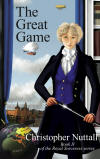
 
Sir Charles understood his prey (and he was hunting her) very well.  He approached her openly, made himself useful, and invited her to ride with him.  By showing no fear (because of her magic) or contempt (because of her sex) he made a very good impression on someone who had spent little time with men, socially.  Gwen reacted well, perhaps better than he had hoped, and they kissed.  But they went no further.  By refraining from pushing her, Sir Charles earned her respect.  Perhaps he even earned her love.

But his very approach should have been a warning that he had something else in mind.  An honourable man would, perhaps, have approached her parents, even though it would have annoyed Gwen.  A marriage in those days wasn't just a match between a boy and a girl; it was a match between two families.  If they had married, Gwen’s family would have been tangled with Sir Charles’s family.  The consequences of their relationship would have spread further than just the two of them.

Gwen didn't realise, until it was almost too late, just how badly he was playing her.  He wasn't interested in luring her into bed, but in manipulating the outcome of the investigation and – if necessary – betraying her.  In hindsight, the signs were all too clear. 

This shouldn't have been surprising.  Georgian and Victorian noblewomen lived a very sheltered life.   They were coddled and protected from the worst of the world outside their walls.  Those women that might have served as examples of the dangers were often driven into social obscurity or death.  Indeed, medical textbooks of that period often concealed details concerning sex and women’s bodies, even though many details were blindingly obvious.  (A quick look in the mirror would have shown the curious woman that some of the details were wrong.)  But they were not encouraged to develop any form of curiosity.  A wedding night could be a frightening introduction to the world of sex.

There were fewer restrictions on men.  Men were expected to sow their oats in brothels, which were populated by women of the lower classes (and thus not considered completely human.)   A woman who disliked her husband had no easy way to leave him (to some extent, she was his property), while the husband could find solace in the arms of a mistress – or a whore.  Female adultery, on the other hand, would face significant punishment.  A husband could even sue his wife’s lover, on the grounds that his property had been damaged.  It is surprising that there were any cases of adultery at all.

Depicting a romance – or a cold and calculating attempt at seduction – in such a society can be tricky.  Will the author, depicting a world where women are expected to be subordinate (at least in public) be accused of sexism?  Or will the author, showing an underage marriage (by our standards), be accused of condoning paedophilia?  Or will the author, showing a mixed-race marriage in 1900, be accused of racism if he depicts the likely reaction of most contemporaries to such a relationship?

And yet, the alternative – transplanting modern values into the past – is worse.  It becomes laughable to see the past’s heroes and villains mouthing politically-correct phrases, particularly when our social attitudes wouldn't permit many features of life in the past. 

Hollywood History is not real history.  When it comes to setting books in the past, and discussing touchy subjects like romance, it behooves us to remember that.


~~~

Well said, Chris. I find the current tendency to misunderstanding the mores of the time, and the trend toward revisionist history, disturbing. I am even aware of classics of literature which have been "revised" in the name of suiting some modern standard of proper behavior and speech. To me, this is an abomination – if we erase the traces of what those eras were really like, and do not teach them to our children, how can we hope to learn from our own history...which we have consequently forgotten?

And for any writer worth his/her salt, it can be a minefield to traverse the fine line between historical accuracy and not offending readers.

-Stephanie Osborn
http://www.stephanie-osborn.com

Wednesday, May 28, 2014

Elements of Modern Storytelling: Romance, Part 1 of 2 by Christopher Nuttall

by Stephanie Osborn
http://www.stephanie-osborn.com

Starting today, and for the next two weeks, I'd like to welcome indie best-selling author Christopher Nuttall to Comet Tales! He sent me some wonderful stuff, enough for two whole blogs, and so I decided not to overwhelm my readers by cramming it all into one. Part One goes live this week, and Part Two, next week.

Chris is a very successful writer of indie (aka "self-published") books in the science fiction and fantasy genres. He has also written for Twilight Times Books, where I believe a book is shortly forthcoming, and Elsewhen Press. Born in Edinburgh, Scotland, he now resides in Malaysia, so contacting him is occasionally interesting!

[ALERT: The following is a very frank, straightforward discussion of historical attitudes
toward sex and marriage, which were not necessarily considered interchangeable "back in the day." This includes consideration of modern taboos and references (but not obvious descriptions) to dominant positions during sex. It is extremely enlightening, and you will learn something. But if said frankness causes offense, then this particular article is probably not for you. My younger fans may want to skip over it also, as this is probably PG-13 or slightly above. --S.O.]

Welcome, Chris!

~~~


Chris:

Thoughts on a Regency Romance

The past is a foreign country, as the old saying goes.  They do things differently there.

I mean it.  It always surprises me how many people look at the past and ask, quite reasonably, why modern values weren't considered by the denizens of the past?  Why couldn't Queen Elizabeth marry when her father had six wives?  Didn’t she need to have an heir?  But if Elizabeth had married, she would have conceded a great deal of power to her husband, as both Mary Tudor and Mary Queen of Scots found out to their cost.

To us, this seems absurd.  We live in a world where a woman has held the highest elective position in Britain and Germany, while another woman made a determined run for the White House.  A married woman in the West doesn't have to give up her name, share her property  or accept her husband’s every wish as a command.  But that wasn't true, even for noblewomen and princesses.  To marry was to concede independence.

Indeed, the very idea of marrying for love would have seemed strange to our ancestors.  How selfish, they would say, for someone to marry for love!  They would have condemned emotion as a driving force, insisted that their children marry someone suitable for them, someone who could  bring much to the family.   Who would want to marry a pauper, no matter how handsome, brave and kind, when there was a chance to marry the rich town miser, even if he was a jerk?

I first came across this when I read Romeo and Juliet at school.  My first thoughts, upon concluding the play, was that both Romero and Juliet were idiots.  Why didn't they just run off together or simply tell their parents that they were married?  But, if you look at the play through the attitudes of the time, that simply wasn't an option.  Juliet was semi-betrothed to Paris, her parents had certainly not consented to her marriage to Romeo ... and, in making love to Romeo, Juliet had defiled herself forever.  It would be quite easy for Juliet’s father to assume that Romeo had set out to damage his family (and succeeded magnificently) or that Juliet had shattered her family’s honour.  Of such viewpoints are honour killings made.

It actually grows worse when you realise that, in the original play, Romeo and Juliet would have been thirteen.

But this too wasn't uncommon.  Our time points to a certain age as the division between childhood and adulthood.  Their time decreed that a girl was marriageable as soon as she started her periods, when she was capable of bearing children.  Our time would see this as paedophilia, all the worse because the girls were not required to give their consent.  For an author, depicting this can be one hell of a challenge. 

This is not the only disconnect between our world and the attitudes of the past.  The Greeks had an open and semi-tolerant attitude to homosexuality.  The Romans, on the other hand, only considered homosexuality acceptable if the Roman Citizen was doing the penetrating, rather than being penetrated.  (The suggestion that he had been deflowered by a foreign king haunted Julius Caesar for his entire life.)  Later generations raged against homosexuality, while accepting childhood marriages and relationships we would probably consider incest.  Even today, sex and relationships can take very different forms around the world.


And now I come to talk about one of my characters and her first true romance...


~~~

To Be Continued next week!

-Stephanie Osborn
http://www.stephanie-osborn.com

Monday, April 8, 2013

We Aren't The Only Ones, Part 4

by Stephanie Osborn
http://www.stephanie-osborn.com

A bit more on the Soviet space program's failures, then on to China next week. Excerpted from A New American Space Plan, by Travis S. Taylor and myself, from Baen Books.

~~~


In 1971 the Soviets put up the world’s first space station, Salyut 1. Sort of like our Skylab, it was expendable and there was a whole series of these stations, military and nonmilitary. It was generally a successful program.

Except for the first flight to Salyut 1, Soyuz 11.

Soyuz 11 was the only manned mission to Salyut 1. All went nominally until it came time for reentry. At that time, the pyrotechnic bolts that were to release the service module from the reentry module fired simultaneously instead of sequentially. This in turn jolted open a breathing ventilation valve at an altitude of 104 miles (168 km) and bled the reentry vehicle’s atmosphere off into space. As it was located underneath the seats, the cosmonauts couldn’t locate and plug it fast enough to stop the loss of atmosphere. And due to the cramped conditions and the presence of 3 crew members, space suits were not worn for these early flights.

Flight recorder data later indicated the crew went into cardiac arrest within forty seconds. Within 212 seconds (less than four minutes) of the separation, the cabin pressure was zero. As a result, ground control lost communications with the crew long before the reentry comm blackout should have begun, realized that conditions were off-nominal, and began emergency preparations for the landing. The crew was found at the landing point, dead inside the cabin. Attempts were made to perform CPR by the service crew, but it was much too late.

In 1975 Soyuz 18a had the first ever manned launch abort. It’s forward momentum carriedit some thousands of miles downrange, nearly into China—which the Soviets were on particularly bad terms with at the time. It came down in the mountains again, sliding down the side of one, and nearly toppling off a cliff. This time, tangled parachutes saved the cosmonauts by snarling in the trees and preventing the sheer drop. The crew was pretty banged up.

In 1980 a Vostok rocket blew up on the launch pad. Forty-eight people died.

~~~

It should be noted that, since the dissolution of the Soviet Union, the Russian space program has, to my knowledge, not suffered a single major setback that has resulted in loss of life.

Next week as promised: The Chinese space program.

-Stephanie Osborn
http://www.stephanie-osborn.com

Monday, April 1, 2013

We Aren't The Only Ones, Part 3

by Stephanie Osborn
http://www.stephanie-osborn.com

Part 3 of this series takes us into the Russian manned program, specifically the Soyuz and the problems it experienced from the very beginning, as excerpted from A New American Space Plan, by Travis S. Taylor and myself.

~~~


Soyuz 1 was the first flight of the Soyuz spacecraft. It was also the Soviets’ first in-flight death. The craft was known to be faulty to begin with. The engineers reported over 203 design faults—not faulty equipment, not improperly installed, faulty design work, before the launch. Unfortunately, by this time Soviet leaders had caught moon fever. They wanted to beat the Americans to a manned landing, and they wanted to take advantage of the delay caused by the Apollo 1 fire. Oh, and they wanted to celebrate Vladimir Lenin's birthday with some fireworks. Big fireworks.


Vladimir Komarov was the primary, and Yuri Gagarin was his backup. The situation was so bad that Gagarin tried to get Komarov bumped from the primary position, because he knew that he was considered a national hero and therefore not expendable. He hoped to get the mission delayed until the problems could be fixed. He failed.

Soyuz 1 was launched, Komarov aboard. Its mission was to rendezvous and EVA with Soyuz 2. As soon as it got on orbit, one of the solar panels failed to unfurl, so the spacecraft was running on low power from the get-go.

The Soyuz 2 crew prepped themselves for a repair mission. Thunderstorms overnight at Baikonur fried the Soyuz electrical systems, so Soyuz 1 was on its own.

Then the “orientation detectors” (I assume this means gyroscopes or star trackers or some such, or maybe not) decided to malfunction, rendering maneuvering difficult. Then the automatic maneuvering system died entirely, and the manual system went on the fritz.

Once the maneuvering system went down, the flight director decided to abort the mission. At this point, everything looked like a happy ending.

Except this was a new ship. With new details. Like a thicker heat shield, and a correspondingly larger parachute. Remember those design flaws? Guess what? Nobody bothered to make the chute receptacle any bigger. In their brilliance, technicians used wooden mallets to beat the parachute into place.


So the drogue chute came out, but the main parachute didn’t. Simple enough: Komarov deployed the manual parachute. Which promptly tangled in the drogue chute. He hit the ground at an estimated 89 mph (140 km/hr).

The ship exploded.
 
The Soviets didn’t have too many manned firsts after that, and they never made it to the moon with a crewed lander. The same year we landed on the moon, they managed a docking and crew exchange of Soyuz 4 and 5. (The Soviets claimed that this was the world’s first space station.) Unfortunately when it came time to come home, Soyuz 5’s service module failed to separate, and the capsule with service module reentered nose first. The cosmonaut inside, Boris Volnyov, hung from his straps until the module’s struts burned through and it broke away, enabling the capsule to right itself before the hatch also burned through—the gaskets were already burning and filling the cabin with noxious fumes. But then the parachute lines tangled, and the landing retros failed, and while Volnyov walked away from that landing, he broke his teeth. He landed in—yes, you guessed it—the Ural Mountains instead of Khazakhstan, and with the temperature outside at -36°F (-38°C), he was forced to walk several kilometers to the cabin of a local.


~~~
 
-Stephanie Osborn

Monday, March 25, 2013

We Aren't The Only Ones, Part 2

by Stephanie Osborn
http://www.stephanie-osborn.com


Just by way of reminder, we've been talking about space program disasters. We started off in memoriam of the Apollo 1, Challenger, and Columbia disasters, all of whose anniversaries fall within about a 2-week timespan on the calendar. Then we went on to begin talking about the space disasters of other countries, beginning with the Nedelin disaster in Soviet Russia in 1960. Let's keep talking about the USSR space program and its problems this week.

Again, we are excerpting from A New American Space Plan by Travis S. Taylor and myself, from Baen Books.

~~~


...The Soviets suffered another setback in 1961. In a tragedy eerily similar to the Apollo 1 fire, but six years earlier, Valentin Bondarenko died in a high-oxygen (but low-pressure) environment during a training session. Yuri Gagarin kept vigil at his hospital bedside, where he died a few hours after extrication.

Shortly thereafter, aboard Vostok 1, that same Yuri Gagarin became the first human in space, completing a single full orbit of Earth. In the same year, the USSR launched Venera I to Venus, and put Gherman Titov into orbit for a full day aboard Vostok 2...In 1965, Voshkod 2 crewmen conducted the first extra-vehicular activity (EVA)—although not successfully. Their airlock was an inflatable, attached to the side of their craft, and it didn’t work quite as well as envisioned. The Voshkod was a redesign of the Vostok, and not a particularly good one. It was cramped, it contained two crewmen instead of one without expanding the volume at all, and it had no provision for emergency escape. As if that weren’t bad enough, after a little over twelve minutes of EVA, Alexei Leonov found that his spacesuit had ballooned out to a point where he had become inflexible. He simply did not have the strength to bend, even at the waist. When he attempted to reenter his vehicle, his suit became wedged and he couldn’t reach anything to free himself!

In the end he had to vent atmosphere from his suit, risking the bends, in order to get it small enough to re-enter his spacecraft and rejoin his crewman Pavel Belyayev. Then the hatch wouldn’t close
properly. Once they got that fixed, the spacecraft was so cramped that, after orienting for deorbit burn, it took them an additional forty-six seconds to navigate their inflated spacesuits back into their seats. This threw off the center of gravity during the initial stages of reentry. The automatic landing system failed, and they had to resort to manual backup— and the orbital module didn’t disconnect when it should have! They spun crazily until the module finally jettisoned at an altitude of only 62 miles (100 km).

The whole mess caused them to miss their designated landing area by a good 240 miles (386 km) in the middle of the Ural Mountains of Siberia. The location was cold, it was snow-covered, it was filled with bears and wolves—and it was the animals’ mating season, the time when said bears and wolves were in their foulest moods. The Soviet control center had no idea where they were—and the hatch’s pyro bolts had blown it off. As was common in the early days of the space program for both Soviet and American, there was a pistol and ammunition aboard, and the men were trained for that terrain, but they had little in the way of shelter save the open Voskhod capsule. Aircraft located them, but it was too heavily forested for helicopters, so the men settled down for the night in their spacesuits— after stripping and wringing perspiration out of their soaked underwear. After a frigid -22°F (-30°C) night, a rescue party on skis arrived the next morning.

Not exactly a successful mission.
...
The N-1 rocket, the Soviet counterpart to the Saturn V, began development in 1965. Unfortunately its principal architect, Sergei Korolev, by this time known only by the enigmatic title “Chief Designer,” as his very existence was a state secret, died abruptly in 1966 of medical reasons which are still debated. Cancer was certainly a factor, as was his known heart condition, but a botched operation, coupled with the inability to intubate him due to jaw damage from beatings dating from his days in the gulag, may well have contributed. This left the N-1 program leaderless. It floundered badly, and after four failed launch attempts, the program was suspended, then cancelled in 1976.
 
~~~
 
More Russian problems next week.
 
-Stephanie Osborn
 

Monday, March 18, 2013

We Aren't The Only Ones, Part 1

by Stephanie Osborn
http://www.stephanie-osborn.com


Just so you know, while NASA has had its horrible accidents, it is far from the only space program to have had them. And it IS the safest, hands down. There is nothing wrong with NASA that I have not seen in other big institutions, whether private enterprise or government agency. And while terrible, Apollo 1, Challenger, and Columbia all put together don't equal some of the space program disasters that other nations have had.

Travis S. Taylor and I wrote this book that came out in late 2012, called A New American Space Plan. It's about what we should be doing to get back on track for the stars. The reason I bring it up is because I already chronicled said disasters in it, and with the permission of Baen Books, the publisher, I'm going to excerpt Space Plan here with respect to those disasters.

First up, let's talk about the Soviet space program. Yes, I know the USSR doesn't exist any more, but the space program the Russians have is founded upon that started by the USSR. Here we go!

~~~


The Russian space program can be traced back to at least the early part of the twentieth century, when Konstantin Tsiolkovsky, a contemporary of America’s Robert Goddard, proposed the notion that space flight was possible and began developing the modern science of rocketry. This was furthered by the Group for the Study of Reactive Motion, or “GIRD,” as it worked out in Cyrillic. This group contained, among others, Sergei Korolev, who would eventually wind up becoming one of the Soviet’s premier rocket scientists. In 1933 this Soviet team launched their first liquid fueled rocket, the GIRD-09, and a few months later, the hybrid fueld GIRD-X. It seemed Soviet rocketry was off to a great start.

 
It received a grave setback during the Stalin era, however. Stalin’s Great Purge killed or imprisoned most rocket scientists of the day. It targeted the intelligentsia and professionals, among others, as presumably a threat to the Communist Party. Those who were not executed by firing squad were sent to the gulags. Many of the stories bear resemblances to atrocities being carried out at the same time but a little farther west. The only developments in the field of any significance occurred during World War II with the invention of the Katyusha multiple rocket launcher.

 
It was that “little farther west” that proved the reinvigoration of the Soviet space program, however. At the end of World War II, not all of Wernher von Braun’s team ended up in the United States. He had purposely split his team in hopes that one or the other might make it to a safe haven with the Allies. The other group ended up with the Soviets, who looked over what von Braun’s team had wrought at Peenemunde and were impressed.

 
Once in their new home in the Soviet Union, the German rocket scientists set to work helping the Soviets replicate the V-2. This Russian version was dubbed the R-1. But it was not powerful enough to carry the large, heavy nuclear warheads of the day—which was the principal Soviet concern at the time. What the Russians wanted was a true intercontinental ballistic missile. That was always the whole point of their rocket program, as it turned out.
 
Nevertheless, the dreamers still got the dregs of the military’s desire. Somehow having managed to survive internment in a gulag during the Purge, Korolev came out on top as one of the principal designers. But he had his enemies; the Soviet space program, unlike the American one, was not centralized, and there was much internal competition...In short order, the USSR began making reasonably regular launches. Oddly enough, it has in recent years been determined that Kruschev had no particular interest in the space program. It was not a high political priority, he did not desire to compete with the Americans to the moon, and he saw its only benefit as propagandistic. Nevertheless the “propagandistic” program kept bringing home world firsts. In 1959, no less than three lunar probes were launched: Luna I, II, and III. These were, respectively, a flyby, an impactor, and a single slingshot orbit around the moon that returned the first images of the lunar far side. And in 1960 they returned living dogs from Earth orbit.
 
But 1960 also saw possibly their greatest space disaster. It is commonly known as the Nedelin catastrophe after the manager who oversaw it. Some say he was cocky. Some say he ordered his subordinates into fatal position. It is likely that we will never know because there was only one survivor of this disaster.

In October 1960, a launch pad test for a prototype of the R-16 ICBM was in preparation. This test was overseen by Soviet Marshal Mitrofan Nedelin. The rocket was on the launch pad at the Baikonur Cosmodrome, and fully fueled with what they called “Devil’s Venom,” a particularly nasty hypergolic fuel system consisting of unsymmetrical dimethyhydrazine (UDMH) and nitric acid. The fuel mix is highly corrosive and toxic, but extremely powerful. However, even its exhaust is poisonous, and the nitric acid cannot be in the oxidizer tank for more than two days without eating through the tank.

It was the very nature of Devil’s Venom, it seems, that led to the disaster. Late on the day before the test, the technicians preparing the rocket accidentally breached a line from the fuel tank, allowing a small amount of fuel into the combustion chamber. This in itself was not dangerous. So rather than go through weeks of untanking, repair, rebuilding the engine, and refitting, the decision was made to move up the launch to the next day. Meanwhile Nedelin notified many military and political dignitaries of the upcoming launch, in case they wanted to watch—and who doesn’t want to watch a rocket launch?

Then on October 24th, engineers, scientists and technicians rushed to complete launch preparation, often performing tasks simultaneously rather than sequentially per checklist. The result was a delay. Nedelin, impatient and perhaps embarrassed, left the dignitaries at the observation stand and went to oversee the final preparation. Word has it he even brought a chair to sit down beside the launch pad.


For reasons unknown—or unreleased—the second stage engines fired prematurely. The flames acted as a blowtorch on the hypergolic tanks in the first stage, cutting through them. As soon as the UDMH and the nitric acid combined, as is the nature of hypergolic fuels, they self-ignited. The resulting explosion cremated everyone near the pad.


Those farther away were burned to death; those who had run away encountered the perimeter fence and were either burned or poisoned by the fumes. The entire horrific debacle was captured on film for posterity by automated cameras. Only one man survived—Mikhail Yangel, an associate (and competitor) of Korolev’s, and that only because he left the viewing area and went into a bunker to smoke a cigarette. He had been the military’s rocket engine designer and a proponent of hypergolic fuels. After this he was directed to concentrate strictly on ICBM design.
 
~~~
 
More next week.
 
-Stephanie Osborn
 

Monday, December 10, 2012

Sarah Hoyt's Darkship Renegades!

by Stephanie Osborn
http://www.stephanie-osborn.com

So what is Sarah Hoyt's Darkship Renegades, you ask?

Why, it's the eagerly-awaited sequel to the Prometheus Award Winning Darkship Thieves, in which Thena discovers the worst tyranny might be one that happens so slowly you never rebel, and also that home is the place you’ll fight for. (With burner battles, spaceships, a hot red-headed girl engineer and a mad cyborg.)

According to Baen's website:

After rescuing her star pilot husband and discovering the dark secret of her own past on Earth, Athena Hera Sinistra returns to space habitat Eden to start life anew. Not happening. Thena and Kit are placed under arrest for the crime of coming back alive. The only escape from a death sentence: return to Earth and bring back the lost secret to creating the Powertrees, the energy source of both Eden and Earth whose technological secrets have been lost to war. But that mission is secondary to a greater imperative. Above all else, Thena must not get caught. If she does, then suicide is to be the only option.

With the odds heavily stacked against not only success, but survival, Thena comes to understand what her cynical accusers do not: it is not merely one woman's life on the line anymore. For it's on Earth where the adventure truly begins, and a secret is discovered that must be revealed and exploited, else humanity's days are most certainly numbered. Thena realizes that what is truly at stake is the fate of Eden and Earth alike, the continuance of the darkship fleet—and freedom for all in the Solar System—and beyond.
 
 The cover art is as cool as the book, and is by David Mattingly.

Wanna buy the first one, Darkship Thieves? That's here. Unless you want it in ebook format, and that's here.

To buy Darkship Renegades, go here for print, and here for ebook.

Now, if you want something REALLY cool, I have authorization from Sarah to have a contest for a Darkship Renegades t-shirt! There won't be very many of these, folks, so this is primo! It's going to be a trivia contest. Send your entries to steph-osborn@sff.net!

Here we go:


  1. Name at least one book I have co-authored with Travis S. Taylor. (points for more than one)
  2. Name at least one book I have co-authored with Darrell Bain. (points for more than one)
  3. Name the artist who does the covers for almost all my books.
  4. Name another book of Sarah A. Hoyt's that is NOT one of the Darkship books. (points for more than one)
  5. Name my three principal publishers.
  6. Name one fiction book I have written entirely by myself. (points for more than one)
  7. Name one nonfiction book I have written entirely by myself. (points for more than one)
  8. What series did Travis start, but I am finishing?
  9. On what television show does Travis star?
  10. What network is it on?
  11. In what city does Sarah live?
  12. What is the song based on my hometown?
  13. Name one genre other than SF in which Sarah writes. (points for more than one)
  14. Name another author Travis has collaborated with. (points for more than one)
  15. Give one of Sarah's pen names. (points for more than one)
  16.  
Remember, copy, paste, answer, and send to steph-osborn@sff.net ! All entries must be sent before Christmas Eve!

-Stephanie Osborn
http://www.stephanie-osborn.com

Thursday, October 18, 2012

A Tidbit of Wonderful News!

by Stephanie Osborn
http://www.stephanie-osborn.com


Last weekend (12-14 Oct) I was the Mistress of Ceremonies for Huntsville's Con*Stellation SF convention. That in itself was a great honor, for it was the second year in a row that I had been asked to fill that slot.

But there were more honors to come.

After the opening ceremonies, famed SF writer Eric Flint came up to me...and informed me that his wife, Lucille, positively loved my books! She has read all three of the Displaced Detective novels currently out, and is eagerly awaiting book 4 next month! THEN he followed me to the dealer's room and bought a copy of Burnout and a copy of Extraction Point - insisting I autograph both! And as if that weren't enough, it turns out that Lucille (Lu as Mr. Flint calls her) was gifted the Displaced Detective books by Walt Boyes, who is, to quote Eric, "one of the inner circle (so to speak) of the [NYT-best-selling] 1632 series authors," and who "recommended them highly"!

My mind is blown. I have been flying high ever since. It doesn't get much better than that!


-Stephanie Osborn