Banner

Banner

Monday, August 22, 2016

Some Solar Updates

by Stephanie Osborn
http://www.stephanie-osborn.com

Just a few tidbits today, guys.

FYI we had another spotless couple days. Scarcely two, but there was nothing yesterday and today there is a spot rotating around from the far side. According to the NOAA Space Weather Prediction Center there is one already on the near side continuing to decay — yet it doesn't show up — and the one rotating to the near side is one that rotated completely around. Judging by the STEREO imagery, however, there isn't another spot on the entire solar surface.


That said, there are some interesting magnetic field patterns in the inner corona in the Solar Dynamics Observatory's 211b channel, and that might indicate where the mysterious unseen spot group is supposed to be. Have a look at this image and look just over coronal hole 07, and you'll see it:


Said SDO channel image also shows the coronal holes, but they're moderate currently. We had a passage through an enhanced solar wind stream from one over the weekend, but it wasn't impressive and only mildly unsettled the geomagnetic field.

This magnetogram (also from SDO) shows that, plus the group rotating around, plus ANOTHER that also isn't showing up.


So yes, there's some activity, but it isn't a lot.


BOOK RECOMMENDATION:
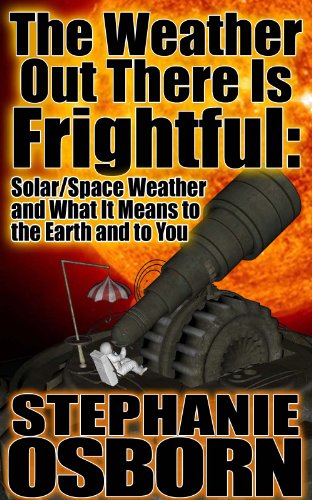
The Weather Out There Is Frightful: Solar/Space Weather and What It Means for the Earth and You

Our Sun is an active star. It may even be a variable star. Sunspots, flares, coronal mass ejections, all are signs of its activity. What kind of effect does it have on Earth? Other than the occasional sunburn, could it be dangerous? Has it been dangerous in the past? What can we expect in the near future?


OFF-TOPIC ADDENDUM:
With any luck, while it isn't about solar/space weather, I should have some exciting news for my fans sometime this week!

~Stephanie Osborn
http://www.stephanie-osborn.com

Thursday, August 18, 2016

Link to Guest Blog Series

by Stephanie Osborn
http://www.stephanie-osborn.com

Just a quick note: Upon request (both from readers and Sarah), I have begun a series on solar, space, and geomagnetic weather on According to Hoyt. The first installment posted today. Future installments should post every Thursday for the next couple of months. I'll try to ensure that a new post goes up here to link my blog readers to it, also.

Here's the link:
https://accordingtohoyt.com/2016/08/18/solar-space-and-geomagnetic-weather-part-i-an-introduction-by-stephanie-osborn/

Tuesday, August 16, 2016

An Op-Ed Guest Post

Today, please welcome my old NASA colleague, Larry Bauer. Currently retired, he and I worked numerous Shuttle missions together as payload flight controllers.
~Stephanie Osborn
http://www.stephanie-osborn.com


* * *


A Few Observations on Reusable Space Hardware,
or Why the Space Shuttle was an engineering masterpiece and a logistical nightmare.
by Larry Bauer

The National Space Transportation System, or what people commonly refer to as the Space Shuttle, was composed of four parts: the Shuttle itself, the three Shuttle main engines, the External Tank, and two Solid Rocket Boosters. In theory everything but the tank and its fuel were recoverable.

I was reminded of this when I saw an article noting the sixth successful landing of a SpaceX Falcon 9 rocket after the successful launch of the JCSAT-16 commercial communications satellite.


From a purely economical aspect it all comes down to what is the cheapest means to launch a payload into a desired orbit. On the face of it reusing hardware only makes sense. However there are a good many factors that mitigate against such as assumption.

With NSTS we salvaged everything except the ET. The Shuttle and engines landed and the SRB shells parachuted back into the sea for recovery. In theory maximum reuse of critical hardware. But let's look first at those boosters. They were made in sections far from the launch site, built and filled in sections so they could be transported by barge to Kennedy Space Center. From a logistics standpoint it would have made much more sense to build them as a single tube and fill them with solid propellant right there at the launch site. However that was not an option. The state of Florida would allow launches from KSC, but they refused permission to build the SRBs there. The solid propellant is nasty stuff and the process of filling the boosters violated too many state pollution restrictions. So the SRBs were built and filled originally by Thiokol of Brigham City, Utah, later bought out by ATK.

I will note that the recovery and remanufacture of the boosters was very cost- and labor-intensive, and there was always a debate over whether a cheaper throw-away design might have been more cost effective. I will also point out that a design incorporating a single continuous tube would have made the failure that caused the Challenger disaster impossible. Which does not mean something equally tragic might not have happened, but you cannot have a joint failure if there are no joints.


The high-performance Space Shuttle Main Engines, known as SSMEs or the Aerojet Rocketdyne RS-25, are an example where reuse of hardware only makes good sense. These are the pinnacle of the state of the art for liquid fuel rocket engines. With the help of the solid boosters, these engines, sucking immense quantities of liquid hydrogen and oxygen from the External Tank, could lift a combined vehicle and payload weight of roughly 2060 tons. Bringing these highly intricate and fine-tuned engines back for reuse only made sense.


And that does lead me to the subject of a rather controversial opinion of mine. As magnificent an engineering achievement as the NSTS was — and I spent the majority of my career at NASA doing ground support to on-orbit experiment operations so I have a great fondness for the beastie — the reason why it was a huge logistics failure rests in the numbers. The shuttle itself weighed in at 2030 tons. Its payload was 30 tons. The NSTS was a true heavy lift rocket, but most of what should have been useful payload mass to orbit was spent instead on creating the ability to land sort of like an airplane. A requirement imposed, by the way, by the Air Force — who withdrew from the project between the time the design was firmed up and the first launch. I will also observe that every astronaut pilot I've ever spoken with all described the shuttle as “that flying brick.” [I can confirm that astronaut description. —Steph]


And all of the above is explanation as to why we don't see any shuttle-like designs these days. It is ever so much more efficient to make as much of the upmass be useful payload as possible, with the crew compartment just sufficiently robust to carry the astronauts up and get them back to Earth safely.

* * *

Thanks much for that information, Larry! It squares pretty nicely with what I know of the various programs, as well.

BOOK RECOMMENDATION:

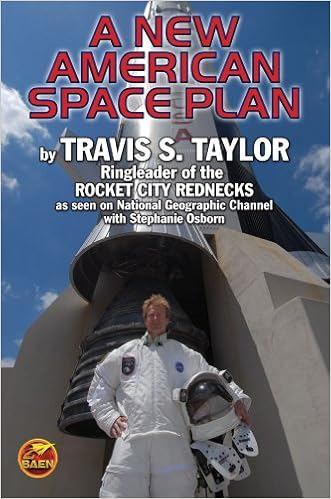
A New American Space Plan, by Travis S. Taylor with Stephanie Osborn, available in print and ebook, discusses the history of space exploration, where we are, how we got there, and where we ought to be and be going. You can find a lot more detail on the Space Shuttle, how it worked, the main engines and how the whole system was designed, right in this book. There's also a good bit about the recent efforts to develop commercial space launch systems and why the epithet "commercial" is often a misnomer.

~Stephanie Osborn
http://www.stephanie-osborn.com

Friday, August 12, 2016

A Couple Quick Updates

by Stephanie Osborn
http://www.stephanie-osborn.com

SOLAR UPDATE:
The Sun has definitely awakened for the time. (Finally.) There are currently half a dozen spot groups on the solar near side; 2571 is about to rotate to the far side, but there are also 2573-7 as well, which range from a simple single spot to a multi-spot complex.


Solar Dynamics Observatory imagery
Labeling by Solarham.com
Note how the spots tend to cluster around the equatorial region. This is pretty typical for late in a solar cycle. Sunspots tend to start out at higher latitudes, closer to the poles, then drift equatorward.

Very minor C-class flares are occurring, but there is little chance for anything stronger. A filament did lift, and this may produce a small coronal mass ejection, or CME. We're waiting on LASCO (Large Angle and Spectrometric Coronagraph, an instrument on SOHO, the Solar and Heliospheric Observatory) imagery to determine if it made a CME or not. Such CMEs tend not to be as strong as those associated with large flares, so even if it is Earth-directed, expect pretty aurorae and a few high-latitude effects, but nothing of significance.

There are some coronal holes, but they aren't "geoeffective" (aimed at Earth). Geomagnetic activity is quiet.


Solar Dynamics Observatory imagery
Labeling by Solarham.com

More data as it comes in.

* * *

PERSEID METEOR SHOWER:
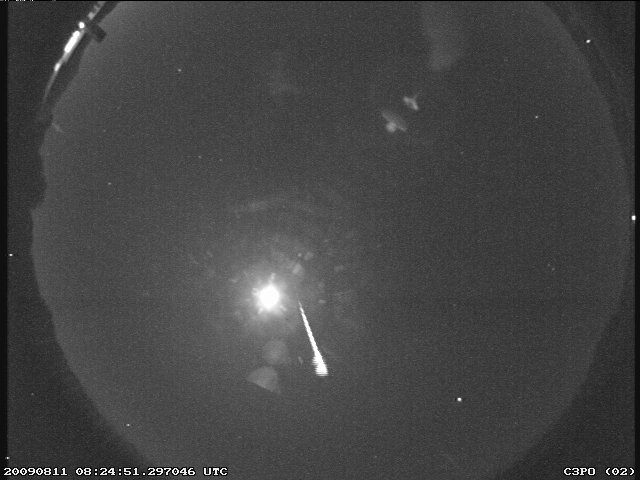
Well, the night of August 11/12 was the absolute peak of the Perseids. I've just come in from spending about 20 minutes outside, having a look. (It's currently 4am local time.)

I have to say that I was underwhelmed, especially given the hype given to the predictions of "up to 200 meteors/hour." That comes out to be over 3 meteors per minute, or about one meteor every 15-20 seconds. So in 20 minutes, I should have seen around 66 meteors.

I saw about 1/10 that.

Now, granted, I'm in a subdivision and my skies are not the darkest. And we had some light patchy clouds moving through. But  I waited until after the moon had set before I went out, to have the darkest possible skies for my location. And I picked the clearest patches of sky to observe, and ensured I blocked any light sources. Keep in mind that I've observed this shower from this location numerous times before, as well, so I know what I'm looking for. And I've seen the Perseids storm, the year after the parent comet, Swift-Tuttle, came through -- both from a rural dark-sky site, and my yard, where I was tonight.

 
Bill Cooke, NASA Meteoroid Environment Office,
Huntsville, AL
August 10, 2009

I undoubtedly would have seen more meteors had I been in a dark-sky site. But ten times more? Really?

It's possible, also, that I simply picked a time when, coincidentally, we were going through a sparse patch -- I was busy writing, and lost track of time, or I'd have been out there earlier, for longer. I'll be interested to see what other observers have to say.

As for me -- I love the Perseids; they're gorgeous, bright fireball meteors. But this didn't come anywhere close to the spectacle I remember right after Swift-Tuttle came through. That was one I'll always remember. Tonight, not so much.

If you were out observing the Perseids, I'd love to hear your observations in the comments.

* * *

BOOK RECOMMENDATIONS:

For more information on solar activity, check out my ebook, The Weather Out There Is Frightful: Solar/Space Weather and What It Means for the Earth and You.


Just a quick promo for me and my fellow scientists, for those of you who are interested in such things: A new anthology will be released in September (we hope!) called Science Fiction By Scientists. Every short story in it is "hard SF" written by an actual scientist, along with a quick primer at the end of each story on the science involved. It's available for preorder now!


~Stephanie Osborn
http://www.stephanie-osborn.com

Monday, August 8, 2016

The Perseid Meteor Shower and Other Stuff

by Stephanie Osborn
http://www.stephanie-osborn.com

FYI, there's a lot of hullaballoo about the Perseid meteor shower this year. Here's a little tidbit to explain why.

http://www.sciencealert.com/guys-the-perseid-meteor-shower-is-here-and-it-s-going-to-be-twice-as-good-this-year

Meteor showers are actually the debris left behind by comets. The tails blown off by the Sun form tiny particles in the swath of the parent comet's orbit, and when the Earth passes through it, the debris we run into flashes through the atmosphere and burns up, producing meteors. Most of these bits are the size of dust and sand; occasionally one is pebble-sized, which will be very bright.

This is why meteor showers are so predictable: we encounter the same orbital path each year, and go through the thickest part on the same day. If the parent comet has been through recently, there is a fresh, dense deposit of debris, and the shower will be especially good.

The radiant of this shower is the constellation Perseus; that is to say, all the meteors of the shower appear to be emerging from Perseus, radiating out and away from it. But the meteors have nothing to do with Perseus. Instead, we are seeing a kind of optical illusion. Imagine that you are in a car at night, headlights on, driving through a snowstorm. As the snowflakes enter the headlights and you move through them, they appear to radiate from a point in front of the car, seeming to move out from that point and around the car. This is the same effect; it is produced by the Earth moving through the meteoric debris.

So it will be easier to see the meteors if we are metaphorically on the hood of our planet-car than on the trunk! So it is better to observe meteor showers after midnight, because we are now on the forward-facing side in our orbit. The best observing times are from around 2 or 3am until near dawn.

Facing the radiant is not the best way to see lots of meteors, because the trails will be short: the meteors are moving right at you, and the trails will be short and quick. If you look away from it, the meteors are passing by you, and they will have long trails and last longer. So the best way to look is to turn, so your shoulder is pointing at the radiant, or even put your back to it and watch one large region of sky. Then you will see meteors entering the atmosphere at shallower angles, and they will have longer tracks, with more chance to spot them.

FWIW, meteor showers are not hard-edged things. Yes, the shower will have already started, but it is early stages yet, and they won't be very frequent. Your best bet for seeing meteors is a few days either side of the peak, which will occur the night of August 11/12. Also you want to go out AFTER MIDNIGHT. This is because you will now be on the forward-facing hemisphere relative to our orbit.

Wear comfortable clothes, and even in summertime, make sure you have a jacket; it can get rather cool in the wee small hours of the night. You'll be there for a while, so think about a chair, a blanket on the ground, or the like. My preference is for a chaise lounge, because it holds me in a comfortable position for watching the sky. A lap throw or similar blanket might be nice, too, depending on the weather where you are. (If you're in the Southern Hemisphere, it'll be de rigueur. It IS winter down there, after all, Summer Olympics in Rio notwithstanding.)

DO NOT FACE the radiant; this almost guarantees you'll see little to nothing. That's because you're looking right into the direction we're going, so meteor tracks will appear short and swift.

On the night of the peak (and for several days fore and aft), Perseus will be in the northeast. Turn so that your shoulder, or even your back, faces northeast, and survey a large area of the sky looking any direction BUT northeast, and give yourself at least an hour to observe. You should see some nice meteors in that time, especially this year.

Now, according to predictions, the Perseids MAY double their normal rate. But I never say an astronomical event like this ABSOLUTELY WILL do a thing. Because there are no guarantees. Yes, Jupiter may tweak the orbit of the debris so we do plow through the center of it -- but the part we plow through might just be unusually sparse, so it makes no difference.

FYI, I have never heard of the meteors from showers making impact. This is because they are the debris left behind from comets, "dirty snowballs" whose ice has sublimated via solar radiation. All that's left is particulates ranging largely from dust up to grains of sand. Rarely you get something pebble-sized. It all burns up in the upper reaches of the atmosphere, and nothing much gets lower than around 60mi. (Regular meteors can get as low as 50mi. Some get as low as 40. It depends on the speed of the meteor. Perseids usually are gone by a 60mi. altitude.)

SOLAR UPDATE: Sometime between Thursday and Friday, a couple of new sunspot groups formed on the solar near side, 2571 and 2572. They began rather unimpressively, but are now rather reasonable sunspot groups. However, the more active of the two groups, 2572, will be rotating off the west edge to the far side in the next couple of days.

It's a little hard to determine what's going on with the solar far side right now; one of the twin STEREO spacecraft, STEREO Behind, has experienced a "transient hit" -- meaning that the electronics likely took a charged particle hit. Instrument recovery is in work now. The STEREO Ahead craft appears to indicate 2-3 large spot groups may be about to rotate to the near side.

The outflow from a large, oblong coronal hole has enhanced the solar wind in the last few days, resulting in an unsettled geomagnetic field. Another one will swing around into a 'geoeffective' (Earth-directed) position in a few more days, possibly producing more minor geomag storming. I'll post if it does.

ADDENDUM:
Just a quick promo for me and my fellow scientists, for those of you who are interested in such things: A new anthology will be released in September (we hope!) called Science Fiction By Scientists. Every short story in it is "hard SF" written by an actual scientist, along with a quick primer at the end of each story on the science involved. It's available for preorder now!

~Stephanie Osborn
http://www.stephanie-osborn.com