Banner

Banner
Showing posts with label hard science fiction. Show all posts

Friday, September 16, 2016

Solar, Space & Geomag Weather Part V and other things

by Stephanie Osborn
http://www.stephanie-osborn.com

My days of the week are in order this week, and so I have been proactive in responding to comments at According to Hoyt, where Solar, Space, and Geomagnetic Weather, Part V went up:

https://accordingtohoyt.com/2016/09/15/solar-space-and-geomagnetic-weather-part-v-solar-activity-and-the-activity-indices-by-stephanie-osborn/

Feel free to pop over there and leave a comment; I'll be checking and responding for a couple days yet. Or leave your comments here. I'll answer those too.

Other stuff:

1) Africa, Europe, Asia, Australia and extreme parts of eastern South America are watching a penumbral lunar eclipse of the harvest moon even as I type this. However, observers in North America will be unable to see it. However, "penumbral" means that the Moon is only passing through the outer edge of the Earth's shadow, so it won't look especially dark, just dimmer.

https://www.timeanddate.com/eclipse/lunar/2016-september-16

Slooh is covering it, and should have a video after the fact, for late viewers.

http://live.slooh.com/stadium/live/the-full-harvest-moon-eclipse

2) The Sun is still cranking along; little has changed. However, on Sep 15, sunspot 2589 rotated around to the far side of the Sun. Another spot formed as it was rotating to the near side and has been numbered 2592. These may be the only two spot groups on the solar surface, though according to STEREO imagery, there may be one more small group on the far side. So things are moving toward spotless again. Whether it gets there or not this time remains to be seen.

There are a few coronal holes, but nothing that is yet in a very geoeffective position. And there have been no strong flares, and no Earth-directed CMEs produced. Consequently the geomagnetic field is quiescent.

Book recommendations:
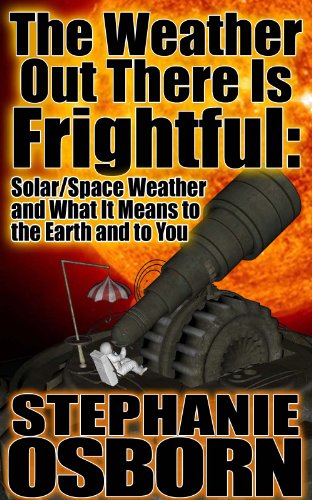
A bit more information, all in one place, on solar/space/geomagnetic weather, can be found in my book, The Weather Out There Is Frightful, available for Kindle.

"Our Sun is an active star. It may even be a variable star. Sunspots, flares, coronal mass ejections, all are signs of its activity. What kind of effect does it have on Earth? Other than the occasional sunburn, could it be dangerous? Has it been dangerous in the past? What can we expect in the near future?"
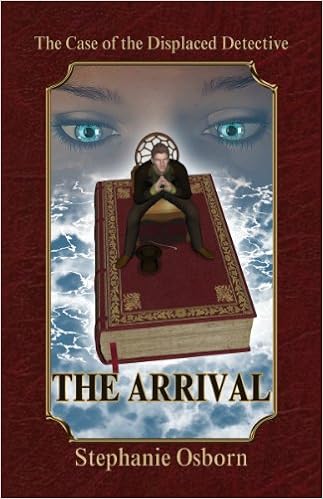


For those who like hard science fiction, perhaps combined with a hint of mystery, check out the first book in the Displaced Detective series, The Case of the Displaced Detective: The Arrival, available in print and ebook. (Yes, it is available for Nook.)

"The Case of the Displaced Detective: The Arrival is a SF mystery in which brilliant hyperspatial physicist, Dr. Skye Chadwick, discovers there are alternate realities, often populated by those we consider only literary characters. Her pet research, Project: Tesseract, hidden deep under Schriever AFB, finds Continuum 114, where Sherlock Holmes was to have died along with Moriarty at the Reichenbach Falls. In a Knee-jerk reaction, Skye rescues Holmes, who inadvertently flies through the wormhole to our universe, while his enemy plunges to his death. Unable to go back without causing devastating continuum collapse, Holmes must stay in our world and adapt. Meanwhile, the Schriever AFB Dept of Security discovers a spy ring working to dig out the details of - and possibly sabotage - Project: Tesseract. Can Chadwick help Holmes come up to speed in modern investigative techniques in time to stop the spies? Will Holmes be able to thrive in our modern world? Is Chadwick now Holmes' new 'Watson' - or more? And what happens next?"
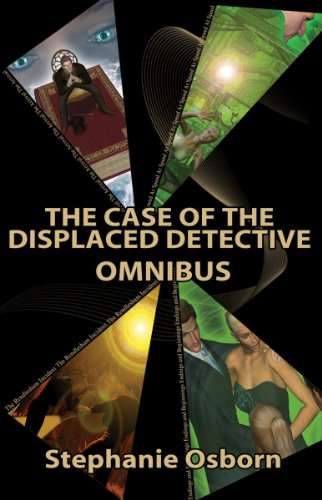
This is an ongoing series; the first four books are collected in an ebook omnibus, The Case of the Displaced Detective Omnibus. The series has been described as, "Sherlock Holmes meets the X-Files." In addition to the mystery aspects of each story, I make use of extrapolations of cutting-edge scientific theory, such as M theory, cosmic strings, nanocarbon chemistry, room-temperature superconductors, and more.


Book 6 of the series, Fear in the French Quarter, is available for pre-release now. The official release date is October 5. More books are planned in the series.

"Fear in the French Quarter revolves around a jaunt by no less than Sherlock Holmes himself -- brought to the modern day from an alternate universe's Victorian era by his continuum parallel, who is now his wife, Dr. Skye Chadwick- Holmes -- to famed New Orleans for both business and pleasure. There, the detective couple investigates ghostly apparitions, strange disappearances, mystic phenomena, and challenge threats to the very universe they call home.

"It was supposed to be a working holiday for Skye and Sherlock, along with their friend, the modern day version of Doctor Watson -- some federal training that also gave them the chance to explore New Orleans, as the ghosts of the French Quarter become exponentially more active. When the couple uncovers an imminently catastrophic cause, whose epicenter lies squarely in the middle of Le Vieux Carre, they must race against time to stop it before the whole thing breaks wide open -- and more than one universe is destroyed."

Have a look at some of my books, enjoy the science, maybe learn a few things...and above all, enjoy.

-Stephanie Osborn
http://www.stephanie-osborn.com

Monday, August 8, 2016

The Perseid Meteor Shower and Other Stuff

by Stephanie Osborn
http://www.stephanie-osborn.com

FYI, there's a lot of hullaballoo about the Perseid meteor shower this year. Here's a little tidbit to explain why.

http://www.sciencealert.com/guys-the-perseid-meteor-shower-is-here-and-it-s-going-to-be-twice-as-good-this-year

Meteor showers are actually the debris left behind by comets. The tails blown off by the Sun form tiny particles in the swath of the parent comet's orbit, and when the Earth passes through it, the debris we run into flashes through the atmosphere and burns up, producing meteors. Most of these bits are the size of dust and sand; occasionally one is pebble-sized, which will be very bright.

This is why meteor showers are so predictable: we encounter the same orbital path each year, and go through the thickest part on the same day. If the parent comet has been through recently, there is a fresh, dense deposit of debris, and the shower will be especially good.

The radiant of this shower is the constellation Perseus; that is to say, all the meteors of the shower appear to be emerging from Perseus, radiating out and away from it. But the meteors have nothing to do with Perseus. Instead, we are seeing a kind of optical illusion. Imagine that you are in a car at night, headlights on, driving through a snowstorm. As the snowflakes enter the headlights and you move through them, they appear to radiate from a point in front of the car, seeming to move out from that point and around the car. This is the same effect; it is produced by the Earth moving through the meteoric debris.

So it will be easier to see the meteors if we are metaphorically on the hood of our planet-car than on the trunk! So it is better to observe meteor showers after midnight, because we are now on the forward-facing side in our orbit. The best observing times are from around 2 or 3am until near dawn.

Facing the radiant is not the best way to see lots of meteors, because the trails will be short: the meteors are moving right at you, and the trails will be short and quick. If you look away from it, the meteors are passing by you, and they will have long trails and last longer. So the best way to look is to turn, so your shoulder is pointing at the radiant, or even put your back to it and watch one large region of sky. Then you will see meteors entering the atmosphere at shallower angles, and they will have longer tracks, with more chance to spot them.

FWIW, meteor showers are not hard-edged things. Yes, the shower will have already started, but it is early stages yet, and they won't be very frequent. Your best bet for seeing meteors is a few days either side of the peak, which will occur the night of August 11/12. Also you want to go out AFTER MIDNIGHT. This is because you will now be on the forward-facing hemisphere relative to our orbit.

Wear comfortable clothes, and even in summertime, make sure you have a jacket; it can get rather cool in the wee small hours of the night. You'll be there for a while, so think about a chair, a blanket on the ground, or the like. My preference is for a chaise lounge, because it holds me in a comfortable position for watching the sky. A lap throw or similar blanket might be nice, too, depending on the weather where you are. (If you're in the Southern Hemisphere, it'll be de rigueur. It IS winter down there, after all, Summer Olympics in Rio notwithstanding.)

DO NOT FACE the radiant; this almost guarantees you'll see little to nothing. That's because you're looking right into the direction we're going, so meteor tracks will appear short and swift.

On the night of the peak (and for several days fore and aft), Perseus will be in the northeast. Turn so that your shoulder, or even your back, faces northeast, and survey a large area of the sky looking any direction BUT northeast, and give yourself at least an hour to observe. You should see some nice meteors in that time, especially this year.

Now, according to predictions, the Perseids MAY double their normal rate. But I never say an astronomical event like this ABSOLUTELY WILL do a thing. Because there are no guarantees. Yes, Jupiter may tweak the orbit of the debris so we do plow through the center of it -- but the part we plow through might just be unusually sparse, so it makes no difference.

FYI, I have never heard of the meteors from showers making impact. This is because they are the debris left behind from comets, "dirty snowballs" whose ice has sublimated via solar radiation. All that's left is particulates ranging largely from dust up to grains of sand. Rarely you get something pebble-sized. It all burns up in the upper reaches of the atmosphere, and nothing much gets lower than around 60mi. (Regular meteors can get as low as 50mi. Some get as low as 40. It depends on the speed of the meteor. Perseids usually are gone by a 60mi. altitude.)

SOLAR UPDATE: Sometime between Thursday and Friday, a couple of new sunspot groups formed on the solar near side, 2571 and 2572. They began rather unimpressively, but are now rather reasonable sunspot groups. However, the more active of the two groups, 2572, will be rotating off the west edge to the far side in the next couple of days.

It's a little hard to determine what's going on with the solar far side right now; one of the twin STEREO spacecraft, STEREO Behind, has experienced a "transient hit" -- meaning that the electronics likely took a charged particle hit. Instrument recovery is in work now. The STEREO Ahead craft appears to indicate 2-3 large spot groups may be about to rotate to the near side.

The outflow from a large, oblong coronal hole has enhanced the solar wind in the last few days, resulting in an unsettled geomagnetic field. Another one will swing around into a 'geoeffective' (Earth-directed) position in a few more days, possibly producing more minor geomag storming. I'll post if it does.

ADDENDUM:
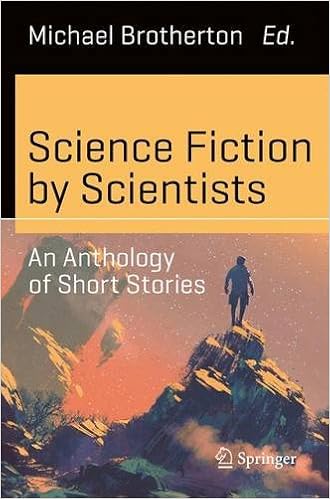
Just a quick promo for me and my fellow scientists, for those of you who are interested in such things: A new anthology will be released in September (we hope!) called Science Fiction By Scientists. Every short story in it is "hard SF" written by an actual scientist, along with a quick primer at the end of each story on the science involved. It's available for preorder now!

~Stephanie Osborn
http://www.stephanie-osborn.com