Banner

Banner
Showing posts with label solar wind. Show all posts

Thursday, September 1, 2016

Solar, Space, and Geomagnetic Weather, Part III, plus News

by Stephanie Osborn
http://www.stephanie-osborn.com

Okay, first off, the third installment of my solar and space weather series has gone up over at Sarah Hoyt's blog, According to Hoyt.


And  an interesting tidbit of information: Several sources are indicating that the cosmic ray influx is increasing. (E.g. see SpaceWeather.com for Sep 1, 2016:  Cosmic Rays in the Atmosphere.)

Now, cosmic rays come in from outside our solar system. Mostly they are particulates, very high-energy charged particles produced in the various high-energy astronomical objects out there. They are very penetrating, and potentially dangerous to life, at least in large quantities. (Not that we are likely to get those large quantities; my point is simply that they ain’t good for ya.)
Normally the solar wind, coupled with the enhanced wind streams from coronas, and CMEs, create enough of a “resisting” effect to keep the cosmic ray flux at Earth fairly low. That said, this means that there is a variation in cosmic ray flux from solar max to solar min.
But 1) we’re only about 2 years out from solar max. We should be 4-5 years away from solar min. 2) If we are indeed going into an extended minimum, then chances are the cosmic ray flux will be higher than at a “simple” solar min.
Just something to keep an eye on.
Additional news:
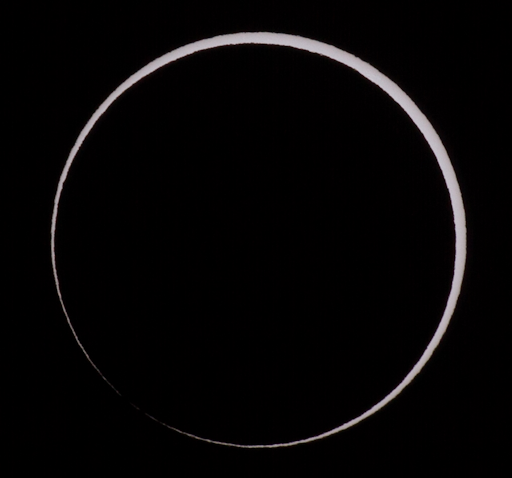
  • Africa saw an annular solar eclipse today. Nearly 97% of the Sun was covered by the Moon for observers in 50 African nations. SpaceWeather.com has a nice gallery of eclipse photography here.
Photo from SpaceWeather.com
Annular solar eclipse seen from Reunion

  • We are experiencing a G1 (minor) geomagnetic storm due to the enhanced wind stream from a coronal hole. High-latitude observers should keep a lookout for aurorae and other effects.

  • SpaceX's Falcon-9 blew up on the pad at Canaveral today; the rocket and its payload, a satellite owned by Facebook and intended to provide satellite internet capability, were total losses. CEO Elon Musk indicated that the problem "originated around the upper stage oxygen tank," during a static test on the pad. The launch had been planned for Saturday.

CNN: http://money.cnn.com/video/news/2016/09/01/explosion-at-spacex-launch-pad-at-cape-canaveral.cnnmoney/index.html 
ABC: http://abcnews.go.com/Technology/video-captures-spacex-rocket-explosion-launch-site/story?id=41803090 
Business Insider: http://www.businessinsider.com/elon-musk-spacex-falcon-9-explosion-tweet-2016-9

 ~Stephanie Osborn
http://www.stephanie-osborn.com

Tuesday, August 23, 2016

AURORA ALERT 23/24 August 2016

by Stephanie Osborn
http://www.stephanie-osborn.com

According to the various solar/geomagnetic data (collected in one convenient place by SolarHam.com; I actively support them with contributions), we are currently experiencing minor geomagnetic storming. This is likely being caused by a combination of a favorably-oriented local interplanetary magnetic field, as well as an enhanced wind stream from a coronal hole.


This is a Solar Dynamics Observatory image 
from 23 August 2016. It depicts the coronal holes 
on that date (yesterday). Holes were numbered by 
SolarHam. Coronal Hole #07 likely produced the
solar wind stream creating the current geomag storming.

The planetary K-index is a NOAA Space Weather Prediction Center (SWPC) product created using magnetometers around the world. According to the SWPC, "The K-index quantifies disturbances in the horizontal component of earth's magnetic field with an integer in the range 0-9 with 1 being calm and 5 or more indicating a geomagnetic storm. It is derived from the maximum fluctuations of horizontal components observed on a magnetometer during a three-hour interval. The planetary 3-hour-range index Kp is the mean standardized K-index from 13 geomagnetic observatories between 44 degrees and 60 degrees northern or southern geomagnetic latitude. The label 'K' comes from the German word 'Kennziffer' meaning 'characteristic digit.' The K-index was introduced by Julius Bartels in 1938. SWPC has used the K-index since the forecast center began operations." 

Any time the K-index reaches 5, geomagnetic storming is occurring. We have been experiencing K=5 for at least 9 hours at the time of this writing.


K-index graph captured as of approximately 10:25pm CDT, 23 Aug 2016.

The higher the K-index, the farther away from the geomagnetic poles the aurora can be seen, and the more effects can be seen. Generally coronal hole wind streams produce only minor storming; it takes a moderate to strong coronal mass ejection (CME) impact to reach the upper levels of the K-index.


The NOAA SWPC Geomagnetic Storm Scale.

We are currently experiecing a G1 Minor geomagnetic storm.

It takes something around an X-class flare producing a large, strong CME to hit an 8-9 on the K-index scale, and that's up around Carrington-event class. So we aren't going to have anything like that, but higher latitudes might have a nice aurora tonight or the next few nights.

Here are maps (posted to SolarHam, but obtained from NOAA SWPC) that will show you where aurorae are possible. Find the line marked Kp=5 for our current condition, then look from that line poleward. If you are in that region, keep a watch out for aurorae. If you are near but outside the region, keep an eye peeled poleward, just in case.


K-index map of North America.
K-index map of South America/Antarctica.
K-index map of Eurasia.
K-index map of Australia/extreme South Pacific.

Good viewing!

~Stephanie Osborn
http://www.stephanie-osborn.com


Monday, August 8, 2016

The Perseid Meteor Shower and Other Stuff

by Stephanie Osborn
http://www.stephanie-osborn.com

FYI, there's a lot of hullaballoo about the Perseid meteor shower this year. Here's a little tidbit to explain why.

http://www.sciencealert.com/guys-the-perseid-meteor-shower-is-here-and-it-s-going-to-be-twice-as-good-this-year

Meteor showers are actually the debris left behind by comets. The tails blown off by the Sun form tiny particles in the swath of the parent comet's orbit, and when the Earth passes through it, the debris we run into flashes through the atmosphere and burns up, producing meteors. Most of these bits are the size of dust and sand; occasionally one is pebble-sized, which will be very bright.

This is why meteor showers are so predictable: we encounter the same orbital path each year, and go through the thickest part on the same day. If the parent comet has been through recently, there is a fresh, dense deposit of debris, and the shower will be especially good.

The radiant of this shower is the constellation Perseus; that is to say, all the meteors of the shower appear to be emerging from Perseus, radiating out and away from it. But the meteors have nothing to do with Perseus. Instead, we are seeing a kind of optical illusion. Imagine that you are in a car at night, headlights on, driving through a snowstorm. As the snowflakes enter the headlights and you move through them, they appear to radiate from a point in front of the car, seeming to move out from that point and around the car. This is the same effect; it is produced by the Earth moving through the meteoric debris.

So it will be easier to see the meteors if we are metaphorically on the hood of our planet-car than on the trunk! So it is better to observe meteor showers after midnight, because we are now on the forward-facing side in our orbit. The best observing times are from around 2 or 3am until near dawn.

Facing the radiant is not the best way to see lots of meteors, because the trails will be short: the meteors are moving right at you, and the trails will be short and quick. If you look away from it, the meteors are passing by you, and they will have long trails and last longer. So the best way to look is to turn, so your shoulder is pointing at the radiant, or even put your back to it and watch one large region of sky. Then you will see meteors entering the atmosphere at shallower angles, and they will have longer tracks, with more chance to spot them.

FWIW, meteor showers are not hard-edged things. Yes, the shower will have already started, but it is early stages yet, and they won't be very frequent. Your best bet for seeing meteors is a few days either side of the peak, which will occur the night of August 11/12. Also you want to go out AFTER MIDNIGHT. This is because you will now be on the forward-facing hemisphere relative to our orbit.

Wear comfortable clothes, and even in summertime, make sure you have a jacket; it can get rather cool in the wee small hours of the night. You'll be there for a while, so think about a chair, a blanket on the ground, or the like. My preference is for a chaise lounge, because it holds me in a comfortable position for watching the sky. A lap throw or similar blanket might be nice, too, depending on the weather where you are. (If you're in the Southern Hemisphere, it'll be de rigueur. It IS winter down there, after all, Summer Olympics in Rio notwithstanding.)

DO NOT FACE the radiant; this almost guarantees you'll see little to nothing. That's because you're looking right into the direction we're going, so meteor tracks will appear short and swift.

On the night of the peak (and for several days fore and aft), Perseus will be in the northeast. Turn so that your shoulder, or even your back, faces northeast, and survey a large area of the sky looking any direction BUT northeast, and give yourself at least an hour to observe. You should see some nice meteors in that time, especially this year.

Now, according to predictions, the Perseids MAY double their normal rate. But I never say an astronomical event like this ABSOLUTELY WILL do a thing. Because there are no guarantees. Yes, Jupiter may tweak the orbit of the debris so we do plow through the center of it -- but the part we plow through might just be unusually sparse, so it makes no difference.

FYI, I have never heard of the meteors from showers making impact. This is because they are the debris left behind from comets, "dirty snowballs" whose ice has sublimated via solar radiation. All that's left is particulates ranging largely from dust up to grains of sand. Rarely you get something pebble-sized. It all burns up in the upper reaches of the atmosphere, and nothing much gets lower than around 60mi. (Regular meteors can get as low as 50mi. Some get as low as 40. It depends on the speed of the meteor. Perseids usually are gone by a 60mi. altitude.)

SOLAR UPDATE: Sometime between Thursday and Friday, a couple of new sunspot groups formed on the solar near side, 2571 and 2572. They began rather unimpressively, but are now rather reasonable sunspot groups. However, the more active of the two groups, 2572, will be rotating off the west edge to the far side in the next couple of days.

It's a little hard to determine what's going on with the solar far side right now; one of the twin STEREO spacecraft, STEREO Behind, has experienced a "transient hit" -- meaning that the electronics likely took a charged particle hit. Instrument recovery is in work now. The STEREO Ahead craft appears to indicate 2-3 large spot groups may be about to rotate to the near side.

The outflow from a large, oblong coronal hole has enhanced the solar wind in the last few days, resulting in an unsettled geomagnetic field. Another one will swing around into a 'geoeffective' (Earth-directed) position in a few more days, possibly producing more minor geomag storming. I'll post if it does.

ADDENDUM:
Just a quick promo for me and my fellow scientists, for those of you who are interested in such things: A new anthology will be released in September (we hope!) called Science Fiction By Scientists. Every short story in it is "hard SF" written by an actual scientist, along with a quick primer at the end of each story on the science involved. It's available for preorder now!

~Stephanie Osborn
http://www.stephanie-osborn.com

Wednesday, August 3, 2016

Solar/Geomagnetic Activity!

by Stephanie Osborn
http://www.stephanie-osborn.com

HEADS UP, SPACE FANS!

Earth is currently experiencing a GEOMAGNETIC STORM! These occur when a sudden influx of plasma (a gas cloud of charged particles) enters Earth's magnetic field from outside, most often from solar activity (a coronal mass ejection aka CME, or an enhanced wind stream from a coronal hole). They can be mild, strong, or severe, depending upon how dense the plasma cloud is.

Okay, for those of you just tuning in, let's work on explaining some terms.

~~~
      We are also sitting inside the atmosphere of the Sun, which is called the corona. Yes, we are, even at 93 million miles distant. It generates a wind, usually coming out from the Sun and spiraling away – yeah, the “solar wind.” Granted, the corona isn't very dense, but it's dense enough to create some effects, and we're working on using it to our benefit, like in solar sails and such, which can use the solar wind as much as light pressure (different topic) to maneuver around the Solar System like the spaceborne clipper ships of old. 
      But when the Sun gets... agitated, we'll say... the solar wind can get a lot denser. Coronal holes tend to move gradually from the poles down to lower latitudes, and the Sun's face develops an astronomical case of acne. This usually occurs around the time of solar maximum.
~The Weather Out There Is Frightful, Stephanie Osborn, ©2011
~~~

Now, a coronal hole is just a place in the magnetic field where the field lines stretch out to infinity, rather than looping back around, like the poles of a bar magnet. That means that the plasma can channel outward along those field lines, deep into the solar system.
This is an image of the inner corona of the Sun, taken by the Solar Dynamics Observatory on August 2, 2016, at a wavelength of 211 Angstroms. The dark regions are the coronal holes, which show up nicely at this spectral region.

If Earth happens to run into one of these "enhanced solar wind streams," as they're called, if it's strong enough, it slams into our magnetic field like a bow wave from a ship. This compressed the magnetic field on the sunward side, and stretches out the "tail" on the anti-sunward side. If the tail is stretched enough, it can snap off, and "magnetic reconnection" occurs, when the field lines reattach closer in. But magnetic reattachment itself generates a HUGE surge of energy, which is fed back into Earth along our own poles.
~~~
      So what are the effects of coronal hole winds and Coronal Mass Ejections (CMEs)? 
      They can actually raise the temperature of the outer layers of the Earth's atmosphere (the thermosphere, aptly named) sufficient to cause it to expand. This affects us, because that increases drag on satellites and spacecraft, and can cause the orbits of satellites to decay and re-enter well before they were intended... 
     Disruption of the Earth's magnetic field can be a problem. It can disrupt radio communication (including cell phones) rather severely. It can damage satellites that remain in orbit. It can generate “induced current” in any lengthy conductor...And it causes the aurorae. Most of you reading this have heard of the Northern Lights, properly termed the Aurora Borealis, but there are also the Southern Lights, the Aurora Australis. These are actually ovals that circle the magnetic poles of Earth (and most other planets with magnetic fields, by the way. They've been photographed on Jupiter.) They are where the charged particles that have been caught up from the solar wind or CME into the geomagnetic field follow the field lines down into the atmosphere. The gas molecules become excited into a higher energy state, then discharge that extra energy as light. This is very similar–in fact, essentially the same–as a fluorescent light bulb, only natural and not contained. The colors are determined mostly by the main gas that is fluorescing. Carbon dioxide produces white light; nitrogen, pink or red; oxygen, green or blue. (It can also generate ozone.)
~The Weather Out There Is Frightful, Stephanie Osborn, ©2011

~~~

So what we've got, space fans, is a big ol' coronal hole generating an enhanced solar wind stream, and the Earth ran smack into it. Currently the planetary K-index (a rough measure of the strength of the disturbance in the planetary mag field) is oscillating between 5 and 4, and at 5, we start geomagnetic storming. It's minor, so far, but it's there. So we are under an official NOAA GEOMAGNETIC STORM ALERT for MINOR GEOMAGNETIC STORMING.

This in turn means that there will be some heating of the upper atmosphere, and it can induce some currents in conductive materials near the poles. Communications may be affected in high latitudes, and migratory animals may briefly become confused.

But what it ALSO means is that we have an AURORA ALERT for high latitudes! Now, NOAA doesn't put out aurora alerts. But I do! My followers on Facebook know that whenever conditions are right, I issue an aurora alert, and give a heads-up to the regions who can reasonably expect to see one. This is not a guarantee that you WILL, only that the probability is GOOD. Therefore --

Residents of Canada, Greenland, extreme northern Russia, Finland, Sweden, Norway, Iceland, possibly extreme northern Scotland, Antarctica and the islands in the Antarctic oceans, Australia's state of Tasmania, the southern tip of New Zealand's south island, and the northern regions of the following USA states: Maine, Michigan, Minnesota, parts of North Dakota, and essentially all of Alaska --

Keep an eye to the skies tonight! You just might see an aurora!

~Stephanie Osborn
http://www.stephanie-osborn.com


Monday, May 7, 2012

Solar, Space, and Geomagnetic Weather, Part 2

But wait! There's more!

At Solar Max, the coronal holes move away from the Sun's poles and group in with the sunspots, spewing high-speed solar particles out into the plane of the solar system.

At the end of every 11-year cycle, the magnetic orientation of the spots...flips. The end that was North becomes South, and the end that was South becomes North. It takes a whole 'nother cycle to get back to the way it started out. So that's a second solar cycle, the 22-year cycle.

In addition there are longer cycles that we are still working on figuring out, because they're hundreds of years long, and it's hard to get data that goes far enough back to chart those.

Now, sunspots look dark not because they're cold, but because they're just a bit cooler than the surrounding plasma of the photosphere (which is the visible “surface” of the Sun). If the photosphere is about 5,800°K (~10,500°F), then the sunspots are about 3,000-4,500°K (4,900-7,600°F). Still plenty hot enough to fry your turkey, but still several thousand degrees cooler than their surroundings. They can be teeny-tiny (relatively speaking, of course) or they can be huge things (80,000km/50,000mi – not too shabby when you consider the Earth is about 13,000km/8,000mi diameter) big enough to be seen by the naked eye (but don't do that – we like having eyesight.)

So you might reasonably expect that during a solar max the Sun would be cooler, and send less energy out into space, right? Well, at first glance you might think so, but that isn't really how it works. Remember, a sunspot is a big magnetic snarl. And the plasma around it follows the lines in that snarl. So we get all those great big loops – prominences and flares and things like that. Occasionally, like a snarl in your hair, the lines break – but unlike your hair, they reattach, producing really spectacular flares.

And then there are the CMEs. Coronal Mass Ejections.

I'm never quite sure how to best anthropomorphise a CME. Are they solar belches, or sneezes? Suffice it to say that all of that magnetic field mess around the sunspot group causes some sort of explosion. (No, we don't know exactly why. We do know it's really, really complicated.) And it is like a giant nuclear bomb, blowing a big bubble of plasma away from the Sun at high speeds.

So between the coronal holes increasing both the speed and density of the solar wind, and these CMEs exploding into the solar system, the most active time for the Sun is in fact solar max, and that is when it's pumping more energy into the solar system, not less.

I know, I know - that doesn't make sense. Let's talk about the details next week.

Stephanie Osborn
http://www.stephanie-osborn.com