by Stephanie Osborn
http://www.stephanie-osborn.com
As I sit and sip my cafe au lait made from Cafe du Monde's signature chicory blend, I must note that I've been recalcitrant in posting lately. Sorry about that; I can only plead that I have been in the depths of a writing jag, and turning out word counts that are both consistent and high. I also totally hosed my reckoning of days of the week for this past week, thanks to the fact that Monday was a holiday.
So I am very late on this post. Please forgive me.
The latest installment of the Solar, Space, and Geomagnetic Weather series went up on Sarah Hoyt's blog, According to Hoyt, on schedule on Thursday. It's here:
https://accordingtohoyt.com/2016/09/08/solar-space-and-geomagnetic-weather-part-iv-by-stephanie-osborn/
An announcement of my title, Sherlock Holmes and the Mummy's Curse, having won the Silver Falchion Award went up on Wednesday's Mad Genius Club, here:
https://madgeniusclub.com/2016/09/07/sherlock-holmes-and-the-mummys-curse-wins-silver-falchion-award-stephanie-osborn/

To purchase a copy in print or ebook, go here:
https://www.amazon.com/Sherlock-Holmes-Mummys-Stephanie-Osborn-ebook/dp/B017IX33NW/ref=asap_bc?ie=UTF8#nav-subnav
I'm still answering comments on both blogs, so feel free to pop over to either of those, or both, or leave comments here.
In addition, solar activity has been fairly quiet, this week-and-a-half into September that we are. Sunspots have been seen throughout, but they are somewhat sporadic and all clustered in the equatorial regions (as would be expected at this point in the solar cycle). There have been a few flares, but nothing of great significance, and no coronal mass ejections have been produced, though there was a "prominence eruption" on the 6th. A few coronal holes have generated enhanced solar wind streams that have produced minor to moderate geogmagnetic storming, and some high-latitude auroras.
And that's it. There really hasn't been any solar/space weather news of significance so far this month. Things remain quiet, but not unusually so, in the solar mechanisms.
Other items:
Happy 50th birthday to Star Trek!
Condolences to SpaceX on the loss of their craft on the 1st.
We finally found the remains of the Philae comet lander:
http://www.space.com/33971-lost-philae-comet-lander-finally-found-photos.html
And that's about all I know, folks.
-Stephanie Osborn
http://www.stephanie-osborn.com
Banner
Showing posts with label auroras. Show all posts
Saturday, September 10, 2016
Wednesday, August 3, 2016
Solar/Geomagnetic Activity!
by Stephanie Osborn
http://www.stephanie-osborn.com
HEADS UP, SPACE FANS!
Earth is currently experiencing a GEOMAGNETIC STORM! These occur when a sudden influx of plasma (a gas cloud of charged particles) enters Earth's magnetic field from outside, most often from solar activity (a coronal mass ejection aka CME, or an enhanced wind stream from a coronal hole). They can be mild, strong, or severe, depending upon how dense the plasma cloud is.
Okay, for those of you just tuning in, let's work on explaining some terms.
Now, a coronal hole is just a place in the magnetic field where the field lines stretch out to infinity, rather than looping back around, like the poles of a bar magnet. That means that the plasma can channel outward along those field lines, deep into the solar system.
This is an image of the inner corona of the Sun, taken by the Solar Dynamics Observatory on August 2, 2016, at a wavelength of 211 Angstroms. The dark regions are the coronal holes, which show up nicely at this spectral region.
If Earth happens to run into one of these "enhanced solar wind streams," as they're called, if it's strong enough, it slams into our magnetic field like a bow wave from a ship. This compressed the magnetic field on the sunward side, and stretches out the "tail" on the anti-sunward side. If the tail is stretched enough, it can snap off, and "magnetic reconnection" occurs, when the field lines reattach closer in. But magnetic reattachment itself generates a HUGE surge of energy, which is fed back into Earth along our own poles.
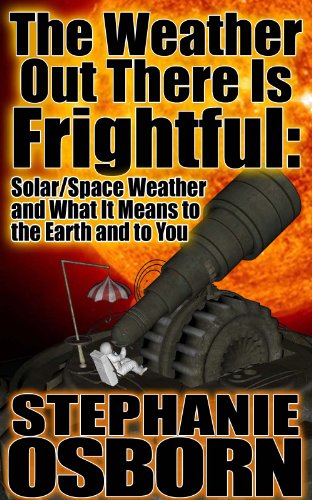
~The Weather Out There Is Frightful, Stephanie Osborn, ©2011
So what we've got, space fans, is a big ol' coronal hole generating an enhanced solar wind stream, and the Earth ran smack into it. Currently the planetary K-index (a rough measure of the strength of the disturbance in the planetary mag field) is oscillating between 5 and 4, and at 5, we start geomagnetic storming. It's minor, so far, but it's there. So we are under an official NOAA GEOMAGNETIC STORM ALERT for MINOR GEOMAGNETIC STORMING.
This in turn means that there will be some heating of the upper atmosphere, and it can induce some currents in conductive materials near the poles. Communications may be affected in high latitudes, and migratory animals may briefly become confused.
But what it ALSO means is that we have an AURORA ALERT for high latitudes! Now, NOAA doesn't put out aurora alerts. But I do! My followers on Facebook know that whenever conditions are right, I issue an aurora alert, and give a heads-up to the regions who can reasonably expect to see one. This is not a guarantee that you WILL, only that the probability is GOOD. Therefore --
Residents of Canada, Greenland, extreme northern Russia, Finland, Sweden, Norway, Iceland, possibly extreme northern Scotland, Antarctica and the islands in the Antarctic oceans, Australia's state of Tasmania, the southern tip of New Zealand's south island, and the northern regions of the following USA states: Maine, Michigan, Minnesota, parts of North Dakota, and essentially all of Alaska --
Keep an eye to the skies tonight! You just might see an aurora!
~Stephanie Osborn
http://www.stephanie-osborn.com
HEADS UP, SPACE FANS!
Earth is currently experiencing a GEOMAGNETIC STORM! These occur when a sudden influx of plasma (a gas cloud of charged particles) enters Earth's magnetic field from outside, most often from solar activity (a coronal mass ejection aka CME, or an enhanced wind stream from a coronal hole). They can be mild, strong, or severe, depending upon how dense the plasma cloud is.
Okay, for those of you just tuning in, let's work on explaining some terms.
~~~
We are also sitting inside the atmosphere of the Sun, which is called the corona. Yes, we are, even at 93 million miles distant. It generates a wind, usually coming out from the Sun and spiraling away – yeah, the “solar wind.” Granted, the corona isn't very dense, but it's dense enough to create some effects, and we're working on using it to our benefit, like in solar sails and such, which can use the solar wind as much as light pressure (different topic) to maneuver around the Solar System like the spaceborne clipper ships of old.
But when the Sun gets... agitated, we'll say... the solar wind can get a lot denser. Coronal holes tend to move gradually from the poles down to lower latitudes, and the Sun's face develops an astronomical case of acne. This usually occurs around the time of solar maximum.
~The Weather Out There Is Frightful, Stephanie Osborn, ©2011
~~~
Now, a coronal hole is just a place in the magnetic field where the field lines stretch out to infinity, rather than looping back around, like the poles of a bar magnet. That means that the plasma can channel outward along those field lines, deep into the solar system.
This is an image of the inner corona of the Sun, taken by the Solar Dynamics Observatory on August 2, 2016, at a wavelength of 211 Angstroms. The dark regions are the coronal holes, which show up nicely at this spectral region.
If Earth happens to run into one of these "enhanced solar wind streams," as they're called, if it's strong enough, it slams into our magnetic field like a bow wave from a ship. This compressed the magnetic field on the sunward side, and stretches out the "tail" on the anti-sunward side. If the tail is stretched enough, it can snap off, and "magnetic reconnection" occurs, when the field lines reattach closer in. But magnetic reattachment itself generates a HUGE surge of energy, which is fed back into Earth along our own poles.
~~~
So what are the effects of coronal hole winds and Coronal Mass Ejections (CMEs)?
They can actually raise the temperature of the outer layers of the Earth's atmosphere (the thermosphere, aptly named) sufficient to cause it to expand. This affects us, because that increases drag on satellites and spacecraft, and can cause the orbits of satellites to decay and re-enter well before they were intended...
Disruption of the Earth's magnetic field can be a problem. It can disrupt radio communication (including cell phones) rather severely. It can damage satellites that remain in orbit. It can generate “induced current” in any lengthy conductor...And it causes the aurorae. Most of you reading this have heard of the Northern Lights, properly termed the Aurora Borealis, but there are also the Southern Lights, the Aurora Australis. These are actually ovals that circle the magnetic poles of Earth (and most other planets with magnetic fields, by the way. They've been photographed on Jupiter.) They are where the charged particles that have been caught up from the solar wind or CME into the geomagnetic field follow the field lines down into the atmosphere. The gas molecules become excited into a higher energy state, then discharge that extra energy as light. This is very similar–in fact, essentially the same–as a fluorescent light bulb, only natural and not contained. The colors are determined mostly by the main gas that is fluorescing. Carbon dioxide produces white light; nitrogen, pink or red; oxygen, green or blue. (It can also generate ozone.)
~~~
So what we've got, space fans, is a big ol' coronal hole generating an enhanced solar wind stream, and the Earth ran smack into it. Currently the planetary K-index (a rough measure of the strength of the disturbance in the planetary mag field) is oscillating between 5 and 4, and at 5, we start geomagnetic storming. It's minor, so far, but it's there. So we are under an official NOAA GEOMAGNETIC STORM ALERT for MINOR GEOMAGNETIC STORMING.
This in turn means that there will be some heating of the upper atmosphere, and it can induce some currents in conductive materials near the poles. Communications may be affected in high latitudes, and migratory animals may briefly become confused.
But what it ALSO means is that we have an AURORA ALERT for high latitudes! Now, NOAA doesn't put out aurora alerts. But I do! My followers on Facebook know that whenever conditions are right, I issue an aurora alert, and give a heads-up to the regions who can reasonably expect to see one. This is not a guarantee that you WILL, only that the probability is GOOD. Therefore --
Residents of Canada, Greenland, extreme northern Russia, Finland, Sweden, Norway, Iceland, possibly extreme northern Scotland, Antarctica and the islands in the Antarctic oceans, Australia's state of Tasmania, the southern tip of New Zealand's south island, and the northern regions of the following USA states: Maine, Michigan, Minnesota, parts of North Dakota, and essentially all of Alaska --
Keep an eye to the skies tonight! You just might see an aurora!
~Stephanie Osborn
http://www.stephanie-osborn.com
Monday, June 25, 2012
Space Weather - The Carrington Event
In August of 1859, during historic Solar Cycle 10, something very strange began to happen. The Sun, as it neared solar max, grew unusually active. It produced prolific numbers of sunspots and flares, some of which were visible to the naked eye. This continued through the end of the month, until, just before noon on September 1, British astronomer Richard Carrington, just 33 and already acknowledged as one of England's premier solar astronomers, observed an incredibly brilliant solar flare – a flare that was easily visible to the naked eye. In later times, this single flare became known as The Carrington Super-Flare. In his own words from his scientific records:
“...Within the area of the great
north group [of sunspots]...two patches of intensely bright and white
light broke out...My first impression was that by some chance a ray
of light had penetrated a hole in the [projection] screen...for the
brilliancy was fully equal to that of direct sun-light; but by at
once interrupting the current observation, and causing the image to
move by turning the R.A. [right ascension, an astronomical coordinate
akin to longitude] handle, I saw I was an unprepared witness to a
very different affair...The instant of the first outburst was not 15
seconds different from 11h 18m Greenwich mean time, and 11h 23m was
taken for the time of disappearance [from the telescope's view]. In
this lapse of 5 minutes, the two patches of light traversed a space
of about 35,000 miles...”
British amateur astronomer Richard
Hodgeson also observed it; Balfour Steward at the Kew Observatory
noted a “crochet” effect on the observatory's magnetometer. (A
“crochet” is also sometimes called a Sudden Ionospheric
Disturbance, or SID. It is when a solar event produces an abnormally
high plasma density – remember, plasma is like the stuff in your
fluorescent lights – in one layer of the ionosphere. This in turn
creates literal electric currents running through the ionosphere,
which magnetometers pick up. It creates something of an invisible
lacy pattern in the atmosphere, hence, I suppose, the term “crochet.”)
And all of the previous flares and
coronal mass ejections had fairly effectively cleared the
interplanetary medium between the Sun and Earth.
The enormous coronal mass ejection
produced by the super-flare slammed into Earth in only 17 hours.
The resulting effects lasted several
days.
What kind of effects?
Worldwide aurorae for starters. These
aurorae were most noted in the Caribbean, where they had never been
seen before. Colorado gold miners, awakened by the brightening skies,
got up and began cooking their breakfasts, because they thought it
was dawn. In Europe and the northeastern United States, newspapers
could be read by the light of the aurorae.
Speaking of newspapers, the Baltimore
American and Commercial Advisor spoke of the ongoing event in
poetic terms. “Those who happened to be out late on Thursday night
had an opportunity of witnessing another magnificent display of the
auroral lights. The phenomenon was very similar to the display on
Sunday night, though at times the light was, if possible, more
brilliant, and the prismatic hues more varied and gorgeous. The light
appeared to cover the whole firmament, apparently like a luminous
cloud, through which the stars of the larger magnitude indistinctly
shone. The light was greater than that of the moon at its full, but
had an indescribable softness and delicacy that seemed to envelop
everything upon which it rested. Between 12 and 1 o'clock, when the
display was at its full brilliancy, the quiet streets of the city
resting under this strange light, presented a beautiful as well as
singular appearance.”
Those dealing in the business of
telegraphy did not think so highly of the display. The incredibly
intense event, a maximal G5 and S5 by any definition, created induced
currents in telegraph wires that were simply impossible to control.
Lines and pylons threw sparks, telegraph batteries were blown,
telegraphers received severe shocks, and telegraph “flimsy” paper
burst into flames.
And yet some telegraph systems
continued to function, despite having no batteries to power them. The
induced current was simply that strong.
This was the Carrington Event, the most
powerful solar/geomagnetic storm ever to occur in recorded history.
It was before the advent of electricity, or electronics, or
integrated grids and networks, save for telegraph systems, with which
it wreaked havoc. Imagine what effect it would have today.
Dibs on the story. ;-)
-Stephanie Osborn
Monday, June 18, 2012
Solar-Earth DefCon Levels, Part 2
Now, while all of this stuff is going on in the geomagnetic field, what's happening in space? Hard radiation, and lots of it, that's what. After all, that's basically what's causing the disturbance in the geomagnetic field.
And of course NOAA has another scale
that relates to that, called the solar storm scale, and represented
by – you guessed it – S.
There's not a direct correlation that
I've ever been able to find between the G scale and the S scale,
because the S scale is determined by the number of protons of a given
energy that passes through, say a square meter in a second. This
number is called the proton flux. (In the case of the S scale, the
energy of the protons must be greater than or equal to 10MeV, where
MeV is mega-electron-volts. An electron volt is very tiny, only
1.6x10⁻¹⁹ joules. So an MeV is an energy of 1.6x10⁻¹²
joules. It's not big, but when you're talking about something as
small as a proton, it's big enough.)
So at S1, our proton flux is 10 protons
per second per steradian per square centimeter. (This is not a very
big area. The bigger the number of protons passing through, the
bigger the radiation dose.) An S1 is a minor solar storm. According
to NOAA, the effects are as follows, “Biological: none.
Satellite operations: none. Other systems: minor
impacts on HF radio in the polar regions.” This happens a lot, but
not quite as often as a G1 – an S1 occurs about 50 times per solar
cycle.
An S2 is a moderate solar storm. It
requires a proton flux of 100, and occurs half as often as an S1.
Effects: “Biological: passengers and crew in high-flying
aircraft at high latitudes may be exposed to elevated
radiation risk. Satellite operations: infrequent
single-event upsets possible. [A single-event upset, or SEU, is
when the bit of a computer is accidentally reset to its opposite
condition by a proton or electron impact.] Other systems:
small effects on HF propagation through the polar regions and
navigation at polar cap locations possibly affected.”
S3 is a little stronger still; it's a
“strong” solar storm, with a proton flux of 1000. (Note that the
solar storm scale is a logarithmic scale like the Richter scale, with
each step of the scale having 10x greater proton flux than the
previous.) Only 10 of these typically occur per solar cycle, but they
aren't pleasant. “Biological: radiation hazard avoidance
recommended for astronauts on EVA; passengers and crew in
high-flying aircraft at high latitudes may be exposed to radiation
risk. Satellite operations: single-event upsets,
noise in imaging systems, and slight reduction of efficiency
in solar panel are likely. Other systems: degraded HF
radio propagation through the polar regions and navigation
position errors likely.”
Stepping up to an S4, a severe solar
storm, we have a proton flux of 10,000. They are pretty rare, with
only about 3 per solar cycle occurring. “Biological:
unavoidable radiation hazard to astronauts on EVA; passengers
and crew in high-flying aircraft at high latitudes may be exposed
to radiation risk. Satellite operations: may experience
memory device problems and noise on imaging systems;
star-tracker problems may cause orientation problems, and
solar panel efficiency can be degraded. Other systems:
blackout of HF radio communications through the polar regions
and increased navigation errors over several days are likely.”
And finally the granddaddy of solar
storms, the S5, the extreme storm. It has a proton flux of 100,000
protons per second per steradian per square centimeter. Simply put, a
flood of 100,000 protons is striking every square centimeter (less
than half an inch each way), every second. These are very rare, and
may or may not occur in any given solar cycle. But they can be
devastating. “Biological: unavoidable high radiation
hazard to astronauts on EVA (extra-vehicular activity);
passengers and crew in high-flying aircraft at high latitudes
may be exposed to radiation risk. Satellite operations:
satellites may be rendered useless, memory impacts can cause
loss of control, may cause serious noise in image data, star-trackers
may be unable to locate sources; permanent damage to solar panels
possible. Other systems: complete blackout of HF (high
frequency) communications possible through the polar regions, and
position errors make navigation operations extremely difficult.”
We're fortunate those don't occur very
often at all.
But
even the typical description of a G5 or S5 doesn't match the
strongest geomagnetic storm in history.
-Stephanie
Osborn
Labels:
aurora,
auroras,
CMEs,
geomagnetic field,
physics,
solar,
solar cycle,
Solar flares,
Solar wind,
space,
space weather,
Stephanie Osborn
Monday, June 11, 2012
Solar-Earth DefCon Levels, Part 1
As
I told you last week, NOAA has a scale of geomagnetic activity that
ranges from G0 to G5, where G0 is quiescent, and G5 is the worst
geomagnetic storm around. Now, we've already talked a little bit
about what geomagnetic storms do...
No,
we didn't, you say?
Ah,
but we did. Back when I told you about all the effects that Coronal
Mass Ejections can have. (Solar,
Space, and Geomagnetic Weather, Part 4.) Because
those sorts of things are what cause the geomagnetic storms.
But
probably the best way I can tell you about the effects is simply to
quote from NOAA's scale itself (which can be found here:
http://www.swpc.noaa.gov/NOAAscales/#GeomagneticStorms).
As
I mentioned last week, a G0 is the normal, quiescent geomagnetic
field. This holds until the Kp index reaches 5, and then we begin
minor geomagnetic storming, with the scale hitting G1. According to
NOAA, “Power systems:
weak
power grid fluctuations
can occur. Spacecraft
operations: minor
impact on satellite operations possible. Other
systems: migratory
animals are affected
at this and higher levels; aurora is commonly visible at high
latitudes (northern Michigan and Maine).” These are fairly
frequent, with on average close to 2000 per 11-year solar cycle.
At
Kp=6, G2 is considered a moderate storm. “Power
systems: high-latitude
power systems
may experience voltage alarms, long-duration storms may cause
transformer
damage.
Spacecraft operations:
corrective
actions to orientation
may be required by ground control; possible changes in drag affect
orbit predictions. Other
systems: HF
radio propagation can fade
at higher latitudes, and aurora has been seen as low as New York and
Idaho (typically 55° geomagnetic lat.).” These are a little less
frequent than G1, but still occur at a rate of about 600 every solar
cycle.
When
Kp=7, G3 is a strong geomagnetic storm. “Power
systems: voltage
corrections may be required,
false alarms triggered on some protection devices. Spacecraft
operations: surface
charging [static
electricity buildup; this can lead to arcing]may
occur on satellite components, drag
may increase on
low-Earth-orbit satellites, and corrections may be needed for
orientation problems.
Other systems:
intermittent satellite
navigation and
low-frequency radio
navigation problems
may occur, HF radio may
be intermittent, and
aurora has been seen as low as Illinois and Oregon (typically 50°
geomagnetic lat.).” These are less frequent still, with on average
200 per solar cycle. Also, as the geomagnetic storms increase in
strength, their likelihood of occurrence tends to concentrate around
solar maximum, though this is not a hard and fast rule.
At
Kp=8, G4 is a severe geomagnetic storm. “Power
systems: possible
widespread voltage
control problems and
some protective systems will mistakenly trip
out key assets from the grid.
Spacecraft operations:
may experience surface
charging and tracking problems,
corrections may be needed for orientation
problems. Other
systems: induced
pipeline currents
affect preventive measures, HF radio propagation sporadic, satellite
navigation degraded for hours,
low-frequency radio
navigation disrupted,
and aurora has been
seen as low as Alabama
and northern California (typically 45° geomagnetic lat.). These are
rarer still, with only about 100 seen per solar cycle.
And
then there's the big boys. Kp=9 means a G5 extreme geomagnetic storm.
“Power systems:
widespread voltage
control problems and
protective system problems can occur, some grid systems may
experience complete
collapse or blackouts.
Transformers may
experience damage.
Spacecraft operations:
may experience extensive
surface charging,
problems with
orientation,
uplink/downlink
and tracking
satellites. Other
systems: pipeline
currents can reach hundreds of amps,
HF (high frequency) radio
propagation may be impossible
in many areas for one to two days, satellite
navigation may be degraded for days,
low-frequency radio
navigation can be out for hours,
and aurora has been seen as low as Florida and southern Texas
(typically 40° geomagnetic lat.).” These are the rarest of all,
but still occur on average 4 per solar cycle.
-Stephanie
Osborn
Monday, June 4, 2012
Solar Activity and the Activity Indices
Okay, back to bar magnets again.
Because the Earth has one. But of course it's three-dimensional, not
like our iron filings on paper example. Imagine picking up the bar
magnet with the iron filings and paper attached, and rotating it
360º,
letting the iron filings remain in the areas they move through. Now
you have an image of what a three-dimensional dipolar (2-pole)
magnetic field looks like – sort of like a giant pumpkin. With the
solar wind (which is probably the largest influence on the
interplanetary magnetic field) pushing on it from the Sun direction,
the side of the pumpkin facing the Sun tends to smush in, but the
side away from the Sun tends to stretch out and form a long tail.
(You can see a really good animation of how this works here:
http://en.wikipedia.org/wiki/File:Animati3.gif)
This is all to say that you HAVE to think of the geomagnetic field
three-dimensionally. And if it is three-dimensional, then each part
of the field has an x-, a y-, and a z-coordinate component.
Let's
simplify for a minute. Let's say that we're going to look at the
component of the geomagnetic field that is running horizontally to
the Earth's surface at any given point. Now because the Earth is
curved, this is a tangent line that is continually changing as you
move around the Earth. Now let's look at the disturbances from
normal, caused by solar weather – coronal holes, CMEs, what have
you.
So
we have these variations, that are going to be different for
different parts of the Earth for the same event. How do we measure
it? It's a little like a Richter scale for geosolar storms. It runs
from zero to nine, and there's a special formula that enables it to
be calculated regardless of the location of the observatory, just
like the Richter magnitude of a quake can be determined from
seismographs on the opposite side of the globe. This scale for
solar-induced geomagnetic activity is called the K-index. Zero is
essentially no activity; anything above 5 is considered a storm level
of activity. The bigger the number, the greater the effects seen on
the ground, and the farther south the auroral oval can be seen. At a
K=9, the aurora can be seen...in the TROPICS.
(Just
for the sake of more information, the letter K was derived from the
German word “kennziffer,” which apparently means “characteristic
number.” Us scientists, we love our imaginative names, you know?)
Now
if we reference the Kp index, we're talking about the interplanetary
K index, not the geomagnetic K index. This is an average of all the K
indices from all of the observatories, weighted as appropriate
(remember, you won't get the same measurements from the various
observation sites, so you have to factor that in, as well as the fact
that the geomagnetic field is constantly changing). This gives us an
indication of what the interplanetary magnetic field (IMF) is doing.
BUT – not all of the stations report in at the same time. So then
scientists have to calculate something called the “estimated Kp”
which is just what it sounds like – an estimate for those stations
that haven't reported in yet. This can sometimes be a very good
predictor of what the magnetic field is going to do, and sometimes
not so much. We're still very much learning this particular science.
But
we're not done with indexes. There's also something called the a
index. This is based on the AMPLITUDES (yep, there's the reason for
using an a) of the deviations from geomagnetic normal, taken over a
three-hour period. Then there's the A index, which is an AVERAGE
(yep, that's where the A came from) of all the a-indices for a
24-hour period.
One
more index we need to look at is the G scale, which is the National
Oceanic and Atmospheric Administration's (NOAA) way of quantifying
the strength of the geomagnetic disturbance. For any K index of 4 or
less, the scale shows G0. At K=5, we jump to G1 – minor storming.
For K=6, we have G2. For K=7, G3. At K=8, we have a storm level of
G4, and at the maximum K=9, we have maximum storming of G5. Think of
it like the Earth's solar DefCon level.
Next
week we'll go into those DefCon levels in detail.
-Stephanie
Osborn
Labels:
astronomy,
aurora,
auroras,
CMEs,
coronal holes,
geomagnetic field,
Osborn,
physics,
Science,
solar,
solar cycle,
Solar flares,
Solar wind,
space,
space weather,
Stephanie,
Stephanie Osborn
Monday, May 7, 2012
Solar, Space, and Geomagnetic Weather, Part 2
But wait! There's more!
At Solar Max, the coronal holes move away from the Sun's poles and group in with the sunspots, spewing high-speed solar particles out into the plane of the solar system.
At the end of every 11-year cycle, the magnetic orientation of the spots...flips. The end that was North becomes South, and the end that was South becomes North. It takes a whole 'nother cycle to get back to the way it started out. So that's a second solar cycle, the 22-year cycle.
In addition there are longer cycles that we are still working on figuring out, because they're hundreds of years long, and it's hard to get data that goes far enough back to chart those.
Now, sunspots look dark not because they're cold, but because they're just a bit cooler than the surrounding plasma of the photosphere (which is the visible “surface” of the Sun). If the photosphere is about 5,800°K (~10,500°F), then the sunspots are about 3,000-4,500°K (4,900-7,600°F). Still plenty hot enough to fry your turkey, but still several thousand degrees cooler than their surroundings. They can be teeny-tiny (relatively speaking, of course) or they can be huge things (80,000km/50,000mi – not too shabby when you consider the Earth is about 13,000km/8,000mi diameter) big enough to be seen by the naked eye (but don't do that – we like having eyesight.)
So you might reasonably expect that during a solar max the Sun would be cooler, and send less energy out into space, right? Well, at first glance you might think so, but that isn't really how it works. Remember, a sunspot is a big magnetic snarl. And the plasma around it follows the lines in that snarl. So we get all those great big loops – prominences and flares and things like that. Occasionally, like a snarl in your hair, the lines break – but unlike your hair, they reattach, producing really spectacular flares.
And then there are the CMEs. Coronal Mass Ejections.
I'm never quite sure how to best anthropomorphise a CME. Are they solar belches, or sneezes? Suffice it to say that all of that magnetic field mess around the sunspot group causes some sort of explosion. (No, we don't know exactly why. We do know it's really, really complicated.) And it is like a giant nuclear bomb, blowing a big bubble of plasma away from the Sun at high speeds.
So between the coronal holes increasing both the speed and density of the solar wind, and these CMEs exploding into the solar system, the most active time for the Sun is in fact solar max, and that is when it's pumping more energy into the solar system, not less.
I know, I know - that doesn't make sense. Let's talk about the details next week.
Stephanie Osborn
http://www.stephanie-osborn.com
At Solar Max, the coronal holes move away from the Sun's poles and group in with the sunspots, spewing high-speed solar particles out into the plane of the solar system.
At the end of every 11-year cycle, the magnetic orientation of the spots...flips. The end that was North becomes South, and the end that was South becomes North. It takes a whole 'nother cycle to get back to the way it started out. So that's a second solar cycle, the 22-year cycle.
In addition there are longer cycles that we are still working on figuring out, because they're hundreds of years long, and it's hard to get data that goes far enough back to chart those.
Now, sunspots look dark not because they're cold, but because they're just a bit cooler than the surrounding plasma of the photosphere (which is the visible “surface” of the Sun). If the photosphere is about 5,800°K (~10,500°F), then the sunspots are about 3,000-4,500°K (4,900-7,600°F). Still plenty hot enough to fry your turkey, but still several thousand degrees cooler than their surroundings. They can be teeny-tiny (relatively speaking, of course) or they can be huge things (80,000km/50,000mi – not too shabby when you consider the Earth is about 13,000km/8,000mi diameter) big enough to be seen by the naked eye (but don't do that – we like having eyesight.)
So you might reasonably expect that during a solar max the Sun would be cooler, and send less energy out into space, right? Well, at first glance you might think so, but that isn't really how it works. Remember, a sunspot is a big magnetic snarl. And the plasma around it follows the lines in that snarl. So we get all those great big loops – prominences and flares and things like that. Occasionally, like a snarl in your hair, the lines break – but unlike your hair, they reattach, producing really spectacular flares.
And then there are the CMEs. Coronal Mass Ejections.
I'm never quite sure how to best anthropomorphise a CME. Are they solar belches, or sneezes? Suffice it to say that all of that magnetic field mess around the sunspot group causes some sort of explosion. (No, we don't know exactly why. We do know it's really, really complicated.) And it is like a giant nuclear bomb, blowing a big bubble of plasma away from the Sun at high speeds.
So between the coronal holes increasing both the speed and density of the solar wind, and these CMEs exploding into the solar system, the most active time for the Sun is in fact solar max, and that is when it's pumping more energy into the solar system, not less.
I know, I know - that doesn't make sense. Let's talk about the details next week.
Stephanie Osborn
http://www.stephanie-osborn.com
Labels:
auroras,
CMEs,
Solar flares,
solar wind,
space weather,
Stephanie Osborn
Subscribe to:
Posts (Atom)


