Banner

Banner
Showing posts with label geomagnetic storming. Show all posts

Thursday, September 29, 2016

Solar, Space, and Geomag Weather parts VI and VII and other things

by Stephanie Osborn
http://www.stephanie-osborn.com


Okay, I'm a little bit behind on mirroring the posts here, guys; forgive me. I've been very busy with a new book release, which I'll talk about below.


But so here are parts VI and VII of the series, as found on Sarah Hoyt's blog, According to Hoyt:

part VI: https://accordingtohoyt.com/2016/09/22/solar-space-and-geomagnetic-weather-part-vi-solar-earth-defcon-levels-by-stephanie-osborn/

part VII: https://accordingtohoyt.com/2016/09/29/solar-space-and-geomagnetic-weather-part-vii-the-carrington-event-by-stephanie-osborn/

Feel free to post comments or questions there or here.

~~~

In addition, and despite the fearmongering of certain nigh-tabloid excuses for newspapers, we are currently experiencing MODERATE (not severe) geomagnetic storming as a result of the high-speed solar wind stream from a coronal hole.

A coronal hole is never going to generate a geomagnetic superstorm, folks, I don't care what the reporters are saying. It requires a superflare producing a mammoth CME to generate such a superstorm. And yes, we are indeed currently experiencing moderate geomagnetic storming. The K index is at about 6. A superstorm would produce a K index of 9 (maxxed out).  Residents of New England, the Great Lakes states, the northern Midwest, the extreme northern Pacific Northwest, Canada, Alaska, Greenland, Iceland, Scotland, the Nordic countries, northern Russia/Siberia, northern China, the northern Kamchatka peninsula, Tasmania, the southern island of New Zealand, and of course Antarctica, should all be on the lookout for aurorae tonight and possibly tomorrow night.

~~~

For those interested in a smidge more information, may I recommend The Weather Out There Is Frightful: Solar/Space Weather and What It Means for the Earth and You, available for Kindle.


In addition, I have a new novel release. Fear in the French Quarter is the sixth book in the Displaced Detective series, and is available in print, Kindle, and Nook.

If you are in the New Orleans area this weekend, come by the CONtraflow science fiction convention at the Airport Hilton! I'll be throwing a release party on Saturday night!


Book 1 of the series, The Case of the Displaced Detective: The Arrival, is currently on sale in ebook
formats for $0.99.
Books 2-4 of the series are also discounted.


My very first novel, Burnout: The mystery of Space Shuttle STS-281, which eerily predicted the Columbia disaster (being written, though not published, before that disaster), is also on sale in ebook formats for $0.99.


Thursday, September 1, 2016

Solar, Space, and Geomagnetic Weather, Part III, plus News

by Stephanie Osborn
http://www.stephanie-osborn.com

Okay, first off, the third installment of my solar and space weather series has gone up over at Sarah Hoyt's blog, According to Hoyt.


And  an interesting tidbit of information: Several sources are indicating that the cosmic ray influx is increasing. (E.g. see SpaceWeather.com for Sep 1, 2016:  Cosmic Rays in the Atmosphere.)

Now, cosmic rays come in from outside our solar system. Mostly they are particulates, very high-energy charged particles produced in the various high-energy astronomical objects out there. They are very penetrating, and potentially dangerous to life, at least in large quantities. (Not that we are likely to get those large quantities; my point is simply that they ain’t good for ya.)
Normally the solar wind, coupled with the enhanced wind streams from coronas, and CMEs, create enough of a “resisting” effect to keep the cosmic ray flux at Earth fairly low. That said, this means that there is a variation in cosmic ray flux from solar max to solar min.
But 1) we’re only about 2 years out from solar max. We should be 4-5 years away from solar min. 2) If we are indeed going into an extended minimum, then chances are the cosmic ray flux will be higher than at a “simple” solar min.
Just something to keep an eye on.
Additional news:
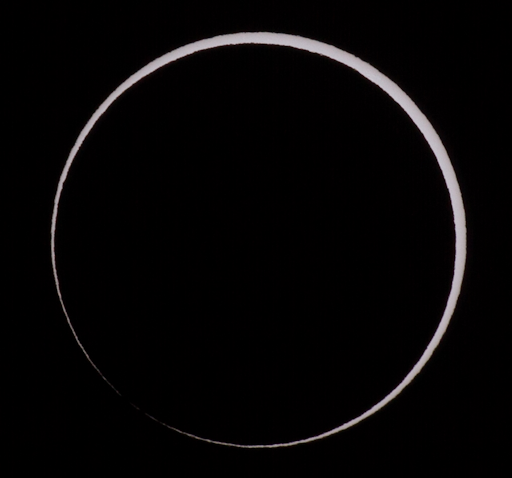
  • Africa saw an annular solar eclipse today. Nearly 97% of the Sun was covered by the Moon for observers in 50 African nations. SpaceWeather.com has a nice gallery of eclipse photography here.
Photo from SpaceWeather.com
Annular solar eclipse seen from Reunion

  • We are experiencing a G1 (minor) geomagnetic storm due to the enhanced wind stream from a coronal hole. High-latitude observers should keep a lookout for aurorae and other effects.

  • SpaceX's Falcon-9 blew up on the pad at Canaveral today; the rocket and its payload, a satellite owned by Facebook and intended to provide satellite internet capability, were total losses. CEO Elon Musk indicated that the problem "originated around the upper stage oxygen tank," during a static test on the pad. The launch had been planned for Saturday.

CNN: http://money.cnn.com/video/news/2016/09/01/explosion-at-spacex-launch-pad-at-cape-canaveral.cnnmoney/index.html 
ABC: http://abcnews.go.com/Technology/video-captures-spacex-rocket-explosion-launch-site/story?id=41803090 
Business Insider: http://www.businessinsider.com/elon-musk-spacex-falcon-9-explosion-tweet-2016-9

 ~Stephanie Osborn
http://www.stephanie-osborn.com

Tuesday, August 23, 2016

AURORA ALERT 23/24 August 2016

by Stephanie Osborn
http://www.stephanie-osborn.com

According to the various solar/geomagnetic data (collected in one convenient place by SolarHam.com; I actively support them with contributions), we are currently experiencing minor geomagnetic storming. This is likely being caused by a combination of a favorably-oriented local interplanetary magnetic field, as well as an enhanced wind stream from a coronal hole.


This is a Solar Dynamics Observatory image 
from 23 August 2016. It depicts the coronal holes 
on that date (yesterday). Holes were numbered by 
SolarHam. Coronal Hole #07 likely produced the
solar wind stream creating the current geomag storming.

The planetary K-index is a NOAA Space Weather Prediction Center (SWPC) product created using magnetometers around the world. According to the SWPC, "The K-index quantifies disturbances in the horizontal component of earth's magnetic field with an integer in the range 0-9 with 1 being calm and 5 or more indicating a geomagnetic storm. It is derived from the maximum fluctuations of horizontal components observed on a magnetometer during a three-hour interval. The planetary 3-hour-range index Kp is the mean standardized K-index from 13 geomagnetic observatories between 44 degrees and 60 degrees northern or southern geomagnetic latitude. The label 'K' comes from the German word 'Kennziffer' meaning 'characteristic digit.' The K-index was introduced by Julius Bartels in 1938. SWPC has used the K-index since the forecast center began operations." 

Any time the K-index reaches 5, geomagnetic storming is occurring. We have been experiencing K=5 for at least 9 hours at the time of this writing.


K-index graph captured as of approximately 10:25pm CDT, 23 Aug 2016.

The higher the K-index, the farther away from the geomagnetic poles the aurora can be seen, and the more effects can be seen. Generally coronal hole wind streams produce only minor storming; it takes a moderate to strong coronal mass ejection (CME) impact to reach the upper levels of the K-index.


The NOAA SWPC Geomagnetic Storm Scale.

We are currently experiecing a G1 Minor geomagnetic storm.

It takes something around an X-class flare producing a large, strong CME to hit an 8-9 on the K-index scale, and that's up around Carrington-event class. So we aren't going to have anything like that, but higher latitudes might have a nice aurora tonight or the next few nights.

Here are maps (posted to SolarHam, but obtained from NOAA SWPC) that will show you where aurorae are possible. Find the line marked Kp=5 for our current condition, then look from that line poleward. If you are in that region, keep a watch out for aurorae. If you are near but outside the region, keep an eye peeled poleward, just in case.


K-index map of North America.
K-index map of South America/Antarctica.
K-index map of Eurasia.
K-index map of Australia/extreme South Pacific.

Good viewing!

~Stephanie Osborn
http://www.stephanie-osborn.com


Wednesday, August 3, 2016

Solar/Geomagnetic Activity!

by Stephanie Osborn
http://www.stephanie-osborn.com

HEADS UP, SPACE FANS!

Earth is currently experiencing a GEOMAGNETIC STORM! These occur when a sudden influx of plasma (a gas cloud of charged particles) enters Earth's magnetic field from outside, most often from solar activity (a coronal mass ejection aka CME, or an enhanced wind stream from a coronal hole). They can be mild, strong, or severe, depending upon how dense the plasma cloud is.

Okay, for those of you just tuning in, let's work on explaining some terms.

~~~
      We are also sitting inside the atmosphere of the Sun, which is called the corona. Yes, we are, even at 93 million miles distant. It generates a wind, usually coming out from the Sun and spiraling away – yeah, the “solar wind.” Granted, the corona isn't very dense, but it's dense enough to create some effects, and we're working on using it to our benefit, like in solar sails and such, which can use the solar wind as much as light pressure (different topic) to maneuver around the Solar System like the spaceborne clipper ships of old. 
      But when the Sun gets... agitated, we'll say... the solar wind can get a lot denser. Coronal holes tend to move gradually from the poles down to lower latitudes, and the Sun's face develops an astronomical case of acne. This usually occurs around the time of solar maximum.
~The Weather Out There Is Frightful, Stephanie Osborn, ©2011
~~~

Now, a coronal hole is just a place in the magnetic field where the field lines stretch out to infinity, rather than looping back around, like the poles of a bar magnet. That means that the plasma can channel outward along those field lines, deep into the solar system.
This is an image of the inner corona of the Sun, taken by the Solar Dynamics Observatory on August 2, 2016, at a wavelength of 211 Angstroms. The dark regions are the coronal holes, which show up nicely at this spectral region.

If Earth happens to run into one of these "enhanced solar wind streams," as they're called, if it's strong enough, it slams into our magnetic field like a bow wave from a ship. This compressed the magnetic field on the sunward side, and stretches out the "tail" on the anti-sunward side. If the tail is stretched enough, it can snap off, and "magnetic reconnection" occurs, when the field lines reattach closer in. But magnetic reattachment itself generates a HUGE surge of energy, which is fed back into Earth along our own poles.
~~~
      So what are the effects of coronal hole winds and Coronal Mass Ejections (CMEs)? 
      They can actually raise the temperature of the outer layers of the Earth's atmosphere (the thermosphere, aptly named) sufficient to cause it to expand. This affects us, because that increases drag on satellites and spacecraft, and can cause the orbits of satellites to decay and re-enter well before they were intended... 
     Disruption of the Earth's magnetic field can be a problem. It can disrupt radio communication (including cell phones) rather severely. It can damage satellites that remain in orbit. It can generate “induced current” in any lengthy conductor...And it causes the aurorae. Most of you reading this have heard of the Northern Lights, properly termed the Aurora Borealis, but there are also the Southern Lights, the Aurora Australis. These are actually ovals that circle the magnetic poles of Earth (and most other planets with magnetic fields, by the way. They've been photographed on Jupiter.) They are where the charged particles that have been caught up from the solar wind or CME into the geomagnetic field follow the field lines down into the atmosphere. The gas molecules become excited into a higher energy state, then discharge that extra energy as light. This is very similar–in fact, essentially the same–as a fluorescent light bulb, only natural and not contained. The colors are determined mostly by the main gas that is fluorescing. Carbon dioxide produces white light; nitrogen, pink or red; oxygen, green or blue. (It can also generate ozone.)
~The Weather Out There Is Frightful, Stephanie Osborn, ©2011

~~~

So what we've got, space fans, is a big ol' coronal hole generating an enhanced solar wind stream, and the Earth ran smack into it. Currently the planetary K-index (a rough measure of the strength of the disturbance in the planetary mag field) is oscillating between 5 and 4, and at 5, we start geomagnetic storming. It's minor, so far, but it's there. So we are under an official NOAA GEOMAGNETIC STORM ALERT for MINOR GEOMAGNETIC STORMING.

This in turn means that there will be some heating of the upper atmosphere, and it can induce some currents in conductive materials near the poles. Communications may be affected in high latitudes, and migratory animals may briefly become confused.

But what it ALSO means is that we have an AURORA ALERT for high latitudes! Now, NOAA doesn't put out aurora alerts. But I do! My followers on Facebook know that whenever conditions are right, I issue an aurora alert, and give a heads-up to the regions who can reasonably expect to see one. This is not a guarantee that you WILL, only that the probability is GOOD. Therefore --

Residents of Canada, Greenland, extreme northern Russia, Finland, Sweden, Norway, Iceland, possibly extreme northern Scotland, Antarctica and the islands in the Antarctic oceans, Australia's state of Tasmania, the southern tip of New Zealand's south island, and the northern regions of the following USA states: Maine, Michigan, Minnesota, parts of North Dakota, and essentially all of Alaska --

Keep an eye to the skies tonight! You just might see an aurora!

~Stephanie Osborn
http://www.stephanie-osborn.com