
http://www.stephanie-osborn.com
Today we move on to a new element in the modern storyteller's tool kit: developing a character. But I've decided to let someone else lead off; Ken Johnson is a social scientist and what once would have been called a "loremaster," and he has chosen to analyze several of my own works of fiction with an eye toward how I created and developed the characters in them. We have had several interesting chats on writing and my philosophy and techniques, and he has taken them into consideration in penning what you are about to read.
~~~

I truly think it is a honor to be asked by Stephanie Osborn to write something for her blog. She is an accomplished lady who has done more in her lifetime than five men could. To be even considered means that you have a voice with something to say. Indeed, that is rather reaffirming in today’s world. So, it should go without saying that I see this opportunity as being extremely important when she asked me to write on the topic of character development.
As a culturalist (social scientist), I try to stay aware of how art, music, literature, and other “relics” of a culture’s “archaeology” are symbolic of their values, beliefs, social protocols, etc. “Are all of the lead characters men, women, or mixed?” “What is the age range of the main characters?” “What is their education level?” “What percentage of diversity is shown in the characters?” “What is the character’s nationality?” Such questions must be asked and contemplated in order to best understand how the character represents a given concept and point of view.
Being that I also do art (paintings on feathers), as well as fictional writings, I also have to appreciate the artistic and technical nuances that take place with not only how the character is created but also as to how a character develops. “What is his back story?” “What drives her?” “Has his emotional past changed him physically?” These questions and more color what will ultimately be the characters in print.

I remember some time back, while researching for a forthcoming book on monster allegory, asking Stephanie about how she comes up with her stories. She explained to me that she has to envision the character both before and after the story she is actually writing. As she told me, oft times there are entire stories that she knows about her characters which never make it to print only because she knows the character that detailed enough that she can finally write about them.
Indeed, my research of accomplished authors has revealed this intriguing commonality as being the foremost trait of sophisticated character development. If you do not know your characters then how can you write about them? For instance, in a story I am wanting to write, I have pieces to a character’s story that I can see almost as if it is a movie in my mind. However, just as I can see these scenes there are also gaping holes in the storyline that I cannot see yet. So, I cannot write the story until I know my characters inside and out. For the writer, this can be maddening at times because there are untold, and oft times unfinished, stories clouding the mind and yearning to be free.
This is one reason why I often prefer short stories and novellas because they are concise and often do better justice to the overall story and the characters involved. The writers of shorter stories are not trying to meet some ambiguous word count minimum/maximum set up by a publisher. Instead, they only set out to tell the story that they know.
Sadly, television has corrupted writing to the point now that most writers are trying to play “screen writer” in their books rather than as authors. Third person omniscient is now becoming status quo. It is the equivalent of a watercolor artist narrating a painting as to why the paint flowed a certain way, why it blended the way it did, etc. The narration ultimately becomes the main stage element and what is being narrated now takes a back stage. When the reader knows everything about the characters then there is little surprise. Thus, many authors compensate with more and more absurd situations rather than focusing their attention on practicing a modicum of restraint.
The only caveat to this is when one writes about a genius. Here, writers often try to make the character an enigma. I remember researching out a number of authors recently who were talking about how to develop an ingenious character. These experts all basically noted that time is something that is on the author’s side. In other words, the “genius” character in the book may not have time to Google “hairy bottomed frog” to give a quip but the author does. This allows for a character that seems almost supernaturally intelligent. So, in such a case, you may have a scene where the genius asks a colleague how (s)he is doing, and gets a response as to something like, “I am fine as a frog’s hair split three ways!” only to have the genius retort by saying, “You know, there is actually a hairy bottomed frog in Africa which, during mating season, grows projections on its rump that looks like hair. Even cut three ways, I dare say that it is anything but ‘fine.’ I guess we shall endeavor to make your day better then.”

Other ways may also include the author leading the reader astray, and surrounding the “genius” with more simple-minded characters, so as to make the “genius” look even more intelligent by comparison to his or her surroundings. In television, this is done all the time. For instance, on the show “Endgame,” an agoraphobic, Russian chess grandmaster is left in his hotel solving cases. As he tries to figure out the puzzle, the viewers are taken down multiple wrong paths only to have the grandmaster reveal the truth at the end.
Verily, the core of any good character is research. However, how you develop the character with this knowledge base can be done a number of ways. Most authors like to do a linear development of characters. But, a few will venture out and take a static point of view. Linear development is nothing more than having the character(s) follow a given timeline of events where they grow and morph along the way. A static development is where the character does not change, usually because it is so complex or formidable that change is nonexistent, and so then the story becomes one of how the character got that way to begin with.
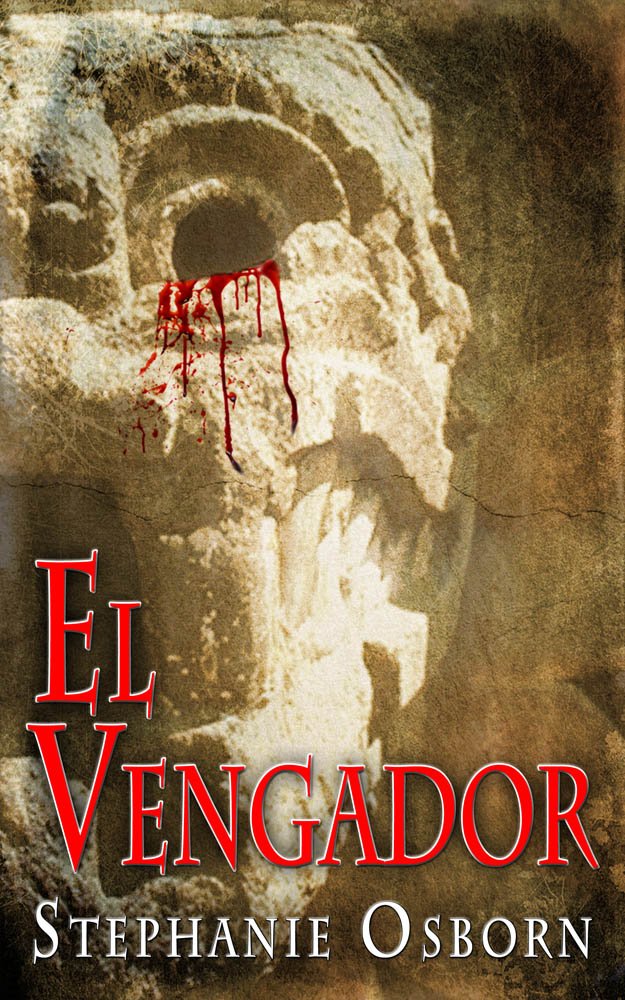 A great example of static character development is El Vengador. As I once wrote in a Yahoo! Voices article on werewolf allegory, Stephanie changed paradigms as to what a werewolf represented. However, she did this by taking the often underutilized static form of character development. Until the end, the reader does not realize that the monster is a single, cursed being. In the end, even though the killing spree and attacks never end, the true story was in depicting how the monster came to be, where he came from, and what motivates him.
 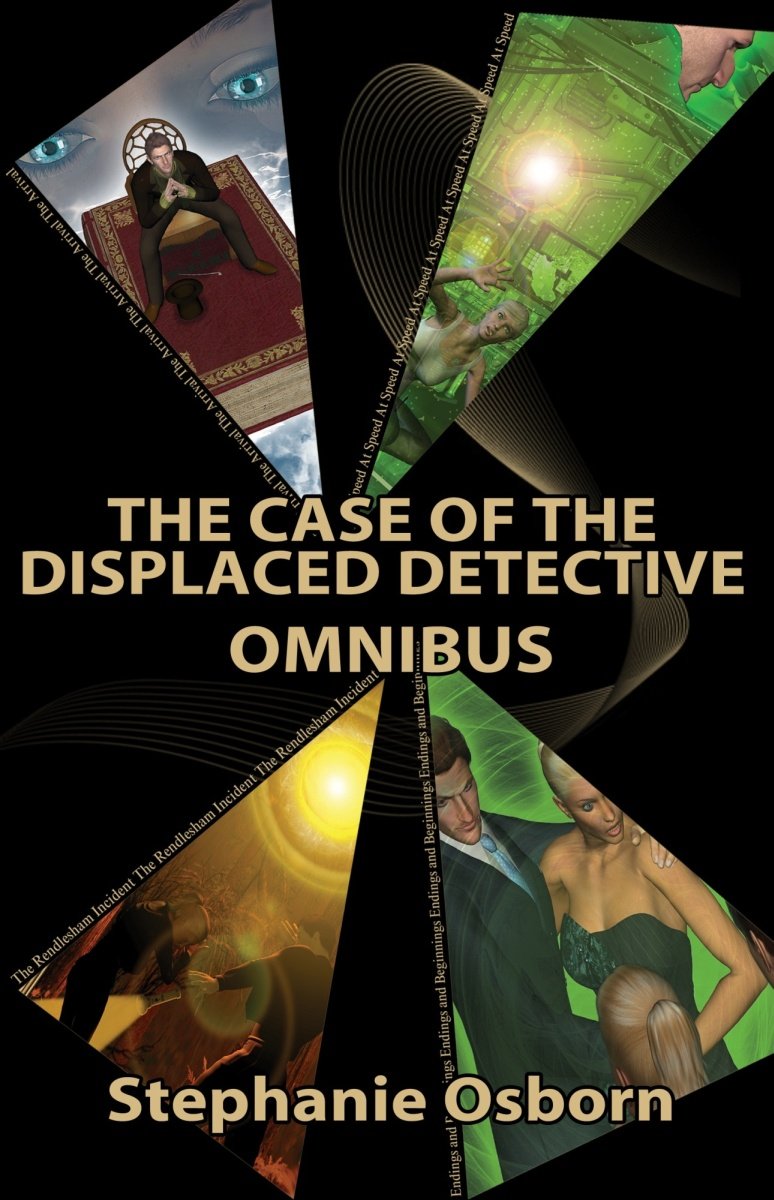 In contrast, the Displaced Detective Omnibus gives the reader a compilation of multiple books which takes the reader along a given time line where Sherlock Holmes is taken from his time and dimension and placed in our world during our time period. While Stephanie gives insight into some of their thoughts, she refrains enough in the story so that you have to work to see and understand the characters independently for who they are. In other words, she does not let the narrative overshadow the characters. What is important to note about the series is the development of Sherlock. In the book, he goes from being a very static, Victorian gentleman to being more animated. Her taking into account cultural and temporal norms allows for unmalleable character to become dynamic. Where his time required men to be almost asexual, he is now allowed to show passion and tenderness openly without the author sacrificing the traits that makes Holmes such an iconic character.
~~~
Ken Johnson is an independent researcher and culturalist who typically writes on issues of culture, conflict, conservation, and literary allegory. Starting college at the age of 16, Ken now holds a BA in Social Sciences, an MBA, and special certifications from the USDA and the Florida Supreme Court in the field of mediation. Predominately a non-fiction writer, he has a book due out in August 2014 called Unbroken Circles SM for Schools. In 2005, he was commissioned as a Kentucky Colonel for his good works by the governor of Kentucky. He has also been nominated for the Grinnell Prize as well as two media awards given by the Society for Personality and Social Psychology.
~~~
I'd like to thank Ken for his analysis of my works and my writing style. He does indeed have my thought processes correct, and to see someone else's take on my attempts at creating other beings has been fascinating!
-Stephanie Osborn
http://www.stephanie-osborn.com


.jpg)
